
TL:DR / Summary:
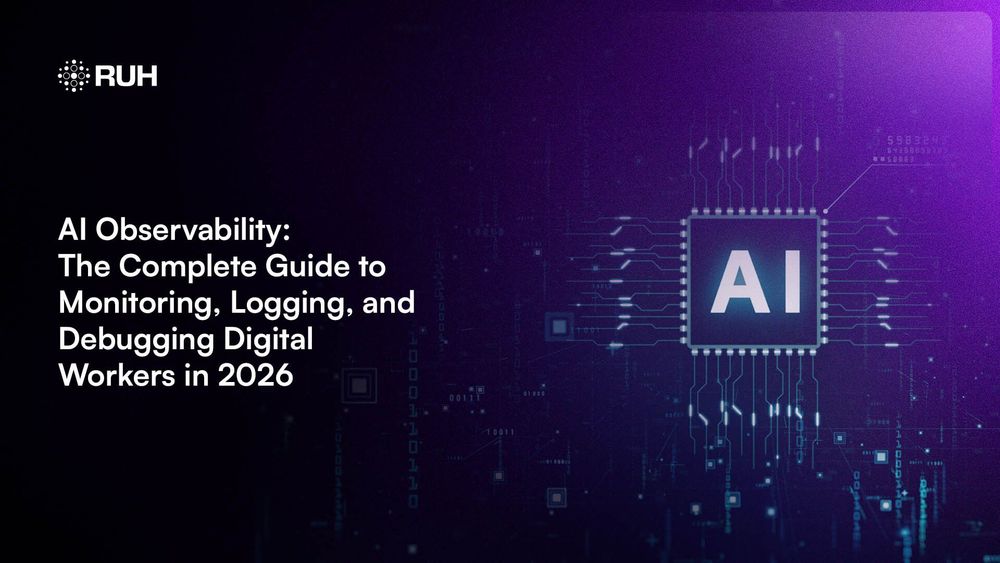
When a digital worker makes a mistake in production, how quickly can the issue be identified? Organizations relying on guesswork, manual log searches, or waiting for user complaints face significant operational risks that compound over time.
AI systems operate fundamentally differently from traditional software. Rather than executing predefined logic, they reason, adapt, and make autonomous decisions based on dynamic context. According to IBM's 2025 AI survey, nearly half of executives cite "lack of visibility into agent decision-making processes" as a significant implementation barrier for agentic AI.
A single AI agent might process customer requests, access sensitive data, invoke multiple tools through API integrations, and execute business-critical actions—all within milliseconds. When something goes wrong, traditional monitoring approaches that worked for decades suddenly fail.
This guide provides a practical framework for implementing AI observability across digital workforces, whether monitoring a single chatbot or orchestrating hundreds of AI agents. Organizations can gain visibility, maintain control, and ensure autonomous systems remain reliable and trustworthy.
Ready to see how it all works? Here’s a breakdown of the key elements:
- What is AI Observability?
- Why Traditional Monitoring Fails for Digital Workers
- The Five Pillars of AI Agent Observability
- Implementing AI Observability: A Practical Framework
- AI Agent Communication Protocols and Observability
- Real-World Troubleshooting with AI Observability
- Cost Optimization Through Observability
- Conclusion
- Frequently Asked Questions
What is AI Observability?
AI observability is the practice of making artificial intelligence systems transparent, measurable, and controllable by collecting and analyzing their unique telemetry data including reasoning processes, decision paths, token usage, model interactions, and tool executions—in real-time.
Unlike traditional application monitoring, which tracks known failure modes through predefined metrics, AI observability addresses the inherent unpredictability of machine learning systems. It answers three critical questions that conventional monitoring cannot:
- How did the AI arrive at this decision? (Cognitive transparency)
- What data and context influenced this outcome? (Input traceability)
- Is the system behaving as intended over time? (Behavioral consistency)
The Critical Difference: AI Observability vs Traditional Monitoring
Traditional application performance monitoring (APM) assumes deterministic behavior: given input X, the system always produces output Y. In contrast, AI systems are probabilistic—the same input can generate different outputs based on the model state, retrieved context, temperature settings, and numerous other variables.
Research from Stanford University demonstrates that foundation models exhibit non-deterministic behavior that renders traditional monitoring insufficient for production AI systems.
Consider a real-world scenario: A customer service AI suddenly starts providing incorrect refund policies. Traditional monitoring shows:
- API response time: Normal (320ms)
- Error rate: Zero
- Server CPU: 45%
- Memory usage: Healthy
Everything appears fine, yet customers receive wrong information. Without AI observability, operational teams are flying blind.
With proper AI observability, the issue becomes immediately visible:
- Retrieval context drift: 73% drop in semantic similarity to policy documents
- Token probability variance: 40% decrease in confidence scores
- Model decision path: Switched to outdated knowledge instead of retrieved docs
- Root cause: Vector database index not refreshed after policy update
This is why AI observability isn't optional; it's foundational for running autonomous systems in production. Organizations deploying AI SDR agents or other digital workers need this level of visibility to maintain service quality and trust.
Why Traditional Monitoring Fails for Digital Workers
Digital workers AI agents that autonomously execute business workflows—operate in ways that break conventional monitoring assumptions. According to Gartner's 2024 research, by 2028, 33% of enterprise software applications will include agentic AI, yet most organizations lack appropriate monitoring capabilities.
1. Non-Deterministic Behavior
The same prompt can yield different responses due to temperature settings, random sampling, or model updates. Traditional "expected output" testing becomes impossible. Organizations deploying self-improving AI agents face this challenge continuously as models adapt and learn.
Real Impact: A financial services company discovered their loan approval AI was rejecting qualified applicants inconsistently. The issue? Subtle changes in how the AI interpreted income documents are visible only through reasoning trace analysis.
2. Hidden Decision Logic
Unlike code with explicit if-then-else statements, AI models make decisions through learned patterns in high-dimensional space. The decision-making process can't simply be "read" like traditional code.
Real Impact: A healthcare AI began recommending unnecessary tests. Traditional logs showed API calls and responses, but couldn't explain why the recommendations changed. Observability revealed the model was overweighting recent training data that included billing optimization patterns.
3. Cascading Failures Across Tool Chains
Digital workers often orchestrate multiple tools, APIs, and data sources. Understanding how AI agents use APIs is crucial, as a failure in one component can propagate silently through the system, manifesting as subtle quality degradation rather than clear errors.
Real Impact: An e-commerce recommendation engine's performance degraded by 30% over three weeks. The cause? A third-party product API started returning incomplete metadata. Traditional monitoring saw successful API calls; observability showed decreasing context quality affecting recommendations.
4. Cost Opacity
Token usage, model inference, and API calls create variable costs that traditional infrastructure monitoring doesn't capture. Without AI-specific observability, costs can spiral unexpectedly.
Real Impact: According to OpenAI's enterprise usage reports, organizations without proper monitoring experience an average 340% cost overrun in their first year of AI deployment. A prototype chatbot racked up $47,000 in API costs in one weekend due to an infinite retry loop—something standard monitoring couldn't attribute to a specific failure pattern.
The Five Pillars of AI Agent Observability
Effective AI observability rests on five interconnected pillars that together provide complete visibility into autonomous systems. Organizations implementing these pillars report significant improvements in system reliability and operational efficiency.
Pillar 1: Cognitive Visibility (Understanding Reasoning)
Cognitive visibility provides insight into how AI systems process information and make decisions.
What to Monitor:
- Reasoning traces showing step-by-step thought processes
- Chain-of-thought progressions and decision branches
- Model activations and attention patterns
- Tool selection logic and prompt evolution
Why It Matters: Understanding how an AI reasons is essential for debugging unexpected outputs, detecting bias, and ensuring alignment with business rules. This is particularly crucial for AI agents that automate complex workflows.
Implementation Example:
python
#Instrument reasoning steps for observability
@trace_reasoning
def process_customer_query(query):
    with span("intent_classification"):
        intent = classify_intent(query)
        log_metadata({"intent": intent, "confidence": intent.score})

    with span("context_retrieval"):
        context = retrieve_relevant_docs(query, intent)
        log_metadata({
            "docs_retrieved": len(context),
            "avg_similarity": np.mean([d.score for d in context])
        })

    with span("llm_generation"):
        response = generate_response(query, context)
        log_metadata({
            "tokens_used": response.usage.total_tokens,
            "finish_reason": response.finish_reason
        })

    return response
Pillar 2: End-to-End Traceability
According to Google Cloud's AI/ML Best Practices, end-to-end traceability is critical for maintaining production AI systems at scale.
What to Monitor:
- Complete request lifecycle from input to output
- Tool and API invocations with parameters
- Data access patterns and retrieval operations
- Inter-agent communications in multi-agent systems
Implementation with OpenTelemetry:
python
from opentelemetry import trace
from opentelemetry.trace import Status, StatusCode

tracer = trace.get_tracer(__name__)

def ai_agent_workflow(user_request):
    with tracer.start_as_current_span("agent_workflow") as span:
        span.set_attribute("user_id", user_request.user_id)
        span.set_attribute("request_type", user_request.type)

        try:
            with tracer.start_as_current_span("tool_selection"):
                tools = select_tools(user_request)

            with tracer.start_as_current_span("tool_execution"):
                results = execute_tools(tools, user_request)

            return results
        except Exception as e:
            span.set_status(Status(StatusCode.ERROR, str(e)))
            raise
Pillar 3: Performance and Cost Monitoring
Performance monitoring prevents degradation from impacting users while cost monitoring prevents budget overruns. McKinsey research indicates that organizations with robust cost monitoring reduce AI operational expenses by 35-40%.
Key Metrics to Track:
python
from prometheus_client import Counter, Histogram

# Token usage tracking
token_usage = Counter(
    'ai_tokens_used_total',
    'Total tokens consumed',
    ['model', 'operation_type']
)

# Latency tracking
request_latency = Histogram(
    'ai_request_duration_seconds',
    'Time spent processing AI requests',
    ['model', 'endpoint']
)

# Cost estimation
estimated_cost = Counter(
    'ai_estimated_cost_dollars',
    'Estimated cost in dollars',
    ['model', 'user_tier']
)
Pillar 4: Security and Compliance Monitoring
AI systems handle sensitive data and make impactful decisions. Security monitoring prevents breaches while compliance monitoring ensures regulatory adherence. IBM's 2024 Cost of a Data Breach Report found that AI-related breaches cost organizations an average of $4.88 million.
Critical Security Monitoring:
python
class SecurityMonitor:
    def __init__(self):
        self.pii_patterns = {
            'ssn': r'\d{3}-\d{2}-\d{4}',
            'credit_card': r'\d{4}[-\s]?\d{4}[-\s]?\d{4}[-\s]?\d{4}',
            'email': r'[a-zA-Z0-9._%+-]+@[a-zA-Z0-9.-]+\.[a-zA-Z]{2,}'
        }

    def scan_for_pii(self, text: str):
        findings = {}
        for pii_type, pattern in self.pii_patterns.items():
            matches = re.findall(pattern, text)
            if matches:
                findings[pii_type] = matches
                log_security_event(
                    event_type="pii_detected",
                    pii_type=pii_type,
                    severity="high"
                )
        return findings
Pillar 5: Model Quality and Drift Detection
AI models degrade over time without proper monitoring. Early detection of drift prevents quality issues from reaching users. Research from MIT's Computer Science and Artificial Intelligence Laboratory demonstrates that continuous monitoring can detect model drift 85% faster than periodic manual reviews.
Drift Detection Implementation:
python
from sentence_transformers import SentenceTransformer
from scipy.spatial.distance import cosine

class DriftMonitor:
    def __init__(self, baseline_responses):
        self.model = SentenceTransformer('all-MiniLM-L6-v2')
        self.baseline_embedding = self.model.encode(baseline_responses)
        self.baseline_mean = np.mean(self.baseline_embedding, axis=0)

    def check_drift(self, current_response, threshold=0.3):
        current_embedding = self.model.encode([current_response])[0]
        similarity = 1 - cosine(self.baseline_mean, current_embedding)

        if similarity < threshold:
            log_alert(
                alert_type="model_drift",
                similarity=similarity,
                severity="warning"
            )

        return similarity < threshold, similarity
Implementing AI Observability: A Practical Framework
Organizations can implement AI observability systematically using this proven four-phase approach. Teams at Ruh AI have used this framework to successfully deploy observability across various AI agent deployments.
Phase 1: Assessment and Foundation (Week 1-2)
Step 1: Inventory AI Assets
- LLM endpoints and models in use
- AI agents and their responsibilities (e.g., AI SDR agents)
- Tool integrations and external APIs
- Data sources and retrieval systems
Step 2: Identify Critical Monitoring Points Prioritize based on business impact:
- Customer-facing agents (highest priority)
- Systems handling sensitive data
- High-volume or high-cost operations
Step 3: Define Success Metrics Establish baselines for response quality, performance (latency, throughput), cost (tokens, API calls), and user satisfaction.
Phase 2: Instrumentation Setup (Week 3-4)
Implement OpenTelemetry Standards:
According to the OpenTelemetry documentation, standardized instrumentation provides maximum compatibility across observability platforms.
python
from opentelemetry import trace, metrics
from opentelemetry.sdk.trace import TracerProvider
from opentelemetry.exporter.otlp.proto.grpc.trace_exporter import OTLPSpanExporter

trace.set_tracer_provider(TracerProvider())

span_exporter = OTLPSpanExporter(endpoint="your-collector:4317")
trace.get_tracer_provider().add_span_processor(
    BatchSpanProcessor(span_exporter)
)
Organizations implementing AI agent tools should ensure instrumentation covers all integration points.
Phase 3: Dashboard and Alerting (Week 5-6)
Create Role-Specific Dashboards:
- Engineering: Request traces, error rates, token usage trends
- Operations: System health, SLA compliance, resource utilization
- Business: User satisfaction, cost per interaction, ROI metrics
Configure Intelligent Alerts:
python
alert_rules = [
    {
        "name": "high_latency",
        "condition": "p95_latency > 3000ms",
        "action": "notify_team"
    },
    {
        "name": "quality_degradation",
        "condition": "avg_quality_score < 0.7 for 15m",
        "action": "page_on_call"
    },
    {
        "name": "cost_spike",
        "condition": "hourly_cost > 2x_baseline",
        "action": "notify_finops"
    }
]
Phase 4: Governance and Optimization (Ongoing)
Establish Review Cadence:
- Daily: Review critical alerts and incidents
- Weekly: Analyze performance trends and cost
- Monthly: Model quality assessment and drift analysis
- Quarterly: Comprehensive system audit
AI Agent Communication Protocols and Observability
As AI systems evolve beyond single agents, understanding agent-to-agent communication becomes critical. Modern agentic browsers and multi-agent systems require standardized protocols for effective monitoring.
Agent2Agent (A2A) Protocol
Google's A2A protocol standardizes how autonomous agents discover and communicate. According to the Linux Foundation AI & Data initiative, A2A enables interoperability across different agent frameworks.
Key Monitoring Points:
- Agent discovery through agent cards
- Request routing and task delegation
- Authentication and authorization events
- Task status transitions
Observability Implementation:
python
class A2AObservableAgent:
    def __init__(self, agent_card):
        self.tracer = trace.get_tracer(__name__)

    def handle_request(self, request):
        with self.tracer.start_as_current_span("a2a_request") as span:
            span.set_attribute("agent.name", self.agent_card.name)
            span.set_attribute("request.task_id", request.task_id)

            auth_result = self.authenticate(request)
            result = self.execute_task(request)

            return result
Model Context Protocol (MCP)
Anthropic's MCP standardizes how LLMs access tools and data. For organizations deploying AI agents that require API integrations, MCP provides consistent observability across tool invocations.
Key Monitoring Points:
- Tool discovery and registration
- Context assembly and size
- Tool invocation frequency
- Prompt augmentation quality
Why Protocol Observability Matters
Standardized protocols enable:
Consistent monitoring across different agent frameworks
Interoperability between observability tools
Debugging of complex multi-agent workflows
Compliance through standardized audit trails
Research from Google Cloud demonstrates that protocol-based observability reduces debugging time by up to 60% in multi-agent systems.
Real-World Troubleshooting with AI Observability
Scenario 1: Debugging Hallucinations
Problem: Customer service AI providing incorrect product information
Investigation Steps:
Check reasoning traces → Model not using retrieval
Examine context assembly → Retrieved docs have low similarity scores
Review embedding quality → Embeddings outdated (3 months old)
Analyze prompt construction → Prompt not emphasizing retrieved context
Solution: Refresh embeddings + modify prompt to prioritize retrieval. This approach follows best practices outlined in Stanford HAI's research on foundation model monitoring.
Scenario 2: Performance Degradation
Problem: Recommendation agent response time increased from 500ms to 2.5s
Root Cause: Vector search timeout due to index fragmentation and 10x product catalog growth
Solution: Rebuild vector index + implement sharding strategy
Scenario 3: Cost Overrun
Problem: Monthly AI costs jumped from $5K to $23K
Root Cause: Retry loop in error handling triggered by specific prompts causing model refusals
Solution: Fix retry logic + add rate limiting + implement bot traffic detection
Organizations can learn more about optimizing AI agent performance through self-improving AI systems.
Cost Optimization Through Observability
Identifying Cost Drivers
Organizations implementing observability typically discover:
Token Usage Analysis:
- Which prompts consume most tokens?
- Can prompts be shortened without quality loss?
- Are responses unnecessarily verbose?
Model Selection Optimization:
- Route simple queries to cheaper models
- Analyze cost vs. quality tradeoffs
- Implement intelligent model routing
Caching Strategies:
- Identify frequently repeated queries
- Measure cache hit rates
- Optimize response caching
ROI Calculation
Real-World Impact: According to McKinsey's State of AI Report, organizations with robust AI observability reduce operational costs by 35-40%.
Typical Results After Implementation:
- Monthly AI cost reduction: 36% ($15,000 → $9,500)
- Incident frequency: 75% decrease (12 → 3 per month)
- Resolution time: 81% faster (4 hours → 45 minutes)
- Customer complaints: 82% reduction (45 → 8)
- Net ROI: 175% (after observability platform costs)
Organizations deploying digital workers like AI SDR agents can significantly benefit from these cost optimizations.
Conclusion
AI observability has evolved from optional to essential for any organization deploying autonomous systems in production. The difference between experimental AI and enterprise-ready AI fundamentally comes down to visibility, control, and trust.
As AI systems become more capable and autonomous, operating them without proper observability increases risk exponentially. A hallucination in a customer service bot damages trust. Bias in a loan approval system creates legal liability. A security breach in a healthcare AI can be catastrophic.
The observability ecosystem has matured significantly. Standards exist, tools are production-ready (both open-source and commercial), and best practices are well-documented. The barrier to entry has never been lower.
Getting Started:
This week: Inventory AI components and identify critical monitoring points
Next week: Implement basic OpenTelemetry instrumentation
This month: Set up dashboards for top 3 metrics (quality, latency, cost)
This quarter: Expand coverage and establish governance processes
Organizations thriving in the AI era won't necessarily have the most advanced models—they'll have the best visibility and control over deployed models.
AI systems are making decisions continuously. The critical question: Can those decisions be understood, monitored, and controlled?
For organizations ready to implement enterprise-grade AI observability, Ruh AI provides the expertise and tools needed to deploy digital workers with confidence. Explore AI SDR solutions or learn more about AI agent capabilities
Frequently Asked Questions
What is AI observability?
AI observability is the practice of monitoring and understanding AI systems by collecting and analyzing their unique telemetry data—including reasoning processes, model interactions, token usage, and decision paths. Unlike traditional monitoring that tracks infrastructure health, AI observability focuses on understanding how and why AI systems make decisions, enabling teams to debug issues, detect drift, ensure quality, and maintain security in production.
Ruh AI's approach integrates these principles across all digital worker deployments, ensuring transparency and reliability.
What is monitoring observability?
Monitoring observability combines traditional monitoring (tracking predefined metrics like latency and error rates) with observability principles (investigating unexpected behavior through exploration). The key difference: monitoring tells teams something is wrong, while observability helps understand why and what to do about it.
In AI systems, this means having the data and tools to investigate AI reasoning and answer unanticipated questions about system behavior.
What are the 4 pillars of observability?
The four traditional pillars are:
- Logs (timestamped event records)
- Metrics (numerical measurements over time)
- Traces (request flows through systems)
- Events (significant system occurrences).
For AI observability, these extend to include reasoning traces (step-by-step AI decisions), token metrics (usage and cost), quality scores (drift detection, hallucination monitoring), and context logs (information AI used for decisions).
What is an AI monitoring system?
An AI monitoring system is a specialized platform that tracks AI applications in production. According to Google Cloud's AI/ML best practices, comprehensive AI monitoring includes model performance tracking, quality monitoring (hallucination detection, semantic drift), cost management, security oversight, and compliance support.
Organizations implementing AI agent tools require these capabilities for production readiness.
How does AI observability make autonomous systems enterprise-ready?
AI observability transforms experimental AI into production-grade enterprise systems through six capabilities:
Risk Reduction & Reliability: Early quality degradation detection, security monitoring, and 75-90% faster incident resolution.
Cost Control: According to McKinsey's research, organizations with proper monitoring reduce AI operational costs by 35-40%.
Accountability: Complete audit trails, reasoning traces for explainability, and governance ensuring operation within approved boundaries.
Continuous Improvement: Performance data drives optimization, user feedback integration, and evidence-based improvements through A/B testing.
Organizations report 81% faster incident resolution, 75% fewer production incidents, 36% cost reduction, and 82% improvement in user satisfaction after implementing comprehensive AI observability.