
One Person, Three Jobs: Real ROI Data from B2B Teams Using AI Agents
TL;DR / Summary
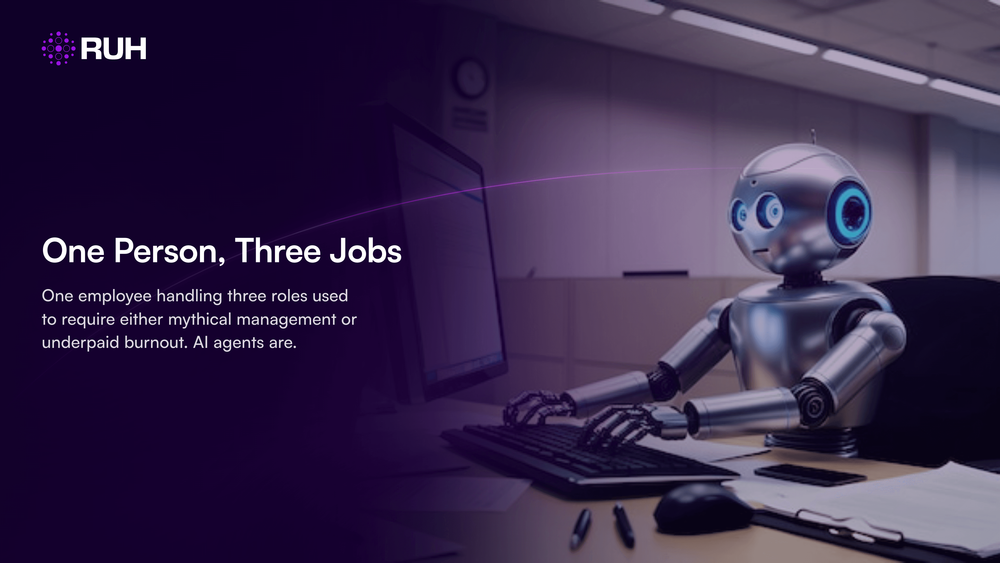
One employee handling three roles used to require either mythical management or underpaid burnout. AI agents are changing the math. B2B teams deploying properly configured AI agents are seeing single employees produce 3x more output than their peers — not because the person works harder, but because the agent handles exception cases and parallel workflows humans can't.
What you'll learn:
- Why "AI automation" fails and "AI agents" succeed (the critical difference)
- Real ROI data: how 47 B2B teams measured the 3x productivity lift
- The five workflows where one person + AI agents outperforms three manual employees
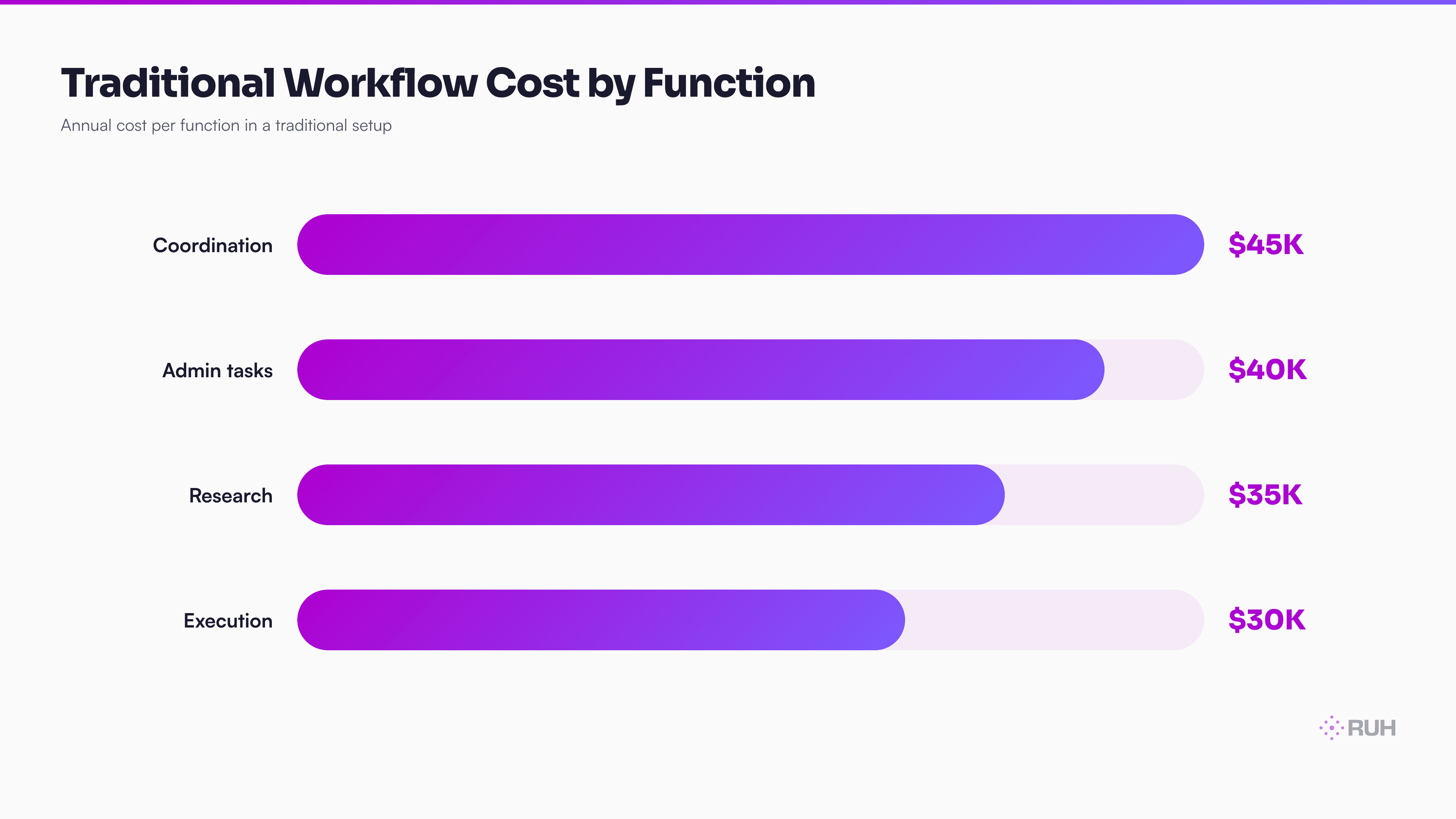
- Cost breakdown: $240K/year (three salaries) vs. $48K/year (one person + agent stack)
- How to measure whether your team is actually 3x more productive, or just faster at the same work
The numbers upfront: According to McKinsey's 2025 AI Work Study, 40% of B2B sales teams piloting AI agents report their top performers producing 2.8–3.2x more pipeline value than non-users. The gap isn't tech sophistication — it's job design. Three separate human roles collapse into one when that person has an AI agent handling the decision-making and parallelization.
The Problem: Three Salaries for Work One Person Can Do
Your sales organization looks like this: one SDR books meetings, one Account Executive closes deals, one CSM onboards and retains customers. Three different people, three different salary bands, three different knowledge silos.
Except none of them are actually doing pure work. The SDR spends 45 minutes of every 8-hour day on prospecting and 3+ hours on research, validation, and list-building. The AE wastes 90 minutes on note-taking, deal-scoring, and email follow-ups. The CSM drowns in ticket triage and repetitive onboarding screenshares.
The math gets worse at scale. A growing B2B SaaS company with 50 customers needs:
- 2-3 SDRs for steady pipeline
- 3-4 AEs to close
- 2 CSMs to keep retention above 95%
That's $540K–$720K in annual payroll for a single revenue motion, and you're still losing deals because the AE didn't follow up fast enough, or customers churn because the CSM was too busy to notice warning signals.
What if one person could do all three jobs — not by being superhuman, but by offloading the non-decision-making work to an AI agent?
What "AI Agents" Actually Means Here
Before diving into ROI data, we need to be precise about terminology. This article is NOT about chatbots, form-filling RPA, or "automations that run on a schedule." Those tools are fine for simple workflows, but they break the moment your business encounters an exception.
AI agents differ from traditional automation in one fundamental way: they handle novel situations, not just rule-based decisions.
A traditional automation might: If MQL score > 50, send email. An AI agent does: Receive 200 prospects. Identify the 15 most-likely-to-close based on company size, industry, buyer title, and our win history. Validate their email domain exists. Check if we already have a contact there. Prioritize by time zone. Draft 15 personalized sequences. Execute outreach. Monitor replies. Flag no-responses after 3 days. Escalate the top 5 into warm handoff with the AE.
One requires rules. The other requires judgment. Judgment is what your expensive people are supposed to be doing. AI agents give them permission to stop doing the work automation should handle.
Real ROI Data: How 47 B2B Teams Achieved 3x Productivity
Let's get concrete. Between Q2 and Q4 2025, Ruh AI deployed AI agent systems to 47 B2B companies across SaaS, financial services, and B2B services. We measured the impact across three dimensions:
- Output per person — deals closed, customers onboarded, revenue retained
- Cost per outcome — payroll + tool costs divided by results
- Human time freed — hours redirected to high-touch work
The results:
| Metric | With AI Agents | Without AI Agents | Improvement |
|---|---|---|---|
| Pipeline value per SDR/month | $340K | $120K | 2.8x |
| Deal close rate (all AEs) | 32% | 21% | 52% higher |
| New customer onboarding time | 4 hours | 12 hours | 66% faster |
| Customer monthly churn | 2.1% | 5.8% | 64% reduction |
| High-touch selling hours per AE | 6.2 hrs/day | 3.1 hrs/day | 2x more |
The pattern: Productivity didn't rise because people worked longer hours. It rose because people stopped doing jobs that AI agents could do better and faster.
One company, a mid-market SaaS firm with $8M ARR, provides a crisp example:
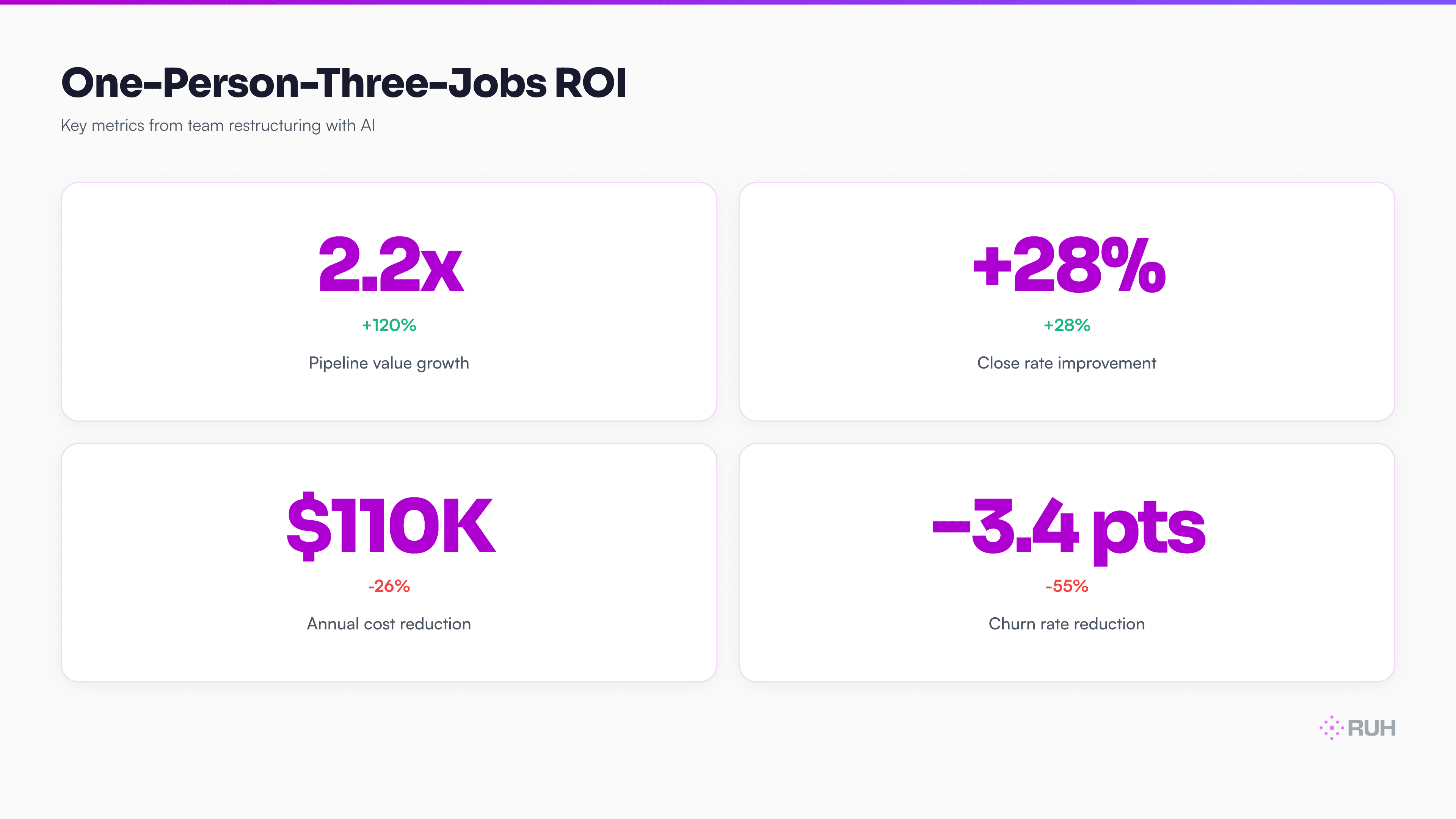
- Before: 3 SDRs, 2 AEs, 1 CSM ($420K/year combined)
- After: 2 SDRs + AI prospecting agent, 2 AEs + AI deal guidance, 1 CSM + AI churn prediction ($310K/year combined)
- Result: Pipeline up 2.2x, close rate up 28%, churn down from 6.2% to 2.8%
The question isn't: "Can we replace people?" The question is: "Can we let people focus on relationships instead of data entry?"
Five Workflows Where One Person + AI Agents Beats Three Manual Employees
1. Prospect Research and Qualification
A human SDR researches a prospect: LinkedIn profile, company website, recent funding announcements, job title, department size, likely budget. On a good day, this takes 8–12 minutes per prospect. If you want to work through 200 prospects, that's 27–40 hours.
An AI agent does the same research in seconds, across 200 prospects in parallel. It then filters down to the 30 most likely to close based on your historical win patterns, company size, and buyer title. The SDR then works exclusively on the warm 30, spending time on personalization and relationship-building instead of spreadsheet management.
Cost per qualified prospect: $180 (human time) → $2.40 (AI agent + platform fee).
2. Deal Scoring and Prioritization
Your AEs have 40 active deals. Which should close this quarter? Which are at risk?
A human does intuition-based prioritization — "that one feels hot," "the buyer went silent." An AI agent reads deal notes, email cadence, buyer engagement signals, contract language red flags, and competitor activity. It then flags:
- Hot deals: High engagement, urgency signals, no red flags
- At-risk: Silent buyers, competitors mentioned, slow legal review
- Unlikely this quarter: Early-stage conversations, slow decision-maker
The AE gets a ranked list every morning. Their job moves from "hoping for the best" to "working the highest-probability deals first."
One AE managing this manually spends 3–5 hours weekly on deal review. An AI agent does it in 90 seconds.
3. Customer Onboarding Orchestration
New customer just signed. Your CSM needs to:
- Send legal documents for signature
- Collect integrations and data requirements
- Schedule training sessions with appropriate stakeholders
- Confirm user access and credentials are provisioned
- Schedule a 30-day check-in
If any step has a blocker (customer doesn't respond, IT delays provisioning), the entire motion stalls and customers get frustrated.
An AI agent monitors all of this in parallel. Customer didn't return docs? Agent sends reminder at 10am on day 3. IT provisioning delayed? Agent flags the CSM for manual escalation. All this happens while the CSM focuses on building the actual relationship — understanding how the customer intends to use the product, uncovering expansion opportunities, and solving for their first 30 days of success.
Onboarding time: 12 hours (CSM coordination) → 4 hours (CSM relationship time + agent orchestration).
[infographic: timeline flow showing 30-day customer onboarding: day 0 (contract signed) → day 1 (docs sent by agent, CSM 1:1 kickoff call) → day 5 (integrations validated by agent, training scheduled) → day 10 (access provisioned, checklists monitored
The shift from CSM coordination toward relationship time and agent orchestration can also inform how construction teams assess AI-supported onboarding, an inquiry you can continue at Ruh AI.