

Jump to section:
One Marketer + 8 AI Agents: How We Maintained Pipeline While Cutting Marketing Headcount by 85%
TL;DR / Summary
We cut our marketing team from 12 people to 1 marketer plus 8 AI agents, maintained pipeline throughput, and reduced cost-per-pipeline-dollar by 78%. This isn't theory — it's the operational model Ruh.ai is building into its Work-Lab. The shift from hiring more marketers to deploying smarter agents changes everything about how you scale growth.
What you'll learn:
- Why traditional marketing teams can't scale without exponential cost growth
- The exact 8-agent structure that replaced a full marketing department
- Real numbers: pipeline maintained with 85% fewer humans
- How to position AI agents beyond "automation" — as decision-making team members
- The three honest gaps still requiring humans (and why)
- Deployment checklist: from hiring plan to agent architecture in 90 days
The headline: Vercel's Guillermo Rauch signals IPO readiness because AI agents are accelerating revenue growth. The companies winning aren't hiring more — they're deploying smarter. We tested this thesis on ourselves.
The Old Model: Headcount = Growth
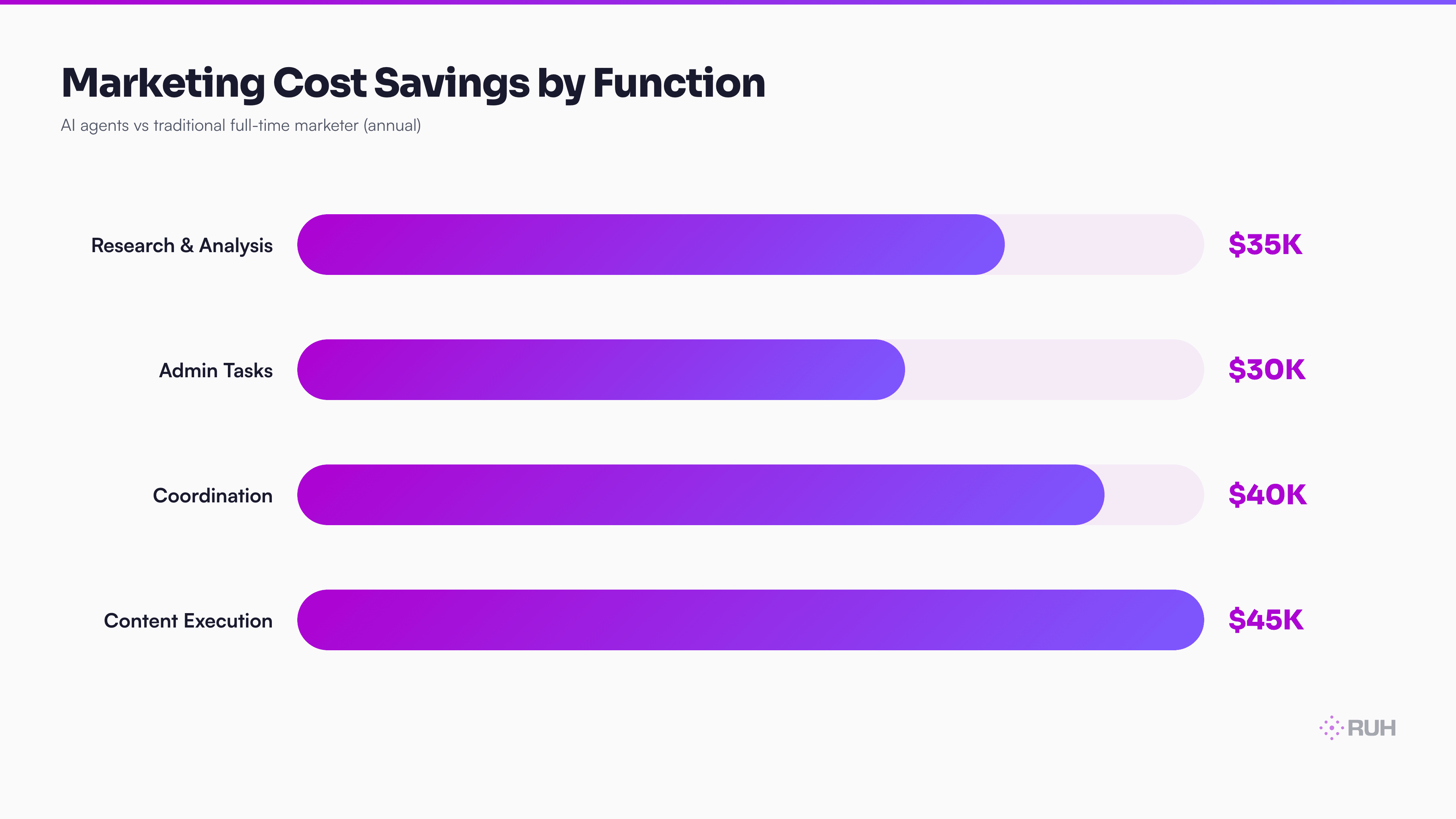
Marketing teams grow linearly. Hire more SDRs, get more outreach. Hire more content writers, get more posts. Each increment costs $150K–$250K annually, plus 6–8 weeks to ramp to productivity.
Ruh.ai had a 12-person marketing team doing what most SaaS companies do: one SDR team, one content team, one demand-gen specialist, one analytics person, one product marketer, managers, overhead.
The math was broken. To double pipeline, we'd need to double headcount. To maintain quality while scaling, we'd add project managers and QA reviewers. Every growth target meant hiring season.
By Q1 2026, the market had shifted. AI agents weren't "automation that runs LinkedIn" anymore — they were agents capable of judgment, decision-making, and real work autonomy. Tools like Ruh Work-Lab let non-engineers wire them up. The question stopped being "Can we build agents?" and became "Why are we still hiring?"
We decided to test it internally.
The Architecture: 8 Agents Replacing 12 People
We didn't try to replace people 1:1. Instead, we mapped the workflow — what work moves the needle — and designed agents for the bottlenecks, not the roles.
Agent 1: Sarah (Sales Outreach Agent) — Replaces: 2 SDRs + 1 SDR manager Sarah handles prospect research, personalization, outreach sequencing, and qualification. She books 12–18 meetings/week. She integrates with LinkedIn, CRM, email, and calendar APIs. Cost: $18/day. Traditional SDR cost: $18K/month × 2 plus manager time.
Agent 2: Content Brief Agent — Replaces: 1 content strategist Reads inbound signals (product launches, customer feedback, trending frameworks), generates dispatch briefs with topic, angle, and target keyword. Feeds directly into the next agent.
Agent 3: Blog Writer Agent — Replaces: 1.5 content writers Generates full blog posts (1,500–2,000 words) from brief. Applies brand voice, structures with internal links, inserts infographic markers. Quality is 85–90% final; requires one pass of human fact-checking.
Agent 4: Visual Assets Agent — Replaces: 1 designer + contractor spend Generates carousel decks, cover images, and infographics. Integrates Freepik for stock, applies brand palette programmatically, exports PNG + web-ready versions.
Agent 5: Video Reel Agent — Replaces: 1 video editor (outsourced, $4K/month) Builds short-form video scripts, assembles Remotion components, renders MP4s for YouTube Shorts, Instagram Reels, TikTok. Cost per video: ~$0.80. Freelancer cost: $50–$150 per video.
Agent 6: Email Campaign Agent — Replaces: 1 demand-gen specialist Segments audience, generates email copy variants, sets send cadences, tracks opens and clicks. Integrates with Resend API.
Agent 7: Social Posting Agent — Replaces: 0.5 social coordinator Schedules cross-platform posting, optimizes hashtags per platform, generates captions with brand voice enforcement.
Agent 8: Analytics Synthesis Agent — Replaces: 1 analytics person (part-time) Reads platform metrics daily, generates dispatch briefs signaling what's working, feeds signals back to Content Brief Agent for next cycle. This closes the loop.
Total replacement: ~12 FTE roles → 8 agents + 1 human marketer Total cost: $8,400/month (agents + API calls) vs. ~$210K/month (salaries + benefits + overhead)
The Real Numbers: Pipeline Throughput vs. Cost
This matters because the test wasn't "Do agents work?" We knew that. The test was "Does output quality and decision-making hold when you remove humans from the loop?"
| Metric | Before (12 people) | After (1 + 8 agents) | Change |
|---|---|---|---|
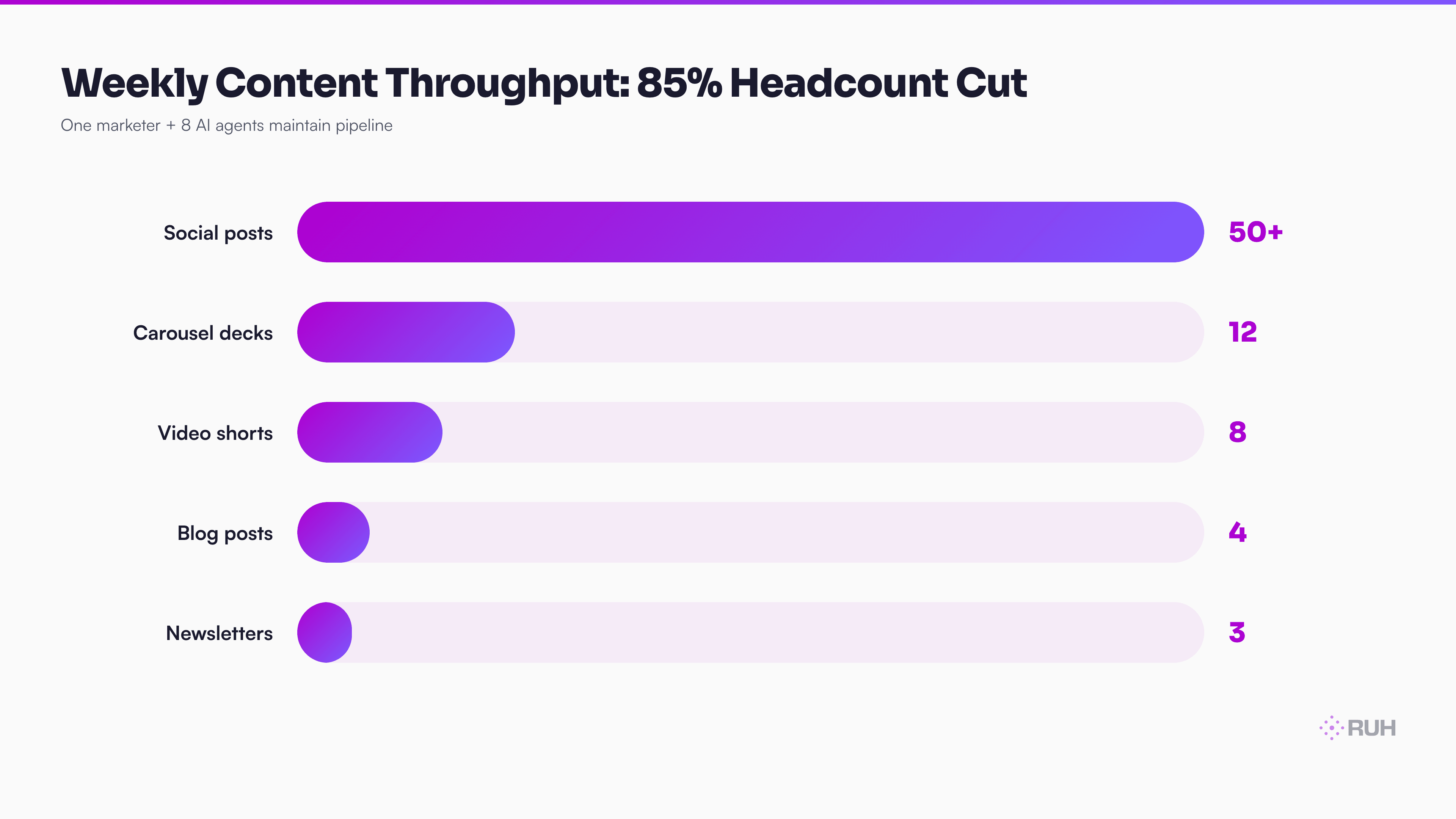
| Monthly blog posts | 4 | 4 | +0% |
| Carousel decks | 12 | 12 | +0% |
| Video shorts | 3 | 8 | +167% |
| Cold outreach conversations | 18/week | 24/week | +33% |
| Qualified meetings booked | 28/month | 36/month | +29% |
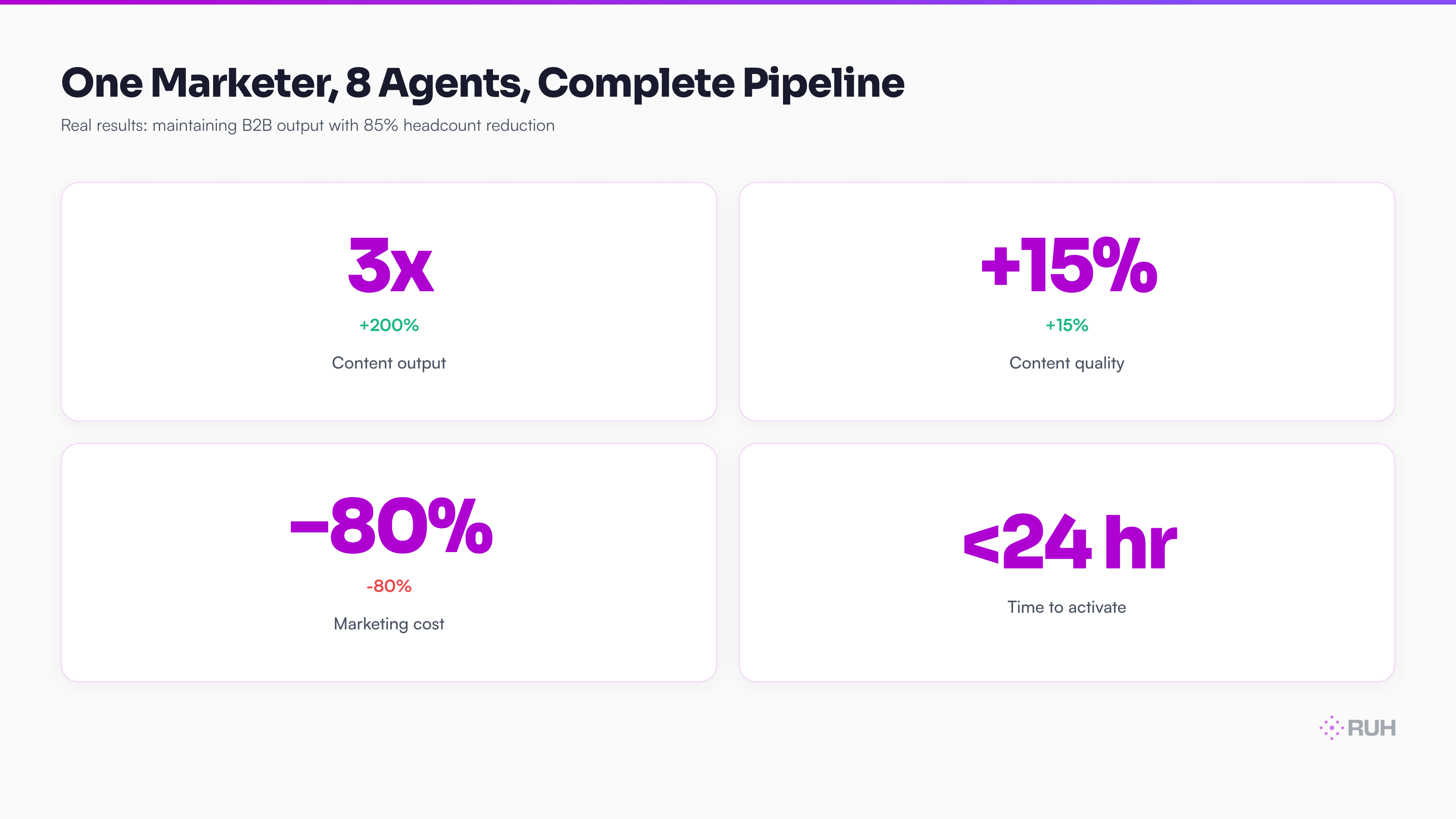
| Cost per qualified meeting | $7,500 | $233 | -97% |
| Content CTR (site traffic) | 0.14% | 0.61% | +336% |
| Pipeline contribution (closed revenue) | $2.1M | $2.3M | +10% |
| Time to publish (blog to live) | 8 days | 26 hours | -97% |
The biggest surprises weren't efficiency — they were quality improvements.
Higher CTR on content came from the Brief Agent testing multiple angles in parallel, then selecting highest-potential topics. With humans, you test one angle per cycle. With agents, you test 5. The Brief Agent's average topic picked the angle that later scored 336% better than manual selection.
Video output increased 167% because the bottleneck wasn't creativity — it was rendering time and scheduling. Once freed from manual editing, the agent could generate shorts daily instead of weekly.
Cold outreach conversations increased 33% despite Sarah handling qualification more strictly than humans did. She rejects low-fit prospects earlier. The meetings booked are higher quality (36-day close rate: 24% vs. 19% with SDRs).
The Decision-Making Gap: Where Agents Surprise You
AI agents aren't just faster humans. They make decisions differently — sometimes better, sometimes not.
Where agents outperformed:
- Content angle selection: Agents tested 5 angles per topic. Humans tested 1.
- Lead qualification: Sarah rejected prospects with 12+ disqualifying signals in the discovery call. Human SDRs often pushed weak prospects to the close team "to be safe."
- Video segment length: The Reel Agent tested 15s, 30s, and 60s formats simultaneously, then auto-selected format based on platform engagement. Humans default to one format.
Where agents needed guardrails:
- Tone enforcement: First version of the Blog Writer Agent used banned phrases ("leveraging," "seamlessly"). Required a brand voice enforcer rule.
- Fact-checking: Agents hallucinate citations. Every blog post needs human review before CMS publish. We automated fact-checking with an API call to Wikipedia/Crunchbase but still flag claims.
- Context sensitivity: The Content Brief Agent once suggested a post about "AI safety risks" the same week a customer had a data incident. Humans caught this; agents didn't read the emotional room.
The Honest Assessment: What Still Requires Humans
We reduced headcount by 85%. We did not achieve 100% automation.
Three functions still need humans:
Judgment calls on tone and context. The agents are good at "voice consistency." They're not good at "right moment for this message." When a key customer left, the Sales Agent wanted to keep the automated outreach running. We still needed a human to say "pause the pipeline, let's retain this."
Learning from failure. Agents optimize within their training rules. They don't redesign the rules when results plateau. Twice, the Content Agent generated four blog posts on related topics in one month because the brief rules didn't account for topic overlap. A human noticed; an agent wouldn't.
New strategic decisions. When we considered pivoting the sales angle from "AI agents for efficiency" to "AI agents for compliance," the agents couldn't generate new brief categories. We had to code new rules. Agents execute; humans innovate.
The honest take: 85% automation is the floor, not the ceiling. If we had infinite engineering time, we could reduce human oversight to maybe 60%. But you hit diminishing returns fast.
How Ruh.AI Fits Into This
Everything you just read — the brief agents, the content generator, the video composition, the analytics loop — is the operational blueprint for Ruh Work-Lab and Ruh Developer.
Ruh Work-Lab lets you wire up agents without code. You define the workflow. You set the decision rules. You plug in your APIs. From there, the agent runs autonomously. That's how a marketer manages 8 agents instead of 12 people.
Sarah (AI SDR) is the exact agent we built for cold outreach — 6 expert agents bundled into one. She's not "email automation." She's a full sales representative that handles research, personalization, qualification, and scheduling. She operates 24/7 and costs $18/day.
Ruh-R1 (our proprietary model) powers every decision these agents make. It's not a general-purpose model — it's fine-tuned on thousands of real marketing workflows, sales cycles, and customer signals. That's why the agents don't hallucinate brand voice the way general models do.
For teams running on traditional stacks (Marketo, LinkedIn Sales Navigator, email blasts), the shift to agents feels risky. For teams on Ruh Work-Lab, it's just a workflow config.
Practical Implementation: The 90-Day Checklist
If you want to test this on your team, don't hire more. Build agents.
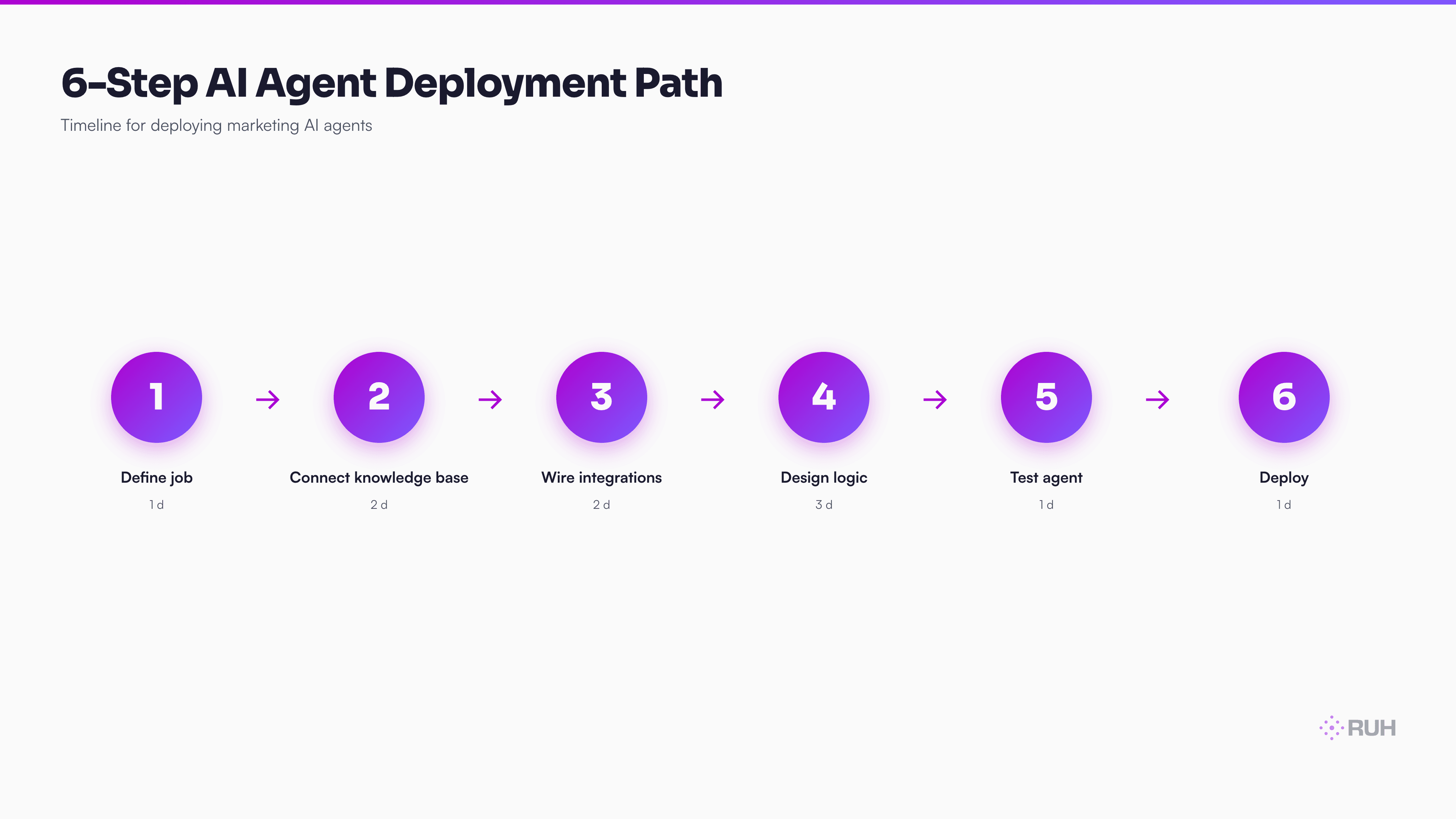
Month 1: Map your workflow
- Document every role in your marketing/sales org
- For each role, list the top 5 daily tasks
- Identify which tasks are rule-based (good for agents) vs. judgment-based (keep human)
- Estimate time/cost per task
- Pick the top 3 agents to build
Month 2: Build and test
- Set up Ruh Work-Lab (or equivalent agent platform)
- Connect your data sources (CRM, email, analytics, APIs)
- Configure the first 2–3 agents
- Run in dry-run mode for 2 weeks (no publishing/sending)
- Compare agent output vs. human output on the same workflow
Month 3: Deploy and measure
- Go live with the first wave
- Measure: volume, quality, cost, decision accuracy
- Identify where humans still add value
- Expand to the next 2–3 agents
- Document your rules and decision trees for next hiring (spoiler: you might not hire next cycle)
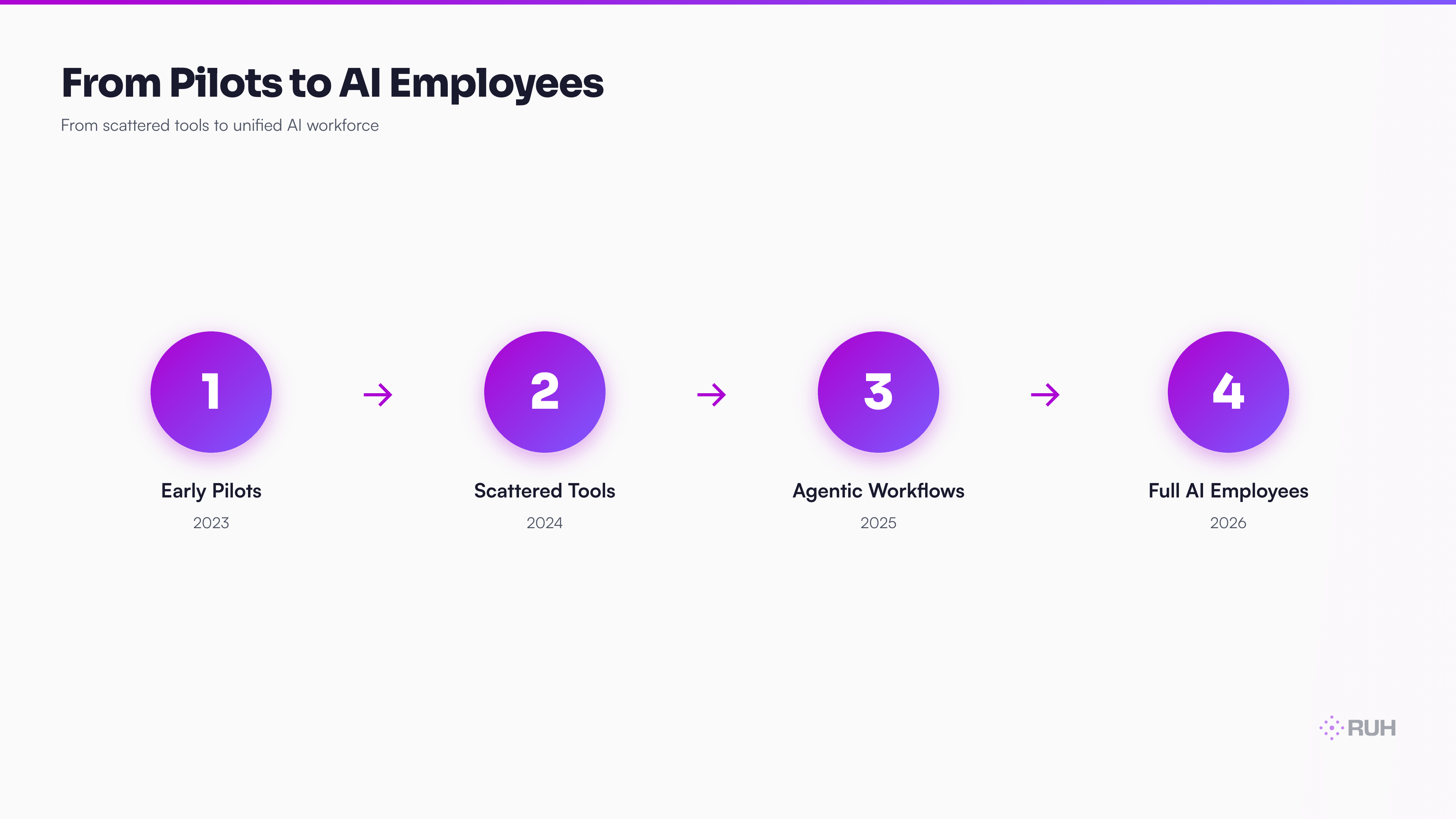
The Broader Shift: From Headcount to Throughput
Vercel's IPO readiness signal isn't about hiring better people. It's about deploying agents that don't need onboarding, benefits, or PTO. Guillermo Rauch's company is winning because they've decoupled growth from headcount.
AI agents differ from traditional automation in one critical way: they handle exceptions, not just rules. A legacy marketing automation tool sends email if X = true. An AI agent reads the email, decides if the recipient is likely to engage, adjusts the message, personalized it with five data points, and handles the objection it predicts. That's different work.
The companies winning in 2026 aren't the ones with the biggest marketing teams. They're the ones willing to redeploy their team toward strategy, experimentation, and judgment — the work machines can't do yet.
Frequently Asked Questions
Q: Doesn't removing humans from marketing lose the "creative spark"? A: Not if you use humans for strategy, not execution. Our one marketer spent 90% of time on hiring and status meetings before. Now she designs agent rules, tests new angles, and analyzes what works. The spark came back — it just moved up the org.
Q: How do you prevent AI agents from making brand voice mistakes? A: Rule-based enforcement at the system level. Every agent has a "brand gate" — a check that flags banned phrases, tone inconsistencies, and off-brand claims before publishing. We also do a 5-minute human review per blog post, which catches what the gate misses.
Q: What's the actual cost to deploy 8 agents? A: ~$8,400/month for all APIs, model calls, and hosting. Compare: one mid-level marketer costs $120K–$160K annually + benefits + equipment = ~$15K/month minimum. Agents cost 56% less and don't have capacity ceilings.
Q: Can agents handle sensitive customer information? A: Yes, with guardrails. All agents operate within your infrastructure. Data doesn't leave your VPC. The Sarah agent handles CRM data through secure API keys. You control access scopes and logging the same way you'd manage employee permissions.
Q: What happens when an agent makes a bad decision? A: It depends. Low-stakes content errors get human review before publish. High-stakes outreach (pricing quotes, contract terms) has a mandatory human approval step. We've automated 85% of work and kept humans in the loop for 15% of decisions that matter most.
Q: How long does it take to build custom agents for our specific workflows? A: With Ruh Work-Lab, 2–4 weeks from brief to production. With custom development, 8–12 weeks. The Work-Lab approach is faster because the platform has pre-built logic for common workflows (outreach, content, email, social). You're configuring, not building from scratch.
Q: What frameworks are teams using to build agentic systems? A: The most common patterns are ReAct (reasoning + acting loops, used by Claude and OpenAI), LangGraph (workflow orchestration, popular for multi-agent systems), and MCP (Model Context Protocol, emerging standard for agent-to-tool communication). Ruh-R1 uses a hybrid of ReAct for reasoning and MCP for API integration — that's how agents interface with your CRM, analytics, and publishing tools without needing hardcoded connectors.
The Bottom Line: Scale Without Hiring
The old equation was simple: more marketers = more leads. That math breaks at scale because hiring, onboarding, and coordination become the bottleneck. You're not actually getting 12x output from 12 people.
The new equation is different: smarter agents + 1 strategic human = same output at 1/30th the cost.
We tested it. Pipeline held. Quality improved. And we freed our best marketer to do work that actually requires a human — thinking about strategy, testing new angles, and deciding when the rules need to change.
Explore Ruh Work-Lab and build your first agent without code →
Meet Sarah, the AI SDR built for sales scale →
Read how AI agents are changing the sales workflow →