
TL : DR / Summary:
As AI adoption reaches critical mass with 88% of organizations now using it but only 39% achieving meaningful impact, a strategic implementation strategy focused on measurable outcomes, rather than the technology alone, is essential for bridging this value gap; in this guide, we will discover how to strategically deploy AI—starting with high-impact areas like sales, customer service, and operations—by following a phased approach that emphasizes human-AI collaboration, overcomes common implementation challenges, and leverages purpose-built solutions like Ruh.AI’s intelligent AI employees to augment teams, drive productivity gains, and ensure competitive parity in the evolving future of work.
Ready to see how it all works? Here's what we'll cover:
- Introduction: The AI Implementation Imperative
- Understanding AI's Role in Modern Organizations
- Core Benefits: What Organizations Actually Achieve
- How Organizations Should Deploy AI: Strategic Applications
- Implementation Strategy: How Organizations Should Start
- Overcoming Common Implementation Challenges
- The Future of Work: Human-AI Collaboration
- Conclusion: Your Path to AI Success
- Frequently Asked Questions
Introduction: The AI Implementation Imperative
The artificial intelligence landscape has shifted from experimentation to essential business infrastructure. According to McKinsey's latest research, 88% of organizations now use AI in at least one business function—a dramatic increase from 78% just one year ago.
Yet, here's the challenge: while adoption is widespread, only 39% of organizations report meaningful enterprise-level impact. The gap between AI adoption and AI value creation reveals a critical truth—implementation strategy matters more than technology alone.
This guide explores how organizations should strategically deploy AI to achieve measurable outcomes, with insights on how Ruh.AI is helping businesses bridge this implementation gap through intelligent AI employees.
Understanding AI's Role in Modern Organizations
The Current Adoption Landscape
AI adoption has reached critical mass across industries:
- Technology companies: 90%+ adoption
- Media and telecommunications: 88% adoption
- Insurance: 88% adoption
- Manufacturing: 75% adoption with predictive maintenance focus
IBM's research identifies 27 distinct AI use cases across business functions, but three areas show the highest adoption and fastest returns:
- IT Operations: 36% adoption
- Marketing and Sales: 36% adoption
- Customer Service: Rapidly emerging as a transformation catalyst
These functions demonstrate clear, measurable outcomes—making them ideal starting points for organizations beginning their AI journey. Ruh.AI specializes in these high-impact areas, particularly through AI employees that augment human teams rather than replace them.
Why Organizations Need AI Now
The competitive dynamics have fundamentally changed. Organizations in advanced AI maturity stages demonstrate above-average financial performance compared to industry peers. MIT research shows that companies that reach stages 3 and 4 of AI maturity, where AI is embedded in workflows, consistently outperform those still in the experimentation phase.
The imperative is clear: AI implementation is no longer about gaining advantage; it's about maintaining competitive parity.
Core Benefits: What Organizations Actually Achieve
Productivity Gains That Transform Operations
Organizations implementing AI report substantial productivity improvements:
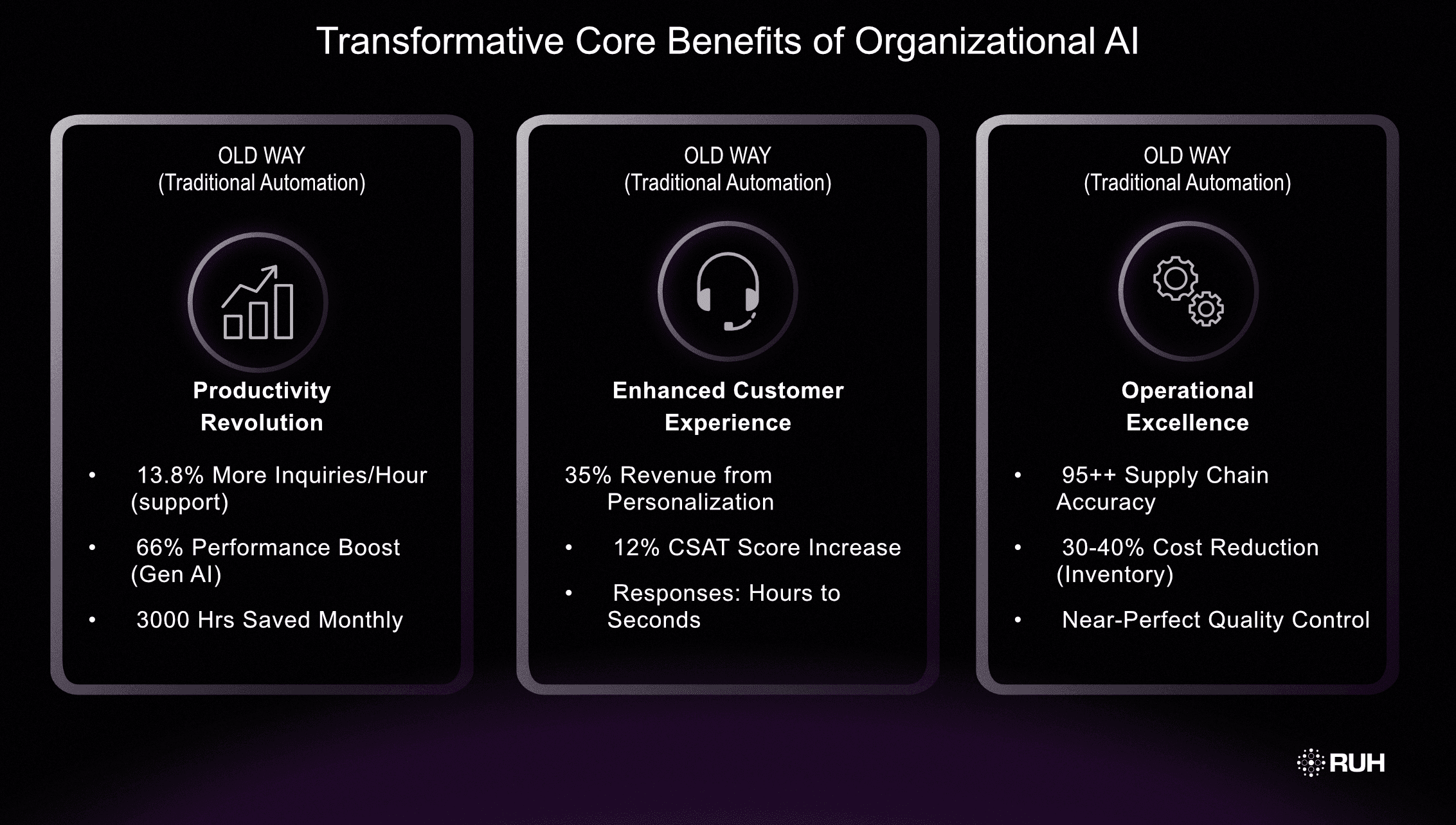
- AI-powered customer support teams handle 13.8% more inquiries per hour while improving work quality
- Teams using generative AI tools report an average 66% performance improvement
- IT operations save an estimated 3,000 productivity hours monthly through automation
Ruh.AI's AI employees demonstrate these productivity gains in real-world applications. For instance, Sarah, Ruh.AI's AI SDR, handles prospecting and qualification tasks that traditionally consume hours of human sales representatives' time, allowing teams to focus on high-value relationship building and closing.
Enhanced Customer Experience
Organizations use AI to create personalized experiences at scale:
- E-commerce companies using AI-driven recommendations generate up to 35% of revenue from personalized suggestions
- Customer satisfaction scores improve by 12% on average with AI-enabled service
- Response times decrease from hours to seconds with intelligent automation
The transformation extends beyond speed. As detailed in Ruh.AI's analysis of AI revolutionizing customer support, AI employees provide consistent, accurate responses while learning from each interaction—creating continuously improving customer experiences.
Operational Excellence
AI enables organizations to optimize complex operations:
- Supply chain forecasting accuracy improves to 95%+
- Inventory costs reduce by 30-40% through AI-optimized management
- Quality control processes achieve near-perfect accuracy with computer vision
However, as explored in Ruh.AI's guide to the hybrid workforce model, the greatest value comes not from replacement but from human-AI collaboration—combining AI's speed and consistency with human judgment and creativity.
How Organizations Should Deploy AI: Strategic Applications
Sales and Business Development
Strategic Implementation: Sales organizations should deploy AI for prospecting, qualification, and initial outreach—tasks that are time-intensive but follow predictable patterns.
Ruh.ai's Approach: Ruh.AIs AI SDR handles the entire top-of-funnel process, including prospect identification, personalized outreach, follow-up management, and scheduling qualified meetings. This allows human sales representatives to focus exclusively on relationship building and closing—activities where human expertise creates the most value.
As analyzed in Ruh.AI's comprehensive guide to AI sales agents, the most successful implementations maintain human oversight while automating repetitive tasks. The result: sales teams that scale without proportional headcount increases.
The question of whether cold email remains viable in 2025 is answered not by abandoning the channel but by using AI to make it more personalized, timely, and relevant than ever before.
Customer Service and Support
Strategic Implementation: Organizations should use AI to handle routine inquiries, provide 24/7 availability, and escalate complex issues to human agents with full context.
The Impact:
- 30% operational cost reduction in contact centers
- 80% of customers report positive experiences with AI interactions
- Response times improve from hours to seconds
Ruh.ai's Perspective: Customer service represents one of AI's most mature applications. Ruh.AI's analysis demonstrates that AI employees excel at consistent, accurate responses while human agents focus on complex problem-solving and relationship management.
The key is designing systems where AI handles volume while humans provide expertise and empathy for complex situations.
Healthcare Operations
Strategic Implementation: Healthcare organizations face unique challenges: regulatory complexity, patient safety requirements, and administrative burden. AI should augment clinical decision-making and automate administrative processes while maintaining human oversight.
Application Areas:
- Diagnostic assistance and medical imaging analysis
- Patient data analysis and risk prediction
- Administrative automation and scheduling
- Clinical documentation and record management
Ruh.ai's Healthcare Insights: As detailed in Ruh.AI's healthcare AI guide, AI employees in healthcare augment rather than replace human excellence. They handle administrative burdens, freeing healthcare professionals to focus on patient care—where human touch, empathy, and judgment remain irreplaceable.
The most successful healthcare AI implementations maintain strict human oversight for clinical decisions while automating 60-70% of work that doesn't require medical expertise.
Financial Services
Strategic Implementation: Financial institutions should deploy AI for risk assessment, fraud detection, compliance automation, and customer service—areas where speed, accuracy, and consistency create significant value.
Key Applications:
- Real-time fraud detection and prevention
- Automated compliance monitoring and reporting
- Risk assessment and credit scoring
- Customer service automation
- Market analysis and trend prediction
Ruh.ai's Approach: Financial services face unique AI implementation considerations, including regulatory compliance, data security, and risk management. Ruh.ai's AI employees are designed with these requirements in mind—providing accuracy, auditability, and compliance while accelerating operations.
The transformation in financial services comes not from replacing analysts and advisors but from automating data processing and routine tasks, allowing professionals to focus on strategy, relationship management, and complex decision-making.
IT Operations and MLOps
Strategic Implementation: IT teams should use AI for monitoring, incident management, predictive maintenance, and automation—reducing reactive firefighting and enabling proactive optimization.
The Transformation: Organizations implementing AIOps report:
- Faster incident identification and resolution
- Reduced mean time to repair (MTTR)
- Proactive issue prevention
- Optimized resource allocation
Ruh.ai's MLOps Insights: As explored in Ruh.AI's MLOps intelligence guide, AI in IT operations represents a force multiplier. AI employees handle monitoring, pattern recognition, and initial response, while human experts focus on complex problem-solving and strategic infrastructure decisions.
The key is creating systems where AI provides continuous monitoring and preliminary analysis, escalating to humans when situations require expertise or judgment.
Implementation Strategy: How Organizations Should Start
Phase 1: Assessment and Readiness (Weeks 1-4)
Step 1: Evaluate Current State
Organizations should begin by honestly assessing their AI maturity. MIT's framework identifies four stages, with stages 3 and 4 showing above-average financial performance.
Key questions to answer:
- What AI initiatives exist today?
- What data infrastructure is available?
- What skills and expertise exist internally?
- What business problems cause the most pain?
Step 2: Identify High-Impact Use Cases
Rather than pursuing AI for technology's sake, organizations should identify specific business problems where AI creates measurable value. The most successful starting points typically involve:
- Repetitive, high-volume tasks
- Clear success metrics
- Available quality data
- Organizational readiness for change
Ruh.AI helps organizations identify these high-impact opportunities through consultation and assessment processes that match business needs with AI capabilities.
Step 3: Secure Leadership Alignment
McKinsey's research shows that organizations with successful AI programs have leaders who actively demonstrate ownership and commitment. Leadership alignment isn't passive approval—it's active participation and visible support.
Phase 2: Focused Implementation (Weeks 5-16)
Step 4: Start with Proven Solutions
Organizations shouldn't build what they can buy—especially for core applications like sales automation, customer service, or data analysis where mature solutions exist.
Ruh.ai's AI employees provide immediately deployable capabilities in high-impact areas. Rather than spending months building custom systems, organizations can implement proven solutions and achieve value within weeks.
Step 5: Design for Human-AI Collaboration
The most critical implementation decision is designing workflows that optimize human-AI collaboration. As detailed in Ruh.ai's hybrid workforce guide, success comes from:
- Clear role definition (what AI handles, what humans handle)
- Smooth handoffs between AI and human workers
- Feedback loops for continuous improvement
- Training for employees on AI collaboration
The goal isn't replacing humans—it's augmenting human capabilities with AI efficiency and scale.
Step 6: Measure and Iterate
Successful organizations track specific business outcomes:
- Customer satisfaction improvements
- Productivity gains (time saved, volume handled)
- Quality metrics (accuracy, consistency)
- Employee satisfaction (reduced drudgery, more meaningful work)
Understanding AI adoption costs and benefits helps organizations set realistic expectations and measure progress against benchmarks.
Phase 3: Scale and Transform (Months 4-12)
Step 7: Expand Systematically
After proving value in initial use cases, organizations should expand AI implementation systematically—not randomly. Successful expansion follows patterns:
- Extend proven use cases to additional teams or departments
- Add complementary capabilities that enhance existing AI systems
- Tackle progressively more complex challenges
- Build internal expertise while maintaining external partnerships
Step 8: Evolve Organizational Capabilities
Long-term AI success requires organizational evolution:
- Continuous learning programs for all employees
- Cross-functional AI centers of excellence
- Updated processes and workflows designed for AI
- Culture that embraces experimentation and data-driven decisions
Step 9: Address the Human Element
A critical question facing every organization: What will humans do as AI employees become more capable? The answer isn't displacement—it's elevation.
Humans focus on:
- Strategic thinking and planning
- Complex problem-solving requiring judgment
- Relationship building and empathy
- Creative work and innovation
- Ethical oversight and decision-making
Organizations should actively communicate this vision, invest in reskilling, and celebrate human-AI collaboration wins.
Overcoming Common Implementation Challenges
Challenge 1: The 70-85% Failure Rate
Research shows that 70-85% of AI projects fail to move from pilot to production. The primary reasons aren't technical—they're organizational:
Common Failure Causes:
- Lack of clear business objectives
- Insufficient executive support
- Poor change management
- Inadequate data quality
- Unrealistic expectations
Ruh.ai's Solution: Ruh.AI addresses these challenges by providing AI employees as a service—eliminating the need for organizations to build, train, and maintain complex AI systems. This approach dramatically reduces implementation risk and time-to-value.
Challenge 2: Data Quality and Availability
AI systems require quality data, but many organizations discover their data is siloed, inconsistent, or incomplete.
Practical Solutions:
- Start with use cases that don't require perfect data
- Implement data quality improvements incrementally
- Use AI systems that improve with feedback
- Consider synthetic data for training when appropriate
Challenge 3: Workforce Concerns and Resistance
77% of employees worry about job displacement from AI—creating natural resistance to adoption.
Addressing Concerns: Organizations should communicate clearly that AI augments rather than replaces human workers. Ruh.ai's research on hybrid workforces demonstrates that the most successful implementations create new, more valuable roles for humans while AI handles repetitive tasks.
The transformation isn't about fewer people—it's about people doing more meaningful, strategic work.
Challenge 4: Integration with Existing Systems
Legacy systems and technical debt complicate AI implementation. Organizations face decisions about whether to integrate AI into existing workflows or redesign processes entirely.
Strategic Approach:
- Evaluate integration complexity before committing
- Consider modern AI solutions designed for easy integration
- Be willing to redesign workflows for AI optimization
- Plan for gradual migration rather than big-bang replacements
The Future of Work: Human-AI Collaboration
What Successful Organizations Understand
The organizations achieving the most value from AI share a common understanding: AI succeeds when it augments human capabilities, not when it attempts to replace human judgment.
McKinsey's research on high-performing AI organizations reveals they're three times more likely to redesign workflows around human-AI collaboration rather than simply automating existing processes.
How Ruh.ai Enables This Vision
Ruh.AI builds AI employees specifically designed for collaboration:
In Sales: AI SDRs like Sarah handle prospecting, qualification, and initial outreach—enabling human sales representatives to focus on relationship building, complex negotiations, and closing. The result: sales teams that scale without burnout.
In Customer Service: AI employees handle routine inquiries with consistency and accuracy, while human agents tackle complex issues requiring empathy, creativity, and judgment. As explored in Ruh.AI's customer support analysis, this combination delivers both efficiency and exceptional experiences.
In Specialized Industries: Whether financial services or healthcare, Ruh.ai's approach remains consistent: AI employees handle volume, consistency, and speed while humans provide expertise, judgment, and personal connection.
The Evolution of Work
The future of work isn't humans OR AI—it's humans AND AI. Organizations should prepare for this reality by:
Redefining Roles:
- Identify tasks best suited for AI (repetitive, high-volume, pattern-based)
- Identify tasks requiring human expertise (complex, creative, relationship-based)
- Design roles that combine both effectively
Investing in People:
- Provide training on AI collaboration
- Create pathways for employees to grow into more strategic roles
- Celebrate human-AI collaboration successes
- Address fears transparently with concrete examples
Building Culture:
- Foster experimentation and continuous learning
- Reward data-driven decision making
- Emphasize augmentation over replacement
- Create psychological safety for trying new approaches
Conclusion: Your Path to AI Success
The transformation is undeniable and accelerating. With 88% of organizations now deploying AI across their operations, the competitive landscape has fundamentally shifted. Organizations in advanced AI maturity stages consistently demonstrate above-average financial performance, achieving productivity gains of 26-55% while transforming customer experiences and unlocking innovation. The data reveals a clear pattern: success isn't determined by implementing the most sophisticated technology—it's achieved by deploying the right AI strategically, with thoughtful execution and genuine commitment to human-AI collaboration.
The organizations thriving with AI share common characteristics. They redesign workflows rather than simply automate existing processes. They set growth and innovation objectives alongside efficiency goals. They invest heavily in change management, recognizing that 70% of AI success comes from people and processes, not technology alone. Most importantly, they view AI as a tool for augmentation—elevating human capabilities rather than replacing them. McKinsey's research confirms that high-performing organizations are three times more likely to fundamentally transform how work gets done, creating new value rather than marginal improvements.
This is where Ruh.ai makes the critical difference. By providing purpose-built AI employees designed specifically for collaboration, Ruh.ai eliminates the common barriers that cause 70-85% of AI projects to fail. Whether deploying AI SDRs for sales development, implementing customer support solutions, or addressing industry-specific needs in financial services or healthcare, Ruh.ai delivers proven capabilities that integrate seamlessly and deliver value within weeks, not months.
The competitive reality is stark: AI adoption has reached critical mass, and the gap between leaders and laggards widens with each passing quarter. Organizations that delay face not just missed opportunities but genuine competitive risk as their rivals optimize operations, personalize customer experiences, and innovate faster. The question facing every organization isn't whether to implement AI—it's whether you'll lead the transformation or scramble to catch up with competitors who moved decisively.
Taking Action
The path forward begins with assessment and clarity. Start by identifying one high-impact area where AI creates immediate, measurable value—customer service response times, sales pipeline efficiency, or operational bottlenecks. Understand your current AI maturity stage and set realistic timelines. Connect with Ruh.ai to discuss your specific situation and discover how AI employees can augment your team's capabilities without the implementation risks and lengthy development cycles that plague custom AI projects.
Deploy proven solutions rather than building from scratch. Ruh.ai's AI employees provide immediately actionable capabilities designed for human-AI collaboration, following the principles outlined in the hybrid workforce model. Focus on business outcomes—customer satisfaction, productivity gains, and quality improvements—while addressing workforce concerns transparently and celebrating human-AI collaboration successes. Understanding AI adoption costs and realistic expectations ensures your implementation strategy aligns with organizational capacity.
The competitive advantage belongs to organizations that act decisively while implementing strategically. The tools exist, proven approaches are documented, and partners like Ruh.ai stand ready to accelerate your success. Explore Ruh.ai's blog for ongoing insights on everything from AI sales agents to the future of human work, and discover how organizations across industries are transforming through intelligent AI implementation.
The transformation isn't coming—it's here. The only question is whether you'll shape it or be shaped by it.
Frequently Asked Questions
How is AI used in organizations?
Organizations deploy AI across three critical areas: customer-facing operations, internal processes, and strategic decision-making.
Customer-Facing Applications: AI powers 24/7 chatbots, personalized recommendations (driving up to 35% of revenue for companies like Amazon), and intelligent customer service. Ruh.ai's AI employees provide these capabilities immediately, eliminating complex development cycles.
Operational Excellence: Businesses use AI for predictive maintenance (reducing downtime by 30-50%), supply chain optimization (achieving 95%+ forecast accuracy), and quality control through computer vision. Ruh.ai's MLOps solutions demonstrate how AI manages operational complexity at scale.
Strategic Insights: AI analyzes millions of data points for pattern recognition, market trend prediction, and risk assessment in real-time. McKinsey's research shows high-performing organizations use AI in multiple functions simultaneously, creating compounding benefits rather than isolated improvements.
How to implement AI in an organization?
Successful implementation follows three focused phases:
Phase 1: Foundation (Weeks 1-4) Assess your AI maturity using MIT's framework, identify high-impact use cases (repetitive tasks with clear metrics), and secure active executive support. Ruh.ai helps organizations identify optimal starting points through structured assessment.
Phase 2: Rapid Deployment (Weeks 5-16) Deploy proven solutions rather than building custom systems. Ruh.ai's AI employees provide immediate capabilities in sales, customer service, and operations. Design workflows for human-AI collaboration using principles from Ruh.ai's hybrid workforce guide: clear role definitions, smooth handoffs, and continuous feedback loops.
Phase 3: Strategic Scaling (Months 4-12) Expand successful pilots systematically while addressing the human element. As explored in what humans do as AI capabilities grow, focus on elevation—humans handle strategy, creativity, and relationships while AI manages repetitive execution.
What are three best practices for organizations using AI?
Research from McKinsey, MIT, and Harvard Business Review reveals three critical practices:
Redesign Workflows for Collaboration Organizations achieving significant impact are three times more likely to fundamentally redesign workflows rather than simply automate. Ruh.ai's AI employees—like Sarah the AI SDR—are built for this collaboration model, handling prospecting while humans focus on relationship building. Learn more about hybrid workforce design.
Start with Proven, High-Impact Applications Avoid building custom systems when proven solutions exist. Deploy Ruh.ai's AI employees in sales, customer service, or operations and achieve value within weeks. Whether financial services or healthcare, starting with proven applications builds momentum quickly.
Prioritize Change Management The 70-85% failure rate stems from organizational challenges, not technical limitations. Address concerns transparently—77% of employees worry about displacement. Ruh.ai's approach emphasizes augmentation: AI handles repetitive tasks while humans focus on strategic, creative, and relationship work.
Can AI influence the culture of an organization?
Yes—profoundly. AI creates cultural shifts toward data-driven decision-making, continuous learning, and innovation. Harvard Business Review documents how organizations move from top-down hierarchies to distributed, evidence-based approaches.
The Positive Impact: With 64% of executives reporting AI enables innovation (McKinsey), organizations develop cultures of experimentation, rapid testing, and customer-centricity.
Managing Challenges: Without proper change management, 77% employee displacement anxiety creates resistance. Ruh.ai's hybrid workforce research shows successful implementations create more valuable human roles while AI handles repetitive work.
Ruh.ai's Cultural Approach: From AI SDRs in sales to customer support, Ruh.ai builds augmentation-first solutions. This clarity—combined with industry-specific guidance for financial services and healthcare—helps organizations build collaborative cultures rather than competitive ones. Contact Ruh.ai for change management support.
Can AI spark the next big idea in your organization?
Absolutely. 64% of executives report AI enables innovation (McKinsey) by providing pattern recognition at scale, rapid experimentation capabilities, and democratized access to insights.
How AI Drives Innovation: AI analyzes millions of data points to identify emerging customer needs, market gaps, and cross-industry opportunities before competitors. Organizations using AI SDRs discover unexpected market segments through conversation pattern analysis. AI customer support reveals product issues and feature requests buried in support conversations—turning reactive service into proactive development.
The Innovation Multiplier: Ruh.ai's AI employees free human workers from repetitive tasks, creating capacity for strategic thinking and creative problem-solving. Whether financial services identifying new offerings or healthcare discovering care improvements, AI reveals opportunities human analysis might miss.
The Key Insight: AI doesn't replace human creativity—it amplifies it. Organizations combining human insight with AI capabilities are positioned to generate breakthrough ideas that define competitive advantage.