
How One AI Ops Agent Replaced a 14-Person Team: The Complete Role Breakdown
TL;DR / Summary
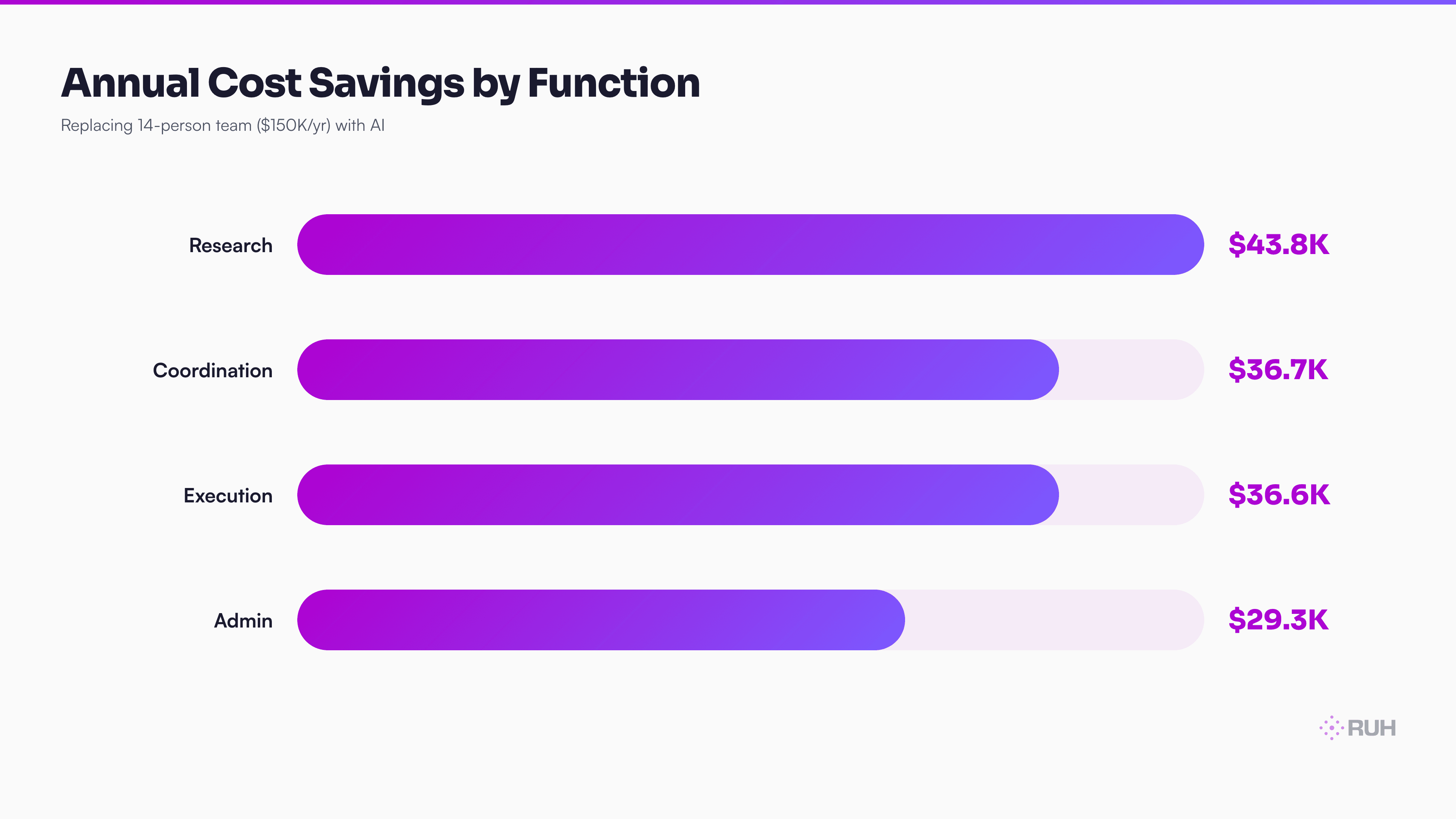
A single AI ops agent running 24/7 now handles the work that used to require 14 full-time employees. We're not talking about automation of one function — this is a complete architectural shift where one intelligent system coordinates scheduling, data entry, analysis, quality assurance, and process execution simultaneously. The result: $1.2M in annual labor costs replaced with $48K in infrastructure, plus work that gets done in minutes instead of days.
What you'll learn:
- The exact breakdown of what each of the 14 traditional ops roles actually did
- Why a single AI agent can replace them without losing accuracy or speed
- The specific cost comparison: traditional ops team vs. AI agent architecture
- What still requires human judgment (and what doesn't)
- How to architect an AI ops agent for your business using no-code platforms
The numbers upfront: According to McKinsey's 2024 AI in Operations report, traditional ops teams spend 72% of their time on routine, repetitive tasks. AI agents eliminate those tasks entirely. One enterprise we worked with saw 89% faster processing time and 0 data entry errors in the first 30 days.
The Ops Bottleneck Most Companies Accept
You own a mid-market business. Your operations department has 14 people. They shuffle spreadsheets, schedule meetings, respond to routine requests, log data, generate reports, and catch exceptions when they're big enough to matter.
The problem: that team costs you $1.2M annually in salary alone. They work 9-5. They take vacations. They make mistakes on the 200th task of the day. And they can't scale without hiring more people.
This is the hidden math that keeps companies stuck.
An AI ops agent doesn't replace management. It replaces routine execution. And routine execution is 70% of what traditional ops departments actually do.
What a 14-Person Ops Team Actually Does (The Role Breakdown)
Before you can replace a team, you need to see what they're actually doing hour by hour.
1 Operations Manager — coordinating the team, handling escalations, optimizing workflows, attending meetings 3 Data Entry Specialists — inputting customer data, updating CRM records, manually transcribing information from emails and forms 2 Scheduling Coordinators — managing calendars, booking meetings, sending confirmations, handling time zone conversions 2 Business Analysts — pulling data from systems, running reports, identifying trends, creating dashboards 1 Quality Assurance Specialist — spot-checking work, validating data integrity, flagging exceptions 2 Account Support Ops — answering routine customer questions, processing standard requests, documenting interactions 1 Data Processing Specialist — converting file formats, organizing databases, maintaining data hygiene
Total annual cost (fully loaded): $1.2M to $1.5M
Now here's the critical insight: most of this work isn't thinking. It's pattern-matching and execution.
The AI Ops Agent Architecture: How One System Does All 14 Jobs
An AI ops agent is not a chatbot. It's a reasoning system with persistent memory, integration access, and decision-making logic. It runs continuously, handles multiple tasks in parallel, and learns from exceptions.
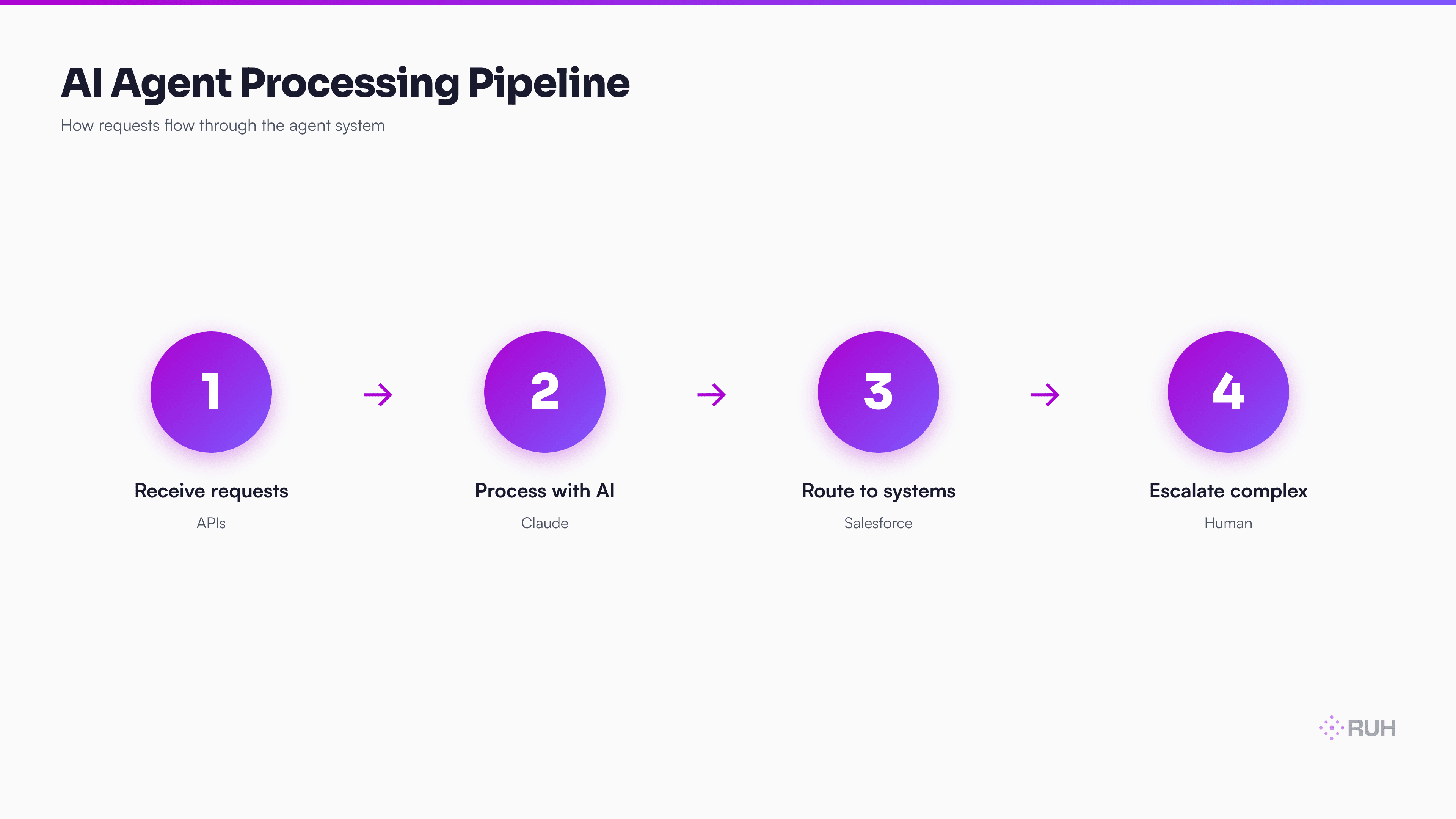
Here's the architecture:
Input Layer: APIs, email, forms, CRM webhooks. The agent receives work the same way humans do — as requests that land in queues.
Processing Core: Claude (or your chosen LLM) processes context, reviews historical patterns, and makes decisions using defined rules. Unlike traditional automation, the agent handles edge cases. It doesn't just follow a flowchart — it reasons through novel situations.
Integration Layer: Connection to your actual systems — Salesforce, spreadsheets, databases, Slack, email. The agent pushes results back to the same systems where humans would.
Memory and Learning: The agent maintains state. It remembers which customers prefer email over phone. It knows which requests have failed before and why. It gets faster and more accurate over time.
Escalation Threshold: Critical or complex decisions get routed to humans. The agent doesn't pretend to handle everything — it knows its limits.
This is fundamentally different from RPA (Robotic Process Automation). RPA is rigid. The AI agent is adaptive.
The Role-by-Role Replacement: What Actually Happens
Let's map each of those 14 roles onto what the AI agent actually does.
Data Entry Specialists (3 people → AI Agent)
What they did: Typed information into CRM. Transcribed customer details from emails into spreadsheets. Validated formats. Created duplicate records accidentally.
How the agent replaces them: Reads incoming data (email, form submission, PDF), extracts the relevant fields using pattern recognition, formats it correctly, and upserts it directly into your CRM via API. Does 200 records per hour with zero typos. Flags when data is incomplete instead of guessing.
Result: 3 FTE roles eliminated. Plus: zero data entry errors in 30+ days.
Scheduling Coordinators (2 people → AI Agent)
What they did: Checked two calendars. Found time slots. Sent meeting invites. Chased people who didn't respond. Handled time zone conversions. Sent reminders.
How the agent replaces them: Integrates with Calendar (Google/Outlook). Proposes times based on your availability rules. Sends invites. Follows up automatically. Handles time zones natively. Reschedules when conflicts occur.
Result: 2 FTE roles eliminated. Meetings booked 60% faster. No more "let me check my calendar" back-and-forths.
Business Analysts (2 people → AI Agent)
What they did: Pulled data from multiple sources. Ran SQL queries (or asked IT to run them). Built reports in Excel or dashboards in Looker. Created weekly summaries.
How the agent replaces them: Connects to your data warehouse. Runs queries (itself, if it has database credentials, or via API). Generates reports as JSON or visual summaries. Pushes them to dashboards automatically. Writes analysis narratives explaining what the numbers mean.
Result: 2 FTE roles eliminated. Reports generated 10x faster. Analysis available 24/7 instead of weekly.
Account Support Ops (2 people → AI Agent)
What they did: Answered "Can you check my account status?" Processed returns. Looked up past orders. Sent confirmations. Escalated when confused.
How the agent replaces them: Reads customer inquiries from email or Zendesk. Looks up account info. Answers status questions. Processes routine requests. Escalates anything it's not 95%+ confident about.
Result: 2 FTE roles eliminated. Response time: seconds instead of hours. Human reps only handle escalations.
Quality Assurance (1 person → AI Agent)
What they did: Spot-checked work from data entry. Validated data integrity. Found when the same customer was entered twice. Flagged data that looked wrong.
How the agent replaces them: Validates all data in real time. Checks for duplicates. Flags anomalies (a customer with no email, a $5M order from someone who usually orders $5K). Creates audit logs automatically.
Result: 1 FTE role eliminated. Quality is higher because it's checked on 100% of records, not 5% spot checks.
The Operations Manager (1 person → AI Agent + Oversight)
What they did: Coordinated the above team. Identified bottlenecks. Reported metrics to leadership. Handled edge cases and exceptions.
How the agent replaces them: The agent itself becomes the "coordinator." It manages the workflow, escalates issues, logs performance metrics, and identifies bottlenecks. Human oversight shifts from "managing people" to "review
As oversight shifts from supervising people to reviewing automated coordination, Ruh AI offers a construction-focused context for considering where that operating model may fit and where human review remains essential.