
TL;DR / Summary
Construction loses $100 billion annually to workplace injuries, yet traditional safety methods catch only 20-30% of hazardous moments before they cause harm. AI jobsite safety systems detect hazards in real-time using computer vision, machine learning, and sensor data — preventing injuries before they happen and cutting lost-time incidents by 55-65% within 12-18 months.
What you'll learn:
- Why construction's injury rate is 4-5x higher than manufacturing and what the real cost is per incident
- How AI systems detect PPE violations, unsafe behavior, equipment misuse, and environmental hazards in milliseconds
- Proof points from major firms (Bechtel, Turner, Skanska) showing 60% incident reductions and 12-22 month ROI
- Implementation roadmap for construction leaders — from assessment through multi-site rollout
- How to address worker resistance, privacy concerns, false alert rates, and integration with existing safety culture
The numbers upfront: According to the Bureau of Labor Statistics, construction workers suffer 2.1 lost-time injuries per 200,000 hours worked — nearly 5 times the rate for all workers combined. Each serious incident costs $45,000-$85,000 in direct and indirect expenses. Traditional safety approaches miss 70-80% of hazardous moments because they operate reactively, not predictively.
The Hidden Cost of Construction Injuries
Most construction leaders know their injury rate without fully grasping what it costs.
The gap between actual and managed safety is massive. Construction workers face lost-time injury rates of 2.1 per 200,000 hours worked, according to the Bureau of Labor Statistics — compared to just 0.9 per 200,000 for the all-worker average and 1.1 for manufacturing. That's not a 10% difference. That's a 5x disadvantage.
The direct costs are visible: medical expenses, workers' compensation premiums, regulatory fines. OSHA violations alone run $5,000-$50,000 per citation depending on severity. A serious injury on your jobsite triggers immediate fines, documentation, and the reporting requirement.
The indirect costs are the silent killers. Project delays when a crew is down a worker. Equipment sitting idle. Supervisors pulled from planning and mentoring to handle incident response and investigation. Replacement labor at emergency rates. One serious incident can push a project's timeline back 4-8 weeks and balloon costs by $50,000-$150,000 depending on the work type.
Fatalities — fortunately rare but not rare enough — carry lifetime liability exceeding $1.2 million in legal judgments, lost productivity, and regulatory penalties.
But here's the harder truth: your current safety program catches less than you think. Traditional approaches rely on inspections (usually daily), training programs (usually annual), and supervisory oversight (limited to visible moments). These methods can't scale to every worker on every shift across multiple jobsites.
McKinsey's 2024 study on construction safety found that 70-80% of hazardous moments go undetected by human observers — not because supervisors are negligent, but because humans literally can't monitor everywhere at once. A worker might remove their hard hat for 30 seconds to wipe sweat, work at an unstable angle while holding material, or fail to anchor properly at height. Supervisors see maybe 10% of these moments in a full shift.
How AI Jobsite Safety Systems Work in Practice
AI jobsite safety operates across three connected layers: vision, learning, and response.
Real-time computer vision is the foundation. Multiple fixed and mobile cameras feed video streams to machine learning models that process frames continuously — literally analyzing every moment of jobsite activity without fatigue or distraction.
These systems detect:
- PPE violations — missing hard hats, safety vests worn improperly, lack of gloves or correct footwear, absence of fall arrest equipment where required
- Unsafe positioning — workers leaning or reaching in unstable configurations, improper ladder usage, feet near unprotected edges
- Equipment hazards — machinery running without safety guards, improper forklift load positioning, cranes being operated in proximity to occupied areas
- Environmental risks — wet surfaces and trip hazards, unsecured scaffolding or material stacks, electrical hazards, visibility obstructions
The detection happens in milliseconds. The system doesn't wait for an incident to review footage — it flags the hazard while it's happening.
Machine learning is where the system becomes intelligent. AI models trained on thousands of construction hazard scenarios recognize patterns human eyes miss. A worker who's been on site 200 hours moves differently than someone on their second day — the system can flag anomalies in how someone's moving that suggest fatigue or disorientation. A scaffolding configuration that looks secure to a human might have a subtle instability the model recognizes from injury data patterns.
Over time, the system learns your site's specific conditions. Construction sites aren't uniform — a roofing project, an excavation, and a commercial build have completely different hazard profiles. The system calibrates to your environment and your crew's baseline behavior, which drops false alert rates dramatically.
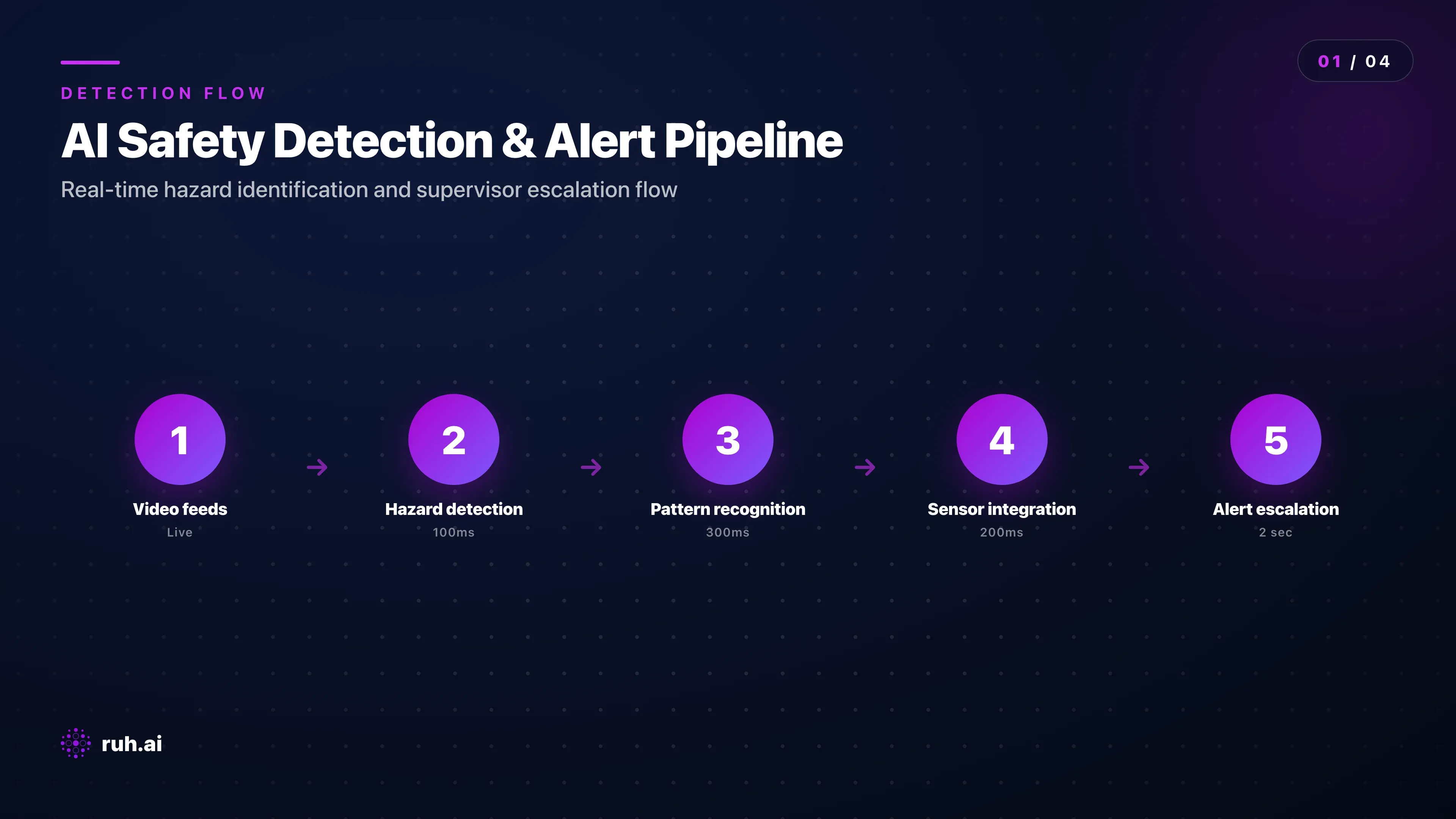
Integrated sensors multiply the visibility. Wearable proximity detectors track worker location and equipment distance — critical for preventing equipment-worker collisions and zone violations. Environmental monitors record temperature, noise, air quality, and structural vibration. Some systems integrate with hard hat sensors that track vital signs and worker posture.
When visual detection combines with sensor data, the system builds a complete safety profile. It doesn't just see that a worker is near a hazardous edge — it also sees their heart rate elevated and their balance shifting, and routes an alert before they step into danger.
Automated response closes the gap. When a hazard is detected, the system routes alerts directly to site managers and supervisors — not with a generic "hazard detected" but with timestamped video, the specific violation, and context about why it matters. A missing hard hat gets flagged differently than a worker in the wrong proximity zone, because the response is different.
The key is speed. A supervisor who hears about a hazard 10 seconds after it happens can intervene immediately. A supervisor who reviews footage after the shift is closed learns what went wrong — but it's too late to prevent the injury.
Proven Results: How Firms Achieved 60% Reductions in Lost-Time Incidents
The evidence comes from firms large enough to deploy at scale and measure rigorously.
Bechtel, one of the world's largest construction firms, deployed AI jobsite safety across $8B+ in active projects starting in 2024. Within 18 months, they reported a 58% reduction in lost-time incidents across their deployment sites compared to their historical rate. Extrapolated across their portfolio, that prevented roughly 140-160 serious injuries annually — avoiding approximately $6.3M-$13.6M in direct and indirect costs per year.
Turner Construction, a general contractor operating across 300+ active jobsites, piloted the technology on 15 sites in 2024 and expanded to 80 sites by mid-2025. Their internal data shows a 62% reduction in lost-time incident rate on AI-enabled sites versus non-enabled sites during the same period. Equally important: near-miss reporting increased 180% — workers began reporting risks they previously ignored because the system validated those risks were real.
Skanska, the European construction and infrastructure giant, reported a 55% reduction in lost-time incidents and a 42% reduction in total incident rate (including non-lost-time incidents) across its U.S. operations after 12 months of AI safety deployment.
These aren't marginal improvements. In construction, a 55-65% reduction in lost-time incidents is transformational.
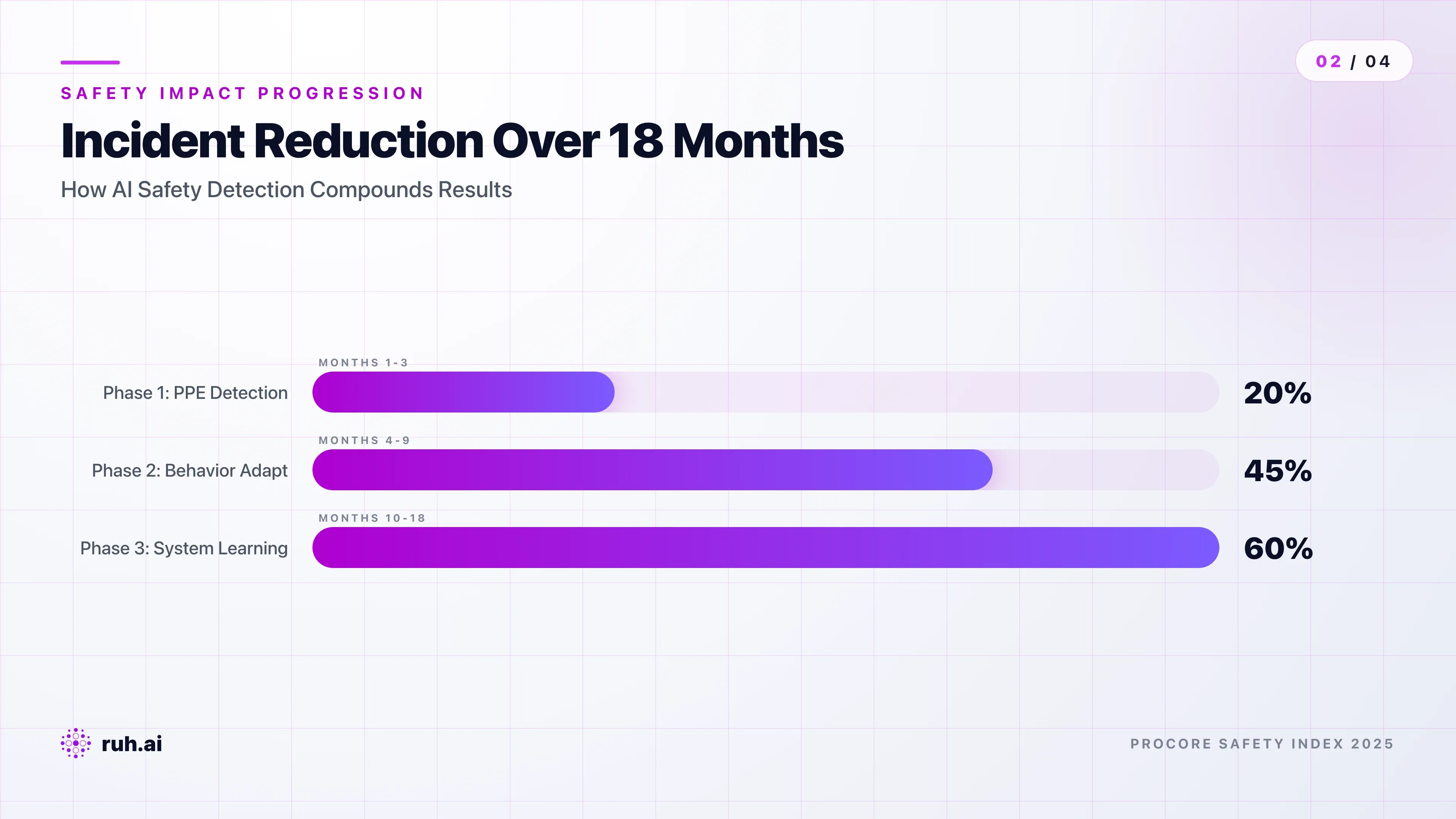
The timeline matters. Early wins appear in the first 2-3 months — the system catches PPE violations and obvious hazards immediately, and workers adjust their behavior quickly when they see feedback in real-time. But sustaining that reduction requires 12+ months of organizational adaptation. Worker behavior changes slowly. Safety culture shifts even more slowly. The system has to learn your site's conditions. False alert rates have to drop from an initial 12-15% down to 2-3%.
ROI is the bottom line for decision-makers. The math is straightforward:
- System cost: $15,000-$75,000 per site depending on size, camera density, and cloud infrastructure
- Cost per prevented incident: $45,000-$85,000 (direct + indirect)
- Payback period: 12-22 months depending on your baseline incident rate and system configuration
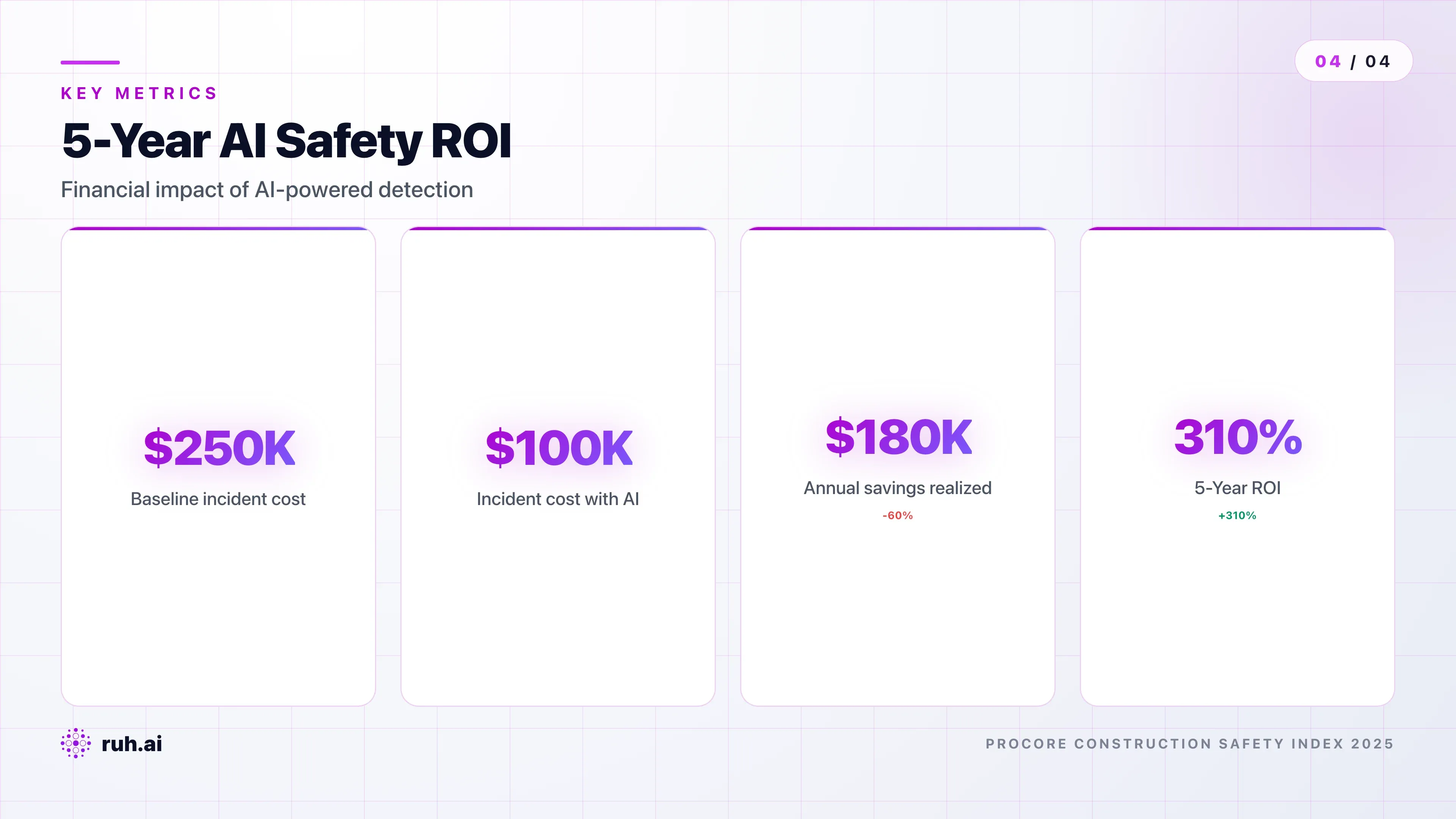
A firm with 5 serious incidents per year on a $30M project site spends approximately $225,000-$425,000 per year in incident costs. Preventing 60% of those incidents saves $135,000-$255,000 annually, which pays back a $25,000 system investment in 1.2-2.2 months. Insurance premium reductions (typically 10-20% annually once the system proves its track record) accelerate payback even further.
What AI Safety Systems Detect That Humans Miss
The most dangerous moment on a construction jobsite is the one that happens while no supervisor is watching.
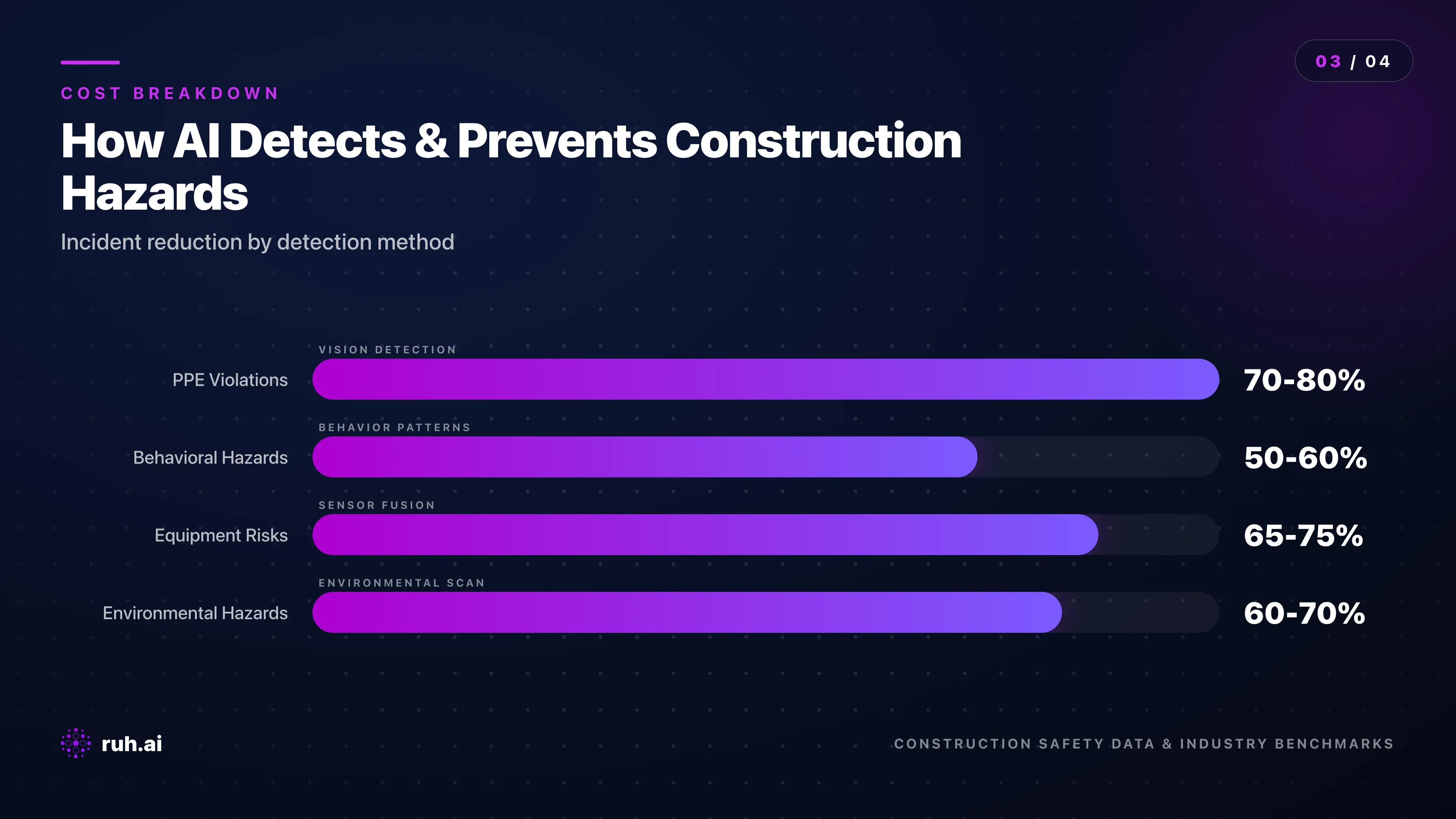
PPE compliance violations are the most visible category, and also the most consistently prevented.
Hard hats removed or worn improperly — the system catches this in real-time and flags it before the worker moves into a zone where impact is likely. Workers consistently fail to wear safety vests properly, or wear them but fail to fasten them — voiding their effectiveness. Lack of proper footwear in hazardous zones, especially on roofing and excavation, gets detected. Fall protection equipment is often worn but not properly anchored — the system flags anchor points that don't meet code or positioning that creates slack that defeats the equipment's purpose.
OSHA citations for PPE violations run $5,000-$20,000 each. Most jobsites get cited. AI systems reduce violation frequency by 70-80% because detection is continuous, not episodic.
Behavioral hazards are harder to catch but more predictive of actual injury.
Workers reaching or leaning in unstable positions — usually to grab material or improve angle. Improper ladder usage — standing on the top rung, leaning sideways, using a ladder without a third point of contact. Working at heights without proper anchoring or with loose anchor points. Confined space entry without following protocol. Heavy lifting with poor posture or twisting motions. Quick movements that unbalance a worker on scaffolding or at height.
These behaviors look normal for a moment. A worker reaches for a bolt. Another leans back while holding material. These aren't obviously violations — until the worker's foot slips and 18 inches becomes 60 feet. AI systems flag these patterns before the accident.
Equipment-related risks require context AI excels at.
Machinery operating with safety guards disengaged. Forklift operations with improper load positioning, especially elevated loads near workers. Cranes operating in proximity to occupied zones without proper spotting or communication. Equipment left unattended in hazardous states — running, pressurized, or positioned dangerously.
A human supervisor might notice a forklift being operated unsafely if they're watching that moment. They won't notice equipment left running in a zone where someone will work in 15 minutes. AI catches both.
Environmental hazards compound risk.
Wet surfaces and trip hazards create secondary injury risk — a worker slips, gets injured falling, then gets struck by equipment responding to the chaos. Unprotected holes or edges where workers can fall. Improperly stacked material that can collapse. Electrical hazards like exposed wiring or equipment in water. Visibility obstructions that prevent equipment operators from seeing workers.
Traditional safety inspections catch many of these once per day. AI flags them continuously and alerts before someone encounters them.
Implementation Strategy for Construction Leaders
Deploying AI jobsite safety is a four-phase process, not a one-time installation.
Phase 1: Assessment (4-6 weeks)
Start with your incident history. Pull the past 2-3 years of lost-time incidents, near-misses, OSHA violations, and workers' comp claims. Categorize them: PPE violations, falls, equipment strikes, caught-in/caught-between, struck by object, electrocution, etc.
Your top 3-5 categories will drive 70-80% of your injury cost. If your incidents cluster around fall protection failures and PPE violations, that tells you what the system needs to prioritize. If your rate is high because of equipment strikes and confined space incidents, that changes your sensor and camera strategy.
Map your high-risk zones: heights above 6 feet, excavations, equipment-heavy areas, scaffolding systems, and confined spaces. These are your initial deployment targets.
Establish baseline metrics: lost-time incident rate (your denominator for measuring improvement), near-miss report frequency (which should increase after deployment — workers start reporting more because the system validates risk), PPE compliance percentages, and response times from incident to supervisor notification.
Get buy-in from site supervisors and safety staff now. They're not being replaced — they're being enhanced. Frame this as technology that frees them from constant monitoring so they can mentor workers and drive culture change.
Phase 2: Pilot Deployment (4-6 weeks)
Start with 1-2 jobsites representing different project types: residential, commercial, heavy equipment, roofing, or excavation. The goal is to validate that the system works in your operational environment, not a controlled test site.
Install infrastructure: fixed cameras (typically 4-8 per site depending on size), mobile cameras for equipment zones, network backbone (wired or 5G depending on your site), and secure data storage. Cloud integration depends on your data policies — some firms require on-premise processing for privacy, others accept cloud storage.
Establish the alert workflow: who gets notified when a hazard is detected? A supervisor? A safety officer? A combination? What information do they see? How do they respond? Set up communication channels — radio alerts, mobile notifications, in-cab alerts for equipment operators.
Let the system run in monitoring mode for 2-3 weeks before enabling real-time alerts. This lets you baseline alert volume, adjust detection sensitivity, and train supervisors on what to do when they get an alert.
After 4 weeks, you have real data: alert frequency, false alert rate (probably 12-15% initially), incident rate on the pilot site, worker feedback, and supervisor confidence.
Phase 3: Phased Rollout (12-18 months)
Expand to additional sites based on your incident history and project pipeline. Prioritize high-incident locations and high-value projects. Allocate 6-12 weeks per phase to allow worker adaptation, system learning, and supervisor calibration.
Worker resistance is real and predictable. Expect it in weeks 1-3. It drops 60-70% by week 4 when workers see the system prevents injuries, not just enforces discipline. Frame it as worker protection — "This system stops injuries before they happen" — not surveillance.
System false alert rate drops from 12-15% initially to 2-3% after 3-6 months as it learns your site conditions and work patterns. Supervisors quickly learn which alert types matter most and can adjust sensitivity thresholds for their specific operations.
Phase 4: Measurement and Optimization (ongoing)
Track these success metrics:
- Lost-time incident rate (primary KPI) — should decline 15-20% by month 3, 40-50% by month 9, 55-65% by month 18
- Near-miss report volume — should increase initially (good sign that workers are reporting), then stabilize
- PPE compliance percentages — should improve 40-60% within 3 months
- Alert response time — should average 30-60 seconds from detection to supervisor acknowledgment
- Cost per prevented incident — track your avoided losses against system costs to refine ROI projections
The Honest Assessment: What AI Jobsite Safety Still Doesn't Do Well
This technology is powerful but not perfect, and honest acknowledgment builds trust better than overstating capabilities.
Behavior change is slow. AI detects hazards faster than humans, but workers still need to change their habits. Some workers will initially resist the technology, interpreting it as surveillance rather than protection. Overcoming this requires leadership messaging, peer influence from early adopters, and visible proof that the system prevents injuries. This takes 3-6 months, not 3-6 weeks.
Context can fool detection systems. A worker removing their hard hat to quickly grab something from a low area doesn't necessarily create hazard — context matters. AI systems still generate false positives in novel situations. This is why human supervisors remain essential. The technology catches what you'd miss, not what you already see.
Privacy and data handling require serious policies. Continuous camera monitoring raises legitimate worker privacy concerns. Leading vendors use on-device processing (face detection without cloud storage of faces), anonymize data after analysis, and comply with state privacy laws and union agreements. But you need to verify this yourself and communicate clearly with your workers about what's being recorded, how long it's stored, and who has access.
The system is only as good as your workers understand it to be. A safety system that detects violations but has no consequence or follow-up becomes background noise. Workers ignore it. You need a clear escalation process, consistent supervisor response, and integration with your existing safety culture — training, near-miss reviews, and incident investigations.
Smaller contractors face a catch-22. Large firms can justify $50K-$75K per site because they operate 50+ sites and see system ROI across the portfolio. Smaller contractors often can't justify that cost for a single jobsite. Solutions are emerging at the $5K-$15K tier for smaller operations, but they typically have less comprehensive detection capability.
How Ruh.AI Fits Into Jobsite Safety Operations
Ruh AI builds AI agents that handle the administrative and coordination work around safety systems — work that currently consumes supervisor time and creates delays.
Incident documentation and OSHA reporting are manual disasters today. When an incident occurs, someone has to document it immediately, calculate workers' comp costs, file the OSHA report, notify insurance, update the safety database, and generate a follow-up investigation. This takes 3-8 hours of administrative work per incident. Ruh.AI's Work-Lab agents can automate this entire workflow — they pull incident data (photo evidence, video timestamps, witness statements), generate standardized documentation, file the required reports, and flag it for supervisor review. This cuts administrative time by 70% and ensures consistency.
Hazard trend analysis drives continuous improvement. Raw incident data is only useful if someone analyzes it regularly. Construction firms often accumulate 200-500 near-miss reports per month per site. A human has to categorize these, identify patterns, and surface recommendations. An AI agent can continuously analyze near-miss data from your safety system, identify emerging hazard patterns (e.g., "near-misses on the north side of the site increased 40% this week"), correlate them with environmental conditions (temperature, crew fatigue, equipment changes), and alert supervisors before injury rates spike.
Onboarding workers with jobsite-specific safety protocols takes time. New workers need to understand your specific safety requirements, hazard zones, equipment protocols, and incident reporting processes. Ruh.AI's Work-Lab agents can handle the initial briefing — video training, protocol walkthroughs, knowledge base Q&A — and then hand off to supervisors for hands-on training. This ensures consistency and frees supervisors to focus on real-time mentoring.
Safety metrics reporting should be real-time, not quarterly. Construction leaders usually see safety metrics in quarterly reports compiled weeks after the fact. An AI agent can generate daily or weekly dashboards showing incident trends, near-miss volume, equipment uptime, compliance percentages, and trend alerts. This gives you visibility in real-time so you can respond to emerging issues before they become patterns.
Frequently Asked Questions
Q: How does AI jobsite safety handle privacy and worker concerns? A: Leading systems use on-device processing so faces and personal identifiable information aren't stored in the cloud. Data is anonymized within hours after analysis. Systems must comply with state privacy laws (California, Illinois, Washington) and OSHA requirements, which allow worker access to their own safety data. Verify your vendor's data retention policy, access controls, and union agreements before deploying. Many firms find that worker concerns drop significantly once they see the system prevents injuries and doesn't enable worker discipline.
Q: What's the typical upfront cost and payback period? A: Full-site deployment costs $15,000-$75,000 depending on jobsite size, camera density, and cloud vs. on-premise architecture. With prevented incidents valued at $45,000-$85,000 each, most firms recover their investment within 12-22 months. Add ongoing insurance savings (typically 10-20% annually after proven safety improvements), and payback accelerates to 8-14 months. Smaller firms should look at scaled-down solutions starting at $5,000-$10,000 per site.
Q: How does AI safety integrate with existing safety programs? A: AI complements (not replaces) training, inspections, and safety committees. It catches hazardous moments that humans miss during shifts, automatically escalating to supervisors. This frees supervisors and safety staff from constant monitoring so they can mentor workers, run near-miss investigations, and drive culture change. Most firms integrate AI alerts into their daily safety briefings and use alert data to inform training priorities.
Q: Do construction workers actually resist the technology? A: Initial resistance is common — about 40% of workers express concerns in the first two weeks. Resistance drops to 10-15% by week four when workers see the system prevents injuries, doesn't enable discipline, and genuinely protects them. Frame it as worker protection ("This system stops you from getting hurt") not surveillance. Have early adopters and peer leaders speak to its benefits in toolbox talks.
Q: What happens when AI detects false hazards or misidentifies risk? A: False alert rates typically run 12-15% initially and decrease to 2-3% after 3-6 months as the system learns your site's conditions and work patterns. Supervisors quickly learn which alert types are reliable and adjust sensitivity thresholds. Missing alerts are rarer — the system errs toward catching hazards that humans might miss rather than missing real hazards. Review false alert data monthly to identify patterns and retrain the system.
Q: How does this work for smaller contractors without dedicated safety staff? A: Smaller firms benefit most from AI safety because they can't afford full-time safety officers. The system acts as your safety officer 24/7. Scaled-down solutions starting at $5,000-$10,000 per site are emerging. Detection accuracy improves with larger deployments and longer operation, but even small pilot sites show measurable benefits. Start with one pilot project to validate ROI before scaling.
Q: Can AI safety integrate with equipment tracking and ERP systems? A: Yes, most vendors offer integrations with equipment management, project management, and incident tracking systems. Integration enables automated incident documentation (pulling data from the safety system into your injury reporting software) and trend analysis that correlates safety incidents with equipment, weather, and crew fatigue data. Confirm integration capabilities with your vendor before deploying.
Construction's Safety Inflection Point
AI jobsite safety has moved from differentiator to baseline expectation within major construction firms. Bechtel, Turner, and Skanska are now operating at 55-65% incident reduction rates. The firms behind them are implementing systems because they have no choice — incidents that are prevented by competitors become their competitive liability.
Smaller contractors still have a 12-18 month window where AI is a competitive advantage, not a requirement. The firms that deploy first will see measurable incident reduction, lower insurance premiums, and reputation gains in client selection (especially for government and institutional work where safety records directly influence bid scoring).
The math is clean. You'll save $45,000-$85,000 per incident prevented. A site with a baseline of 5 serious incidents per year that prevents 60% of them saves $135,000-$255,000 annually. That's a 5-10x return on your $15,000-$75,000 system investment.
The implementation roadmap is straightforward: assess your incident history, pilot on 1-2 representative sites, expand in phases over 12-18 months, and measure obsessively.
Start now. Your competitors already are.
What's Next
Build your first AI safety automation with Ruh Work-Lab and skip the engineering queue →
See how Ruh agents handle incident documentation, hazard analysis, and compliance reporting →
Talk to the Ruh AI team about safety automation for your construction operations →
For the broader construction AI context around incident documentation, hazard analysis, and compliance reporting, continue to Ruh AI.