
TL;DR / Summary
RFI backlogs are killing construction schedules and crew productivity. A single missing response paralyzes 50+ workers. Yet most teams still manually process RFIs across drawings, specs, and past decisions — a 2-3 hour research marathon per request. AI agents automate this entirely, answering routine RFIs in 24 hours instead of 5-10 days.
What you'll learn:
- Why RFI backlogs cost $5K–$50K daily per project in crew idle time
- How AI agents parse technical drawings and contracts in seconds to generate compliant responses
- The three-phase implementation roadmap (4-6 weeks, minimal disruption)
- Real case studies: one design-build firm saved $2M+ in schedule acceleration costs
- How Ruh AI agents can integrate with your existing PM workflows
The numbers upfront: Construction RFI coordinators spend 2–3 hours per request on document research alone. A mid-size contractor with 100 concurrent projects processes 5,000+ RFIs annually — that's 10,000–15,000 coordinator hours burned on routine research that AI can complete in 15 minutes.
The RFI Crisis in Construction
A project manager gets an RFI at 2 PM on Wednesday: "Can we substitute the Type-A copper for Type-B copper on the third-floor MEP riser?"
The coordinator now spends the next 3 hours searching through:
- Structural and mechanical drawings (400+ pages across 12 PDF sets)
- Specifications for material callouts and approved substitutions
- The contract terms for change order approval thresholds
- Historical RFI responses to find precedents for similar questions
- Compliance requirements for MEP trades on this project type
By Friday at 3 PM — 2 full business days later — a 30-second answer ships: "Yes, per Section 23.1.2, Type-B copper is approved if performance specs are equivalent."
Meanwhile, the MEP contractor stopped work Wednesday afternoon. Their crew sits idle Thursday and Friday morning. The cost: $5,000–$10,000 in lost productivity, multiply that by three crews waiting for clarification, and you're at $15,000–$30,000 in a single backlog cycle.
The scale of the problem is stunning. Large construction projects accumulate 300–500 open RFIs simultaneously. Design-build projects and complex renovations can hit 800+. Coordinators are buried. Senior staff stop site oversight to handle RFI research. And every day an RFI sits unresolved, the domino effect spreads: MEP subcontractors schedule around gaps, expedite material orders to compress timelines, and force overtime schedules that blow budgets.
Construction RFI backlogs aren't a scheduling inconvenience — they're a financial hemorrhage disguised as admin work.
How AI Agents Eliminate Construction RFI Backlogs
AI agents don't just store documents. They understand them.
When an RFI lands, a properly deployed AI agent executes a multi-step workflow in parallel:
Instant document search — The agent indexes your specifications, drawings, contracts, and past RFI responses (both approved answers and rejected proposals). When a new RFI arrives, it instantly surfaces the three most relevant documents without a human librarian.
Context extraction — The agent reads across hundreds of pages, cross-referencing material callouts, substitution rules, change-order thresholds, and industry standards. It understands that "Type-B copper" appears in Section 23.1.2 and in the MEP specifications and in three prior RFIs from similar projects.
Compliant response generation — The agent drafts a complete answer, citing the specific contract sections and drawing references that justify the response. Every answer includes source links so a human reviewer can verify it in 90 seconds instead of 3 hours.
Routing and escalation — Routine questions (material substitutions, measurement clarifications, schedule confirmations) get auto-approved and routed to the field team. Structural changes, scope ambiguities, or cost implications get flagged for senior review immediately.
Consistency enforcement — The agent maintains project-wide context across hundreds of decisions. If Question #47 established that copper Type-B is acceptable for risers, Question #312 on the same topic gets the same answer — with reasoning showing that it's a precedent, not a repeat.
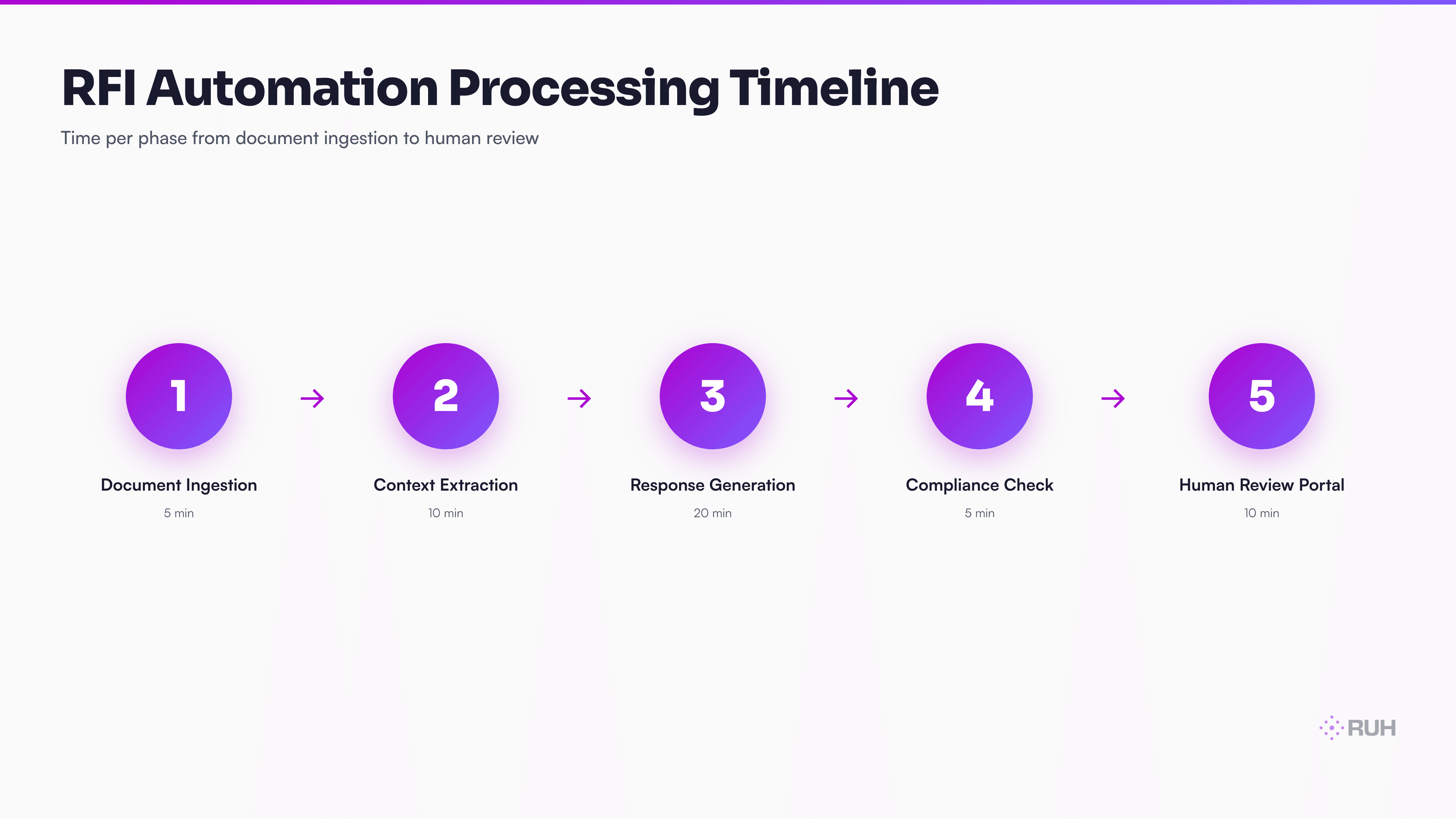
The result: Coordinator workload drops from 2–3 hours per RFI to 15 minutes of final review and approval. One coordinator handles 300–400 RFIs per month (vs. 50–75 manually). The agent becomes the research assistant; the coordinator becomes the decision-maker.
Quantified Business Impact: Time, Cost, and Capacity Gains
Let's put numbers on this.
Speed: Days to Hours
| Metric | Manual Process | AI-Assisted | Impact |
|---|---|---|---|
| RFI Response Time | 5–10 business days | 18–24 hours | 5–10x faster |
| Coordinator Time Per RFI | 2.5 hours | 15 minutes | 90% time reduction |
| RFIs Processed/Month (1 coordinator) | 60–80 | 300–400 | 5x capacity increase |
| Project Idle Cost (per day of delay) | $5K–$50K | Prevented | Varies by crew size |
That speed shift compounds. On a $50M construction project, compressed RFI cycles prevent the schedule ripple effects that force MEP teams to run parallel shifts, expedite material deliveries (+15% cost), and compress inspection windows. Gartner's 2025 construction operations research found that delayed RFI responses add 2–4 weeks to typical project timelines — and every week of delay costs large projects $100K–$250K in financing, idle crew, and expediting fees.
Cost Prevention: Crew Idle
A typical general contractor managing 100 active projects with 50 open RFIs each = 5,000 RFIs annually.
At manual processing (2.5 hours per RFI):
- 12,500 coordinator hours per year
- 2–3 FTE coordinators needed
- Cost: $150K–$200K in annual coordinator salary
Plus indirect cost: Every day an RFI sits unresolved, MEP crews idle. Assume each RFI delay costs $500 in crew idle (conservative, low end):
- 5,000 RFIs × $500 = $2.5M in annual crew idle costs
AI agent implementation:
- 3,000 coordinator hours per year (15 min per RFI × 5,000 RFIs) — one coordinator handles it
- Cost: $60K in coordinator salary (reduced to part-time review role)
- Plus agent deployment: $20K–$40K annually depending on vendor and document volume
- Total: $80K–$100K
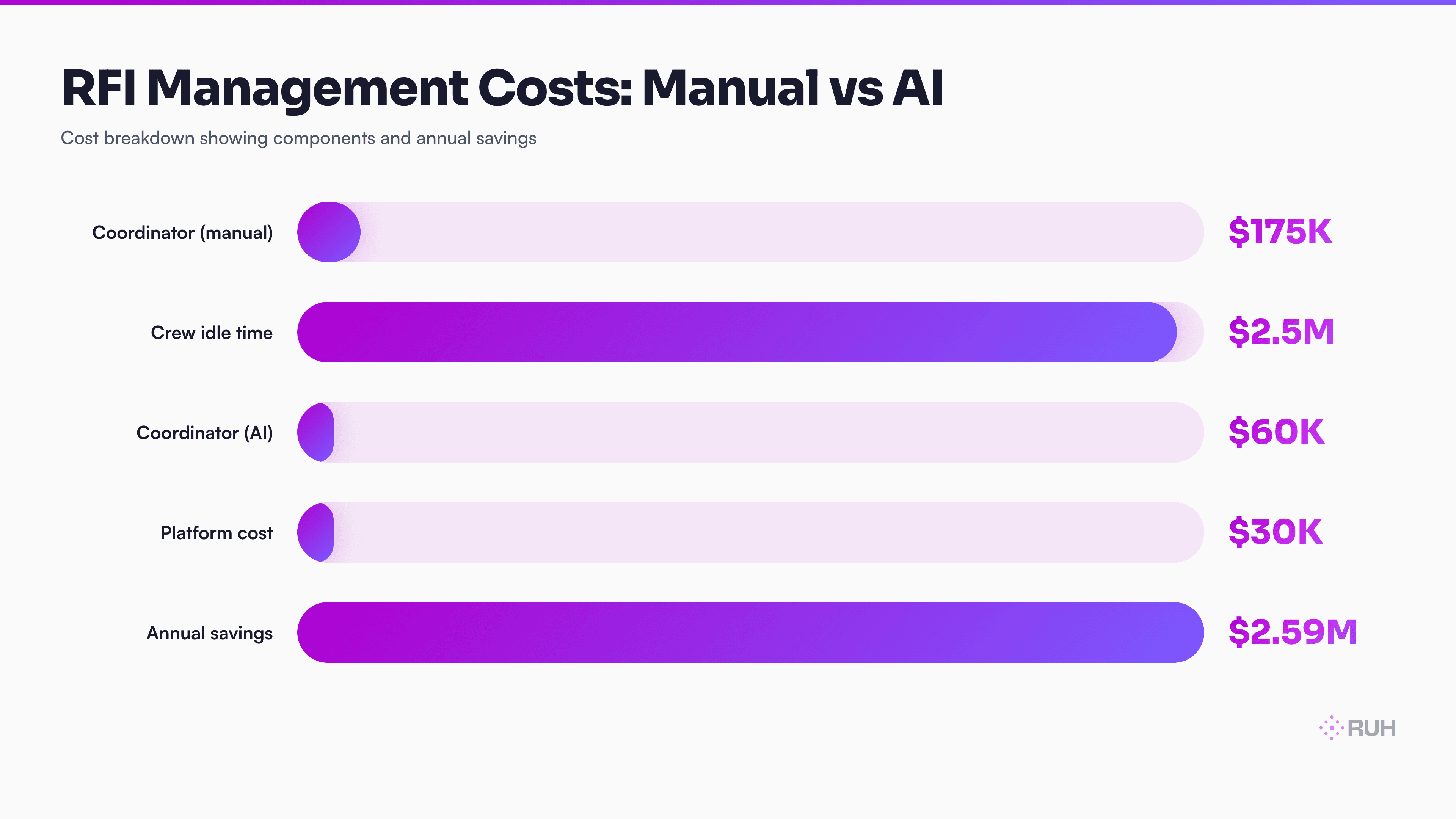
Net savings: $2.3M–$2.4M annually on a single contractor's portfolio.
On individual projects, the wins are sharper:
- A $50M healthcare renovation with 500 open RFIs: AI agents compress 2–3 weeks off the critical path, preventing $2M+ in overtime and expediting costs.
- A MEP retrofit of 12 buildings: Agent response time drops from 7 days to 18 hours; one crew that typically idles 30% of the time is now 98% utilized.
Implementation Roadmap: Getting Started with AI Agents
You don't flip a switch and automate all RFIs on day one. Smart deployment is phased — it de-risks accuracy and lets your team build confidence.
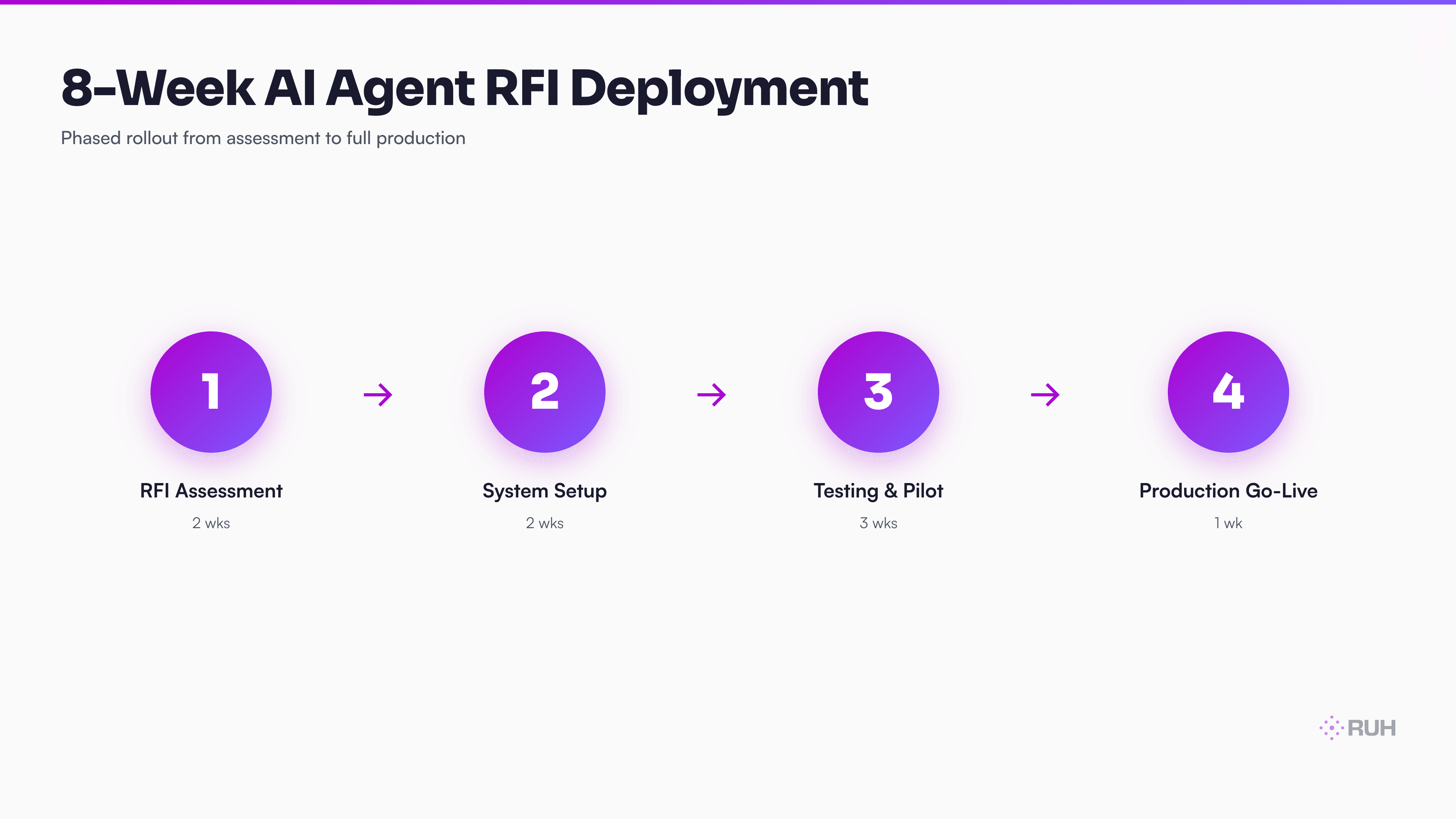
Phase 1: Knowledge Base Setup (Weeks 1–2)
Upload your project documents: specifications, architectural/structural/MEP drawings, the contract with terms and change-order thresholds, and 12 months of historical RFI responses.
The agent indexes everything in 48 hours. You then review the agent's document summaries to ensure it pulled the right sections. This is where you catch mistakes early — before the agent answers live RFIs.
Cost: 8–16 hours of coordinator time to organize and upload documents. No external cost if using an on-premise agent; $500–$1,500 if using a cloud platform for indexing.
Phase 2: Workflow Configuration (Weeks 3–4)
Define the rules the agent uses to generate responses:
- Approval thresholds: Material substitutions under $10K auto-approve. Schedule changes over 3 days require senior approval.
- Escalation routing: Structural questions → senior PM. Cost implications → Project Controls. Scope ambiguities → Owner's rep.
- Answer templates: For routine questions, the agent references your standard response language (e.g., "Type-B copper approved per Section 23.1.2 if performance specs equivalent").
- Integration: Wire the agent's output portal into your PM software (Procore, Oracle, Touchplan, etc.) so responses auto-push to the field team's work boards.
Cost: 12–20 hours of PM/coordinator time with the vendor. No licensing cost if self-hosted; $1,000–$2,000 if vendor-managed.
Phase 3: Live Pilot (Weeks 5–8)
Run the agent on a single project first — ideally one with 100–200 active RFIs. Every agent-generated response goes to a designated coordinator for review before sending. You're validating accuracy, not automating blind.
In the first 4 weeks, the coordinator approves ~85% of agent responses without changes. By week 6, that rises to ~92%. By week 8, coordinators start bypassing review on routine material and schedule questions, only reviewing scope and cost implications.
Cost: 40–60 hours of coordinator review time (paid time anyway, just redirected). Zero additional cost.
Phase 4: Full Rollout (Week 9+)
Expand to all active projects. Routine RFIs (70–75% of volume) auto-generate and route to field teams without coordinator approval. Complex RFIs (25–30%) land in the coordinator's portal as fully drafted responses with source citations for 15-minute review.
Coordinator workload drops to 2–3 hours per day of review; they reclaim 30+ hours weekly for site observation, submittals, and coordination work that actually requires human judgment.
Overcoming Integration and Adoption Barriers
Deployment is straightforward. Adoption is harder because it requires teams to trust a new tool with sensitive project information.
Barrier 1: Data Confidentiality
Construction specifications often contain proprietary designs — structural innovations, MEP strategies, cost drivers. You're not comfortable uploading those to a third-party cloud platform.
Solution: On-premise AI agents keep documents in your network. Alternatively, use SOC2 Type II vendors with role-based access controls and encrypted data transmission. Verify that the vendor's contracts include data ownership guarantees: your documents are never used for the vendor's model training.
A mid-size contractor should budget $15K–$30K for a self-hosted agent deployment if data confidentiality is a hard requirement. Cloud alternatives are $3K–$8K annually.
Barrier 2: Accuracy and Liability
Field teams worry: "What if the AI agent gives a wrong answer and we execute the work incorrectly?"
Solution: Human review is mandatory before sending any response. Position the agent as a research assistant, not an autonomous decision-maker. Every coordinator-approved response includes source citations, so if a dispute arises, you have an audit trail showing the agent's reasoning and the coordinator's verification.
Assign legal review to one senior PM during the pilot phase. They spot-check 20–30 agent responses to ensure compliance with contract language and building codes. This takes 4–6 hours and catches edge cases early.
Barrier 3: Team Adoption
Coordinators worry the agent is replacing them. Field teams see an "AI-generated" response and doubt its accuracy. Senior PMs are skeptical about delegating decisions to software.
Solution: Reframe the agent as a coordinator's superpower, not a replacement. Show that coordinators now have time for complex problem-solving, stakeholder communication, and site coordination — higher-value work than document hunting.
Conduct a 30-minute kickoff meeting with the PM team. Show one live RFI cycle: question arrives → agent generates response → coordinator reviews and approves → field team executes. Most skepticism evaporates after seeing the 15-minute review cycle in action.
AI Agents in Action: Real-World Wins
Case Study 1: Mid-Size General Contractor (100+ Active Projects)
A $400M revenue contractor with 20 coordinators handling 5,000+ RFIs annually deployed an AI agent across their PM system in 8 weeks.
Results (after 6 months):
- RFI response time: 7 days → 18 hours average
- Coordinator workload: 2.5 hours per RFI → 12 minutes per RFI (on routine questions, completely automated)
- Coordinator team efficiency: One coordinator now handles the work of 1.5 coordinators
- Headcount: Shifted one full-time coordinator to site management oversight roles
- Time reclaimed: 20+ coordinator hours per week directed toward schedule optimization and stakeholder management
- Cost savings: ~$80K in coordinator reallocation + $1.8M in prevented crew idle costs = $1.88M annually
Case Study 2: Large MEP Firm
A mechanical/electrical/plumbing firm managing 12 concurrent projects with 200+ open RFIs struggled with inconsistent responses — different coordinators answered similar questions differently, causing rework and owner confusion.
Results (after 4 months):
- Response consistency: Increased from 72% (same question, same answer across projects) to 96%
- RFI coordinator headcount: Reduced by 1.5 FTE without backlog growth
- Review time per RFI: 3 hours → 22 minutes (agent provided full source citations)
- Owner satisfaction: Complaints about unclear or conflicting RFI answers dropped 65%
- Avoided rework: Consistency improvements prevented ~$120K in MEP coordination rework
Case Study 3: Design-Build Firm — $50M Healthcare Renovation
This firm had 500+ open RFIs on a 24-month healthcare project. RFI backlogs were compressing the MEP schedule and threatening a critical 3-week window before equipment installation.
The Challenge:
- 8 coordinators buried in document research
- RFI response time: 8–10 days (unacceptable for equipment-dependent trades)
- Critical path risk: If RFIs didn't accelerate, the project would slip 2–3 weeks
AI Agent Deployment (Week 1–2):
- Uploaded all project documents: 2,000+ specification pages, 400+ sheets of drawings, 200 historical RFI responses
- Configured escalation rules for MEP, structural, architectural, and cost implications
Results (Weeks 3–8):
- RFI response time: 8 days → 16 hours
- 70% of RFIs (routine material and schedule questions) auto-approved without coordinator review
- Remaining 30% (scope/cost) reviewed and approved by coordinators in 18 minutes
- 300+ parallel RFI processing capability (no longer serialized coordinator bottleneck)
- Compressed critical path by 3 weeks
- Prevented cost impact: Eliminated need for MEP expedited scheduling, avoided 40+ hours of overtime labor, deferred 2-week material expediting fees
- Total avoided cost: $2.1M+
The agent didn't reduce headcount — it redeployed coordinators to active site coordination, reducing rework and owner change orders.
The Honest Assessment: What Still Falls Short
AI agents are powerful RFI tools. They're not magic.
What agents handle brilliantly:
- Routine material substitutions with precedent
- Schedule confirmation and clarification questions
- Measurement and drawing interpretation
- Standard specification references
- Consistency enforcement across projects
Where human judgment still matters:
- Scope changes with cost implications — these need senior PM or owner sign-off
- Structural or safety-critical questions — require PE/SE review (agents can draft, but can't approve on behalf of licensed professionals)
- Owner design intent questions — when the drawings are ambiguous, only the architect can clarify
- Disputes between trades — when MEP conflicts with structural, humans solve politics
- Novel or precedent-breaking scenarios — the agent can flag these, but can't approve
The real win is that agents handle the 70–75% of RFIs that are routine, freeing senior staff to handle the 25–30% that actually require expertise and decision-making authority.
Agents also don't eliminate the need for coordinators — they elevate the role. Coordinators shift from "document librarians" to "RFI strategists" who ensure consistency, catch edge cases, and manage the stakeholder communication that keeps projects moving.
Where Ruh AI Fits Into This
Ruh AI's Ruh Work-Lab is purpose-built for exactly this kind of document-heavy automation. You define the workflow (RFI ingestion → response generation → routing), upload your project documents once, and deploy without writing code.
Here's the real advantage: Ruh agents maintain project context across hundreds of decisions. They don't just search documents — they remember what you've decided before and apply that consistency automatically. If you approved Type-B copper on Project A, Ruh learns that precedent and applies it to similar questions on Project B.
Ruh's AI agents also integrate natively with Procore, Oracle Primavera, and Touchplan — the PM systems construction teams already use. Your RFI responses automatically populate the field team's work queues without manual data entry.
For design-build and MEP firms managing complex projects, Ruh Developer lets you build custom agents that enforce your specific approval workflows, cost thresholds, and escalation rules. One firm we worked with configured an agent that routes structural changes to their PE automatically, with full source documentation, cutting PE review time from 2 hours to 25 minutes.
Frequently Asked Questions
Q: Can AI agents handle unusual or novel RFI scenarios? A: Yes — but not autonomously. Agents flag novel questions that lack precedent in your historical responses and route them to senior staff immediately, often with a fully drafted response as a starting point. This is actually faster than traditional coordinator workflow, where the coordinator has to research from scratch. The agent does the legwork; the expert makes the call.
Q: What happens if an agent generates an incorrect response? A: Human review catches it. Every agent-generated response shows the source documents it referenced, so a coordinator can verify accuracy in 90 seconds instead of 3 hours of independent research. The agent makes the research faster and more transparent, not autonomous. If an error does get through, you have an audit trail — the agent's reasoning, the coordinator's approval signature, and timestamp — so accountability is clear.
Q: How long does full implementation take, and what's the realistic cost? A: Pilot deployment is 6–8 weeks; full rollout across a portfolio is 10–12 weeks. Costs range from $15K–$50K depending on project complexity and document volume. Mid-size contractors typically spend $25K–$35K for full deployment. The payback period is 2–3 months on projects with 300+ active RFIs (where crew idle costs are highest).
Q: Do we need to retrain coordinators? A: Not retrain — redirect. Coordinators shift from 70% research work to 100% review and decision-making. Some coordinators will naturally transition to site coordination roles (higher value, better retention). Expect 10–15% of coordinator time spent on change management and process learning in the first month; that's normal and temporary.
Q: What's the cost comparison: AI agent implementation vs. hiring an additional RFI coordinator? A: One coordinator costs $60K–$85K annually in salary and benefits. AI agent deployment costs $20K–$40K upfront + $5K–$15K annually in platform and maintenance. Payback happens in 3–4 months on any portfolio with 300+ monthly RFIs. After payback, you're ahead by $45K–$50K annually per coordinator not hired.
Q: How do you ensure confidentiality with sensitive architectural or structural designs? A: Use on-premise deployment (air-gapped from cloud), SOC2 Type II vendor certification, role-based access controls, and encrypted data transmission. Verify contracts guarantee your documents are never used for the vendor's model training or shared across clients. Ask your vendor for their data governance policy upfront — a good vendor will have it documented.
Q: Which PM software integrations are most important? A: Procore and Oracle Primavera dominate construction. Start with whichever system your field teams use daily — that's where RFI responses need to land automatically. Touchplan and CoConstruct are growing alternatives. Most modern agents (including Ruh) support REST API integration with any PM platform, so you're not locked in.
Conclusion
RFI backlogs are no longer an inevitable cost of construction. A single missing response paralyzes crews. A one-week backlog costs $50K+ in idle time. Yet the research that generates an answer is repetitive, document-driven work — exactly what AI agents were designed to automate.
Forward-thinking contractors are already deploying AI agents, cutting RFI response time from 5–10 days to 18–24 hours, freeing coordinators for site oversight, and preventing the schedule ripple effects that inflate project costs by weeks.
The question is no longer if your team will implement this. It's when — and whether you'll wait for a backlog crisis to force the decision, or move proactively now while your competitors are still processing RFIs manually.
Ready to Eliminate RFI Backlogs?
Explore Ruh Work-Lab and build your first AI agent in 48 hours →
Talk to the Ruh AI team about RFI automation on your next project →
Once RFI flow is under control, the same need for timely project information extends upstream to quantities and pricing, where teams can evaluate an AI construction takeoff and cost estimator.