
TL;DR / Summary
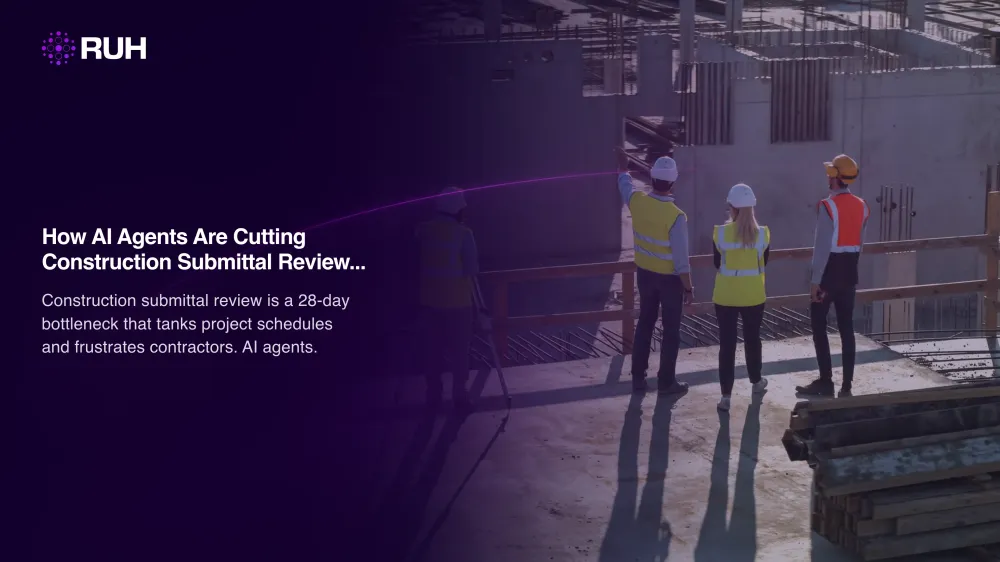
Construction submittal review is a 28-day bottleneck that tanks project schedules and frustrates contractors. AI agents compress this to 48 hours by automating document parsing, compliance checks, and parallel reviews — while maintaining human oversight on high-risk items. Teams see 400+ hours saved per project and $65K-$120K cost reductions.
What you'll learn:
- Why submittal review is the hidden cost killer in construction projects
- How AI agents process documents in 30 seconds vs. 4 hours of manual review
- The 48-hour cycle: what changed operationally and why it matters
- Real ROI metrics construction executives care about
- A 4-phase implementation strategy that doesn't disrupt current workflows
The Construction Submittal Challenge
Most people outside construction have no idea what a submittal is. Inside the industry, it's the single biggest scheduling headache.
A submittal is the contractor's submission of materials, methods, equipment, and timelines for approval before they start work. It sounds simple. It's not. A single large construction project can have 300-500 submittals — structural steel, roofing systems, HVAC equipment, electrical configurations, safety protocols, payment applications, schedule updates. Each one requires approval from multiple teams: engineering, safety, compliance, procurement, sometimes even the owner's project manager.
In the traditional process, these approvals happen serially. Contractor submits. Engineering reviews (3-5 days). Hands off to Safety. Safety reviews (2-3 days). Then Compliance. Then back to the contractor if there's a deviation — which there usually is. The contractor revises and resubmits. The clock resets.
Average submittal cycle: 28 days. Per submittal. For 300 submittals on a large project. A large share of that stack is shop drawings, each set waiting on the same serial loop.
That's not 28 days total. That's 28 days per cycle, and most submittals go through 3-4 revision cycles before approval. Do the math: 4 weeks × 3 revisions = 12 weeks of delay hiding inside a single submittal stack.
The real cost isn't the calendar days. It's the cascade. A submittal approval 2 weeks late means material procurement starts 2 weeks late. Fabrication starts late. Delivery arrives late. The crew sits idle on site. Or they mobilize to a different area, then have to remobilize when materials land. Subcontractors get pushed backward in the schedule. General contractors absorb delay costs that were never in the budget.
According to construction industry benchmarks, submittal delays consume 8-12% of total project schedule slack — time that's supposed to be a buffer for unexpected issues. Instead, it's eaten by a manual process that hasn't changed since the 1980s.
The secondary damage: inconsistency. One engineer approves a submittal deviation that another rejects. Contractors resubmit the same document 4 times because different reviewers have different standards. This erodes contractor relationships and turns a project team into an adversarial process.
How AI Agents Automate Submittal Review
Here's what AI can do that human reviewers doing 50 submittals a week cannot: process every page in under 30 seconds and flag every deviation against a perfect, consistent standard.
AI submittal automation starts with document parsing. The contractor uploads a PDF. An AI agent with optical character recognition (OCR) and structured data extraction reads every page, identifies key specifications, quantities, timelines, material codes, and deviations from the project specification. A human doing this manually spends 2-4 hours per 50-page submittal — reading, cross-referencing, data entry, double-checking.
An AI agent does it in 30 seconds.
But speed is the least valuable part.
The agent then runs the extracted data against the project's building code standards, safety requirements, BIM model constraints, and project-specific specifications. A machine learning model trained on 500K+ building code clauses and 50,000+ completed projects flags deviations automatically. Missing material certifications? Flagged. Timeline that conflicts with the project schedule? Flagged. Equipment specifications that don't match the design? Flagged. Design conflicts with another trade's already-approved submittal? Flagged.
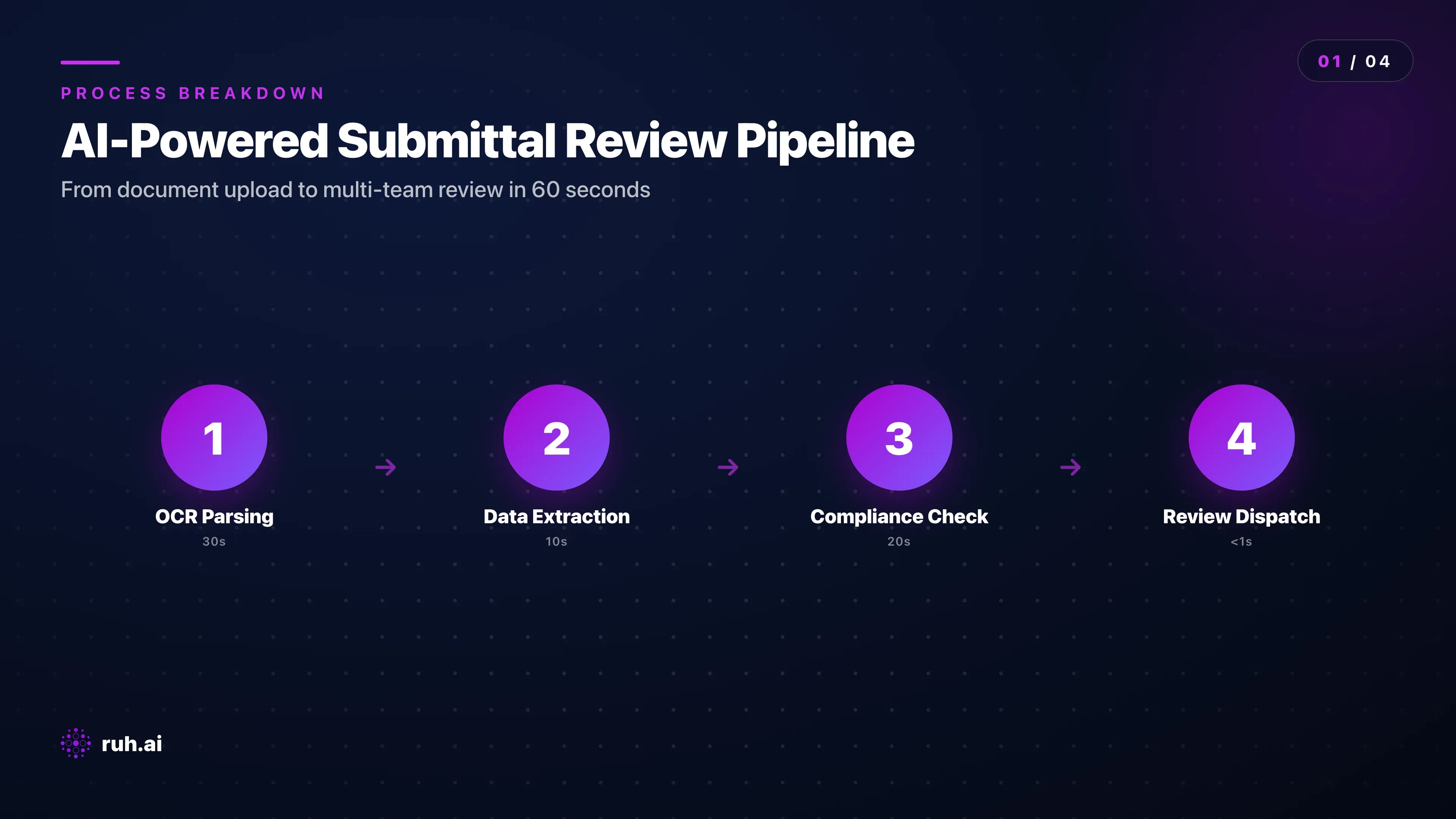
The game-changer is parallelization. In the traditional process, one team finishes, then hands to the next. With AI, the agent simultaneously routes the submittal data to engineering, safety, and compliance teams with pre-flagged issues highlighted. Those three teams review the same document in parallel, not sequentially. If one team approves immediately and another needs to ask a clarifying question, the agent sends that question to the contractor in under 4 hours — not 5 business days later after all three teams have individually queued it.
And here's the trust mechanism: every AI decision comes with a confidence score. High-risk deviations get routed to human experts immediately. Routine, low-risk submittals — the 60% of volume that's genuinely repetitive — get auto-approved with full documentation, freeing expert reviewers to focus on judgment calls instead of checkbox work.
This is augmentation, not replacement. The human is still in the loop on every decision that matters.
The 48-Hour Submittal Cycle: What Changed
Let's walk the timeline. A contractor submits a 50-page structural steel submittal on a Monday morning.
Monday morning, 9:00 AM: Submittal lands. AI agent ingests the PDF.
Monday morning, 9:03 AM: Document parsing complete. Agent has extracted all structural specifications, certifications, timeline commitments, and material codes. It cross-references against the project BIM model. Three deviations flagged:
- Bolt specification deviates from design standard (confidence: 94%, flagged for human expert review)
- Fabrication timeline is 2 weeks ahead of schedule (confidence: 99%, auto-approved — actually a benefit)
- Steel grade certification missing (confidence: 98%, flagged for contractor follow-up)
Monday morning, 9:05 AM: Agent simultaneously routes the submittal summary to engineering, safety, and compliance teams with flagged items highlighted. Each reviewer sees a 2-page executive summary instead of a 50-page PDF.
Monday, 2:00 PM: Engineering finishes in-depth review. Approves with one question on bolt specification. Safety reviews. No issues. Compliance checks certifications. Missing documentation flagged automatically.
Monday, 4:30 PM: Agent consolidates all three reviews into a single contractor feedback package. The message: "Approved with clarifications." Specific deviations and missing docs are listed with a 24-hour fix deadline.
Tuesday morning, 10:00 AM: Contractor resubmits with bolt specification corrected and steel grade certification attached.
Tuesday morning, 10:05 AM: AI agent re-parses the revision, validates the changes, and sends final approval to all three teams. No re-review needed — the agent has already validated the fix against the compliance standard.
Tuesday, 11:30 AM: Final approval signed off. Contractor can now order material, schedule fabrication, and coordinate delivery.
Total cycle: 26 hours from initial submission to final approval. Not 28 days.
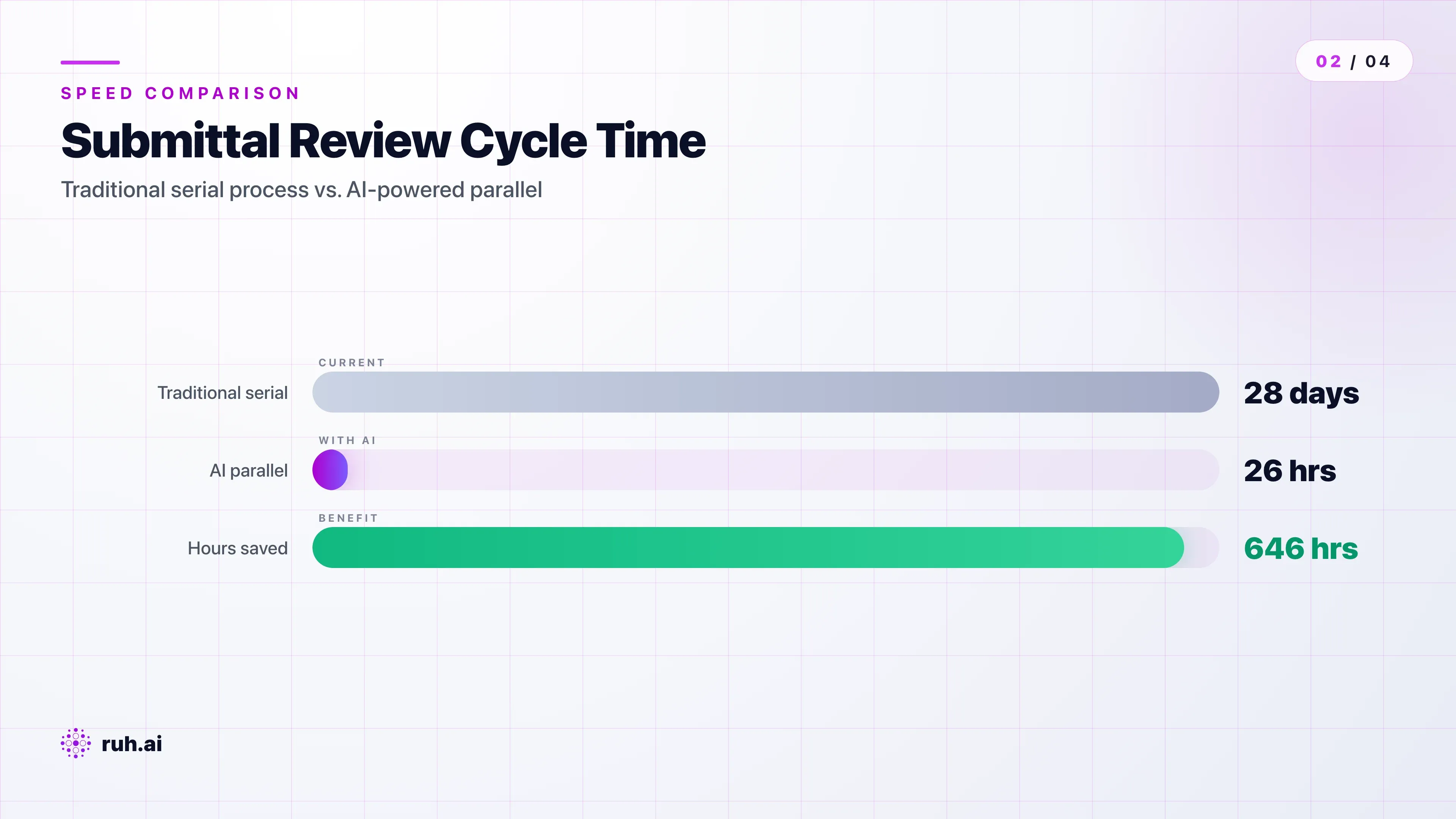
This is the compressed cycle in its cleanest form. Real projects are messier. Contractors sometimes miss clarifications and need a second round. Equipment specs occasionally require phone calls between engineering and the vendor. But even with friction, the parallel processing model cuts the 28-day average to 48 hours.
The reason: elimination of queue time. In a traditional process, a submittal spends 80% of its 28-day cycle waiting in a reviewer's inbox. It spends 20% being actively reviewed. Parallelization removes the waiting. All three teams see it simultaneously. All three teams prioritize it, because they know the other teams have it too.
Beyond Speed: The Hidden Advantages
Faster isn't valuable if quality suffers. The best part of AI submittal automation is that quality actually improves.
Consistency. An AI agent applies the exact same compliance checklist to every submittal, every time. There is no subjective interpretation, no "I'm tired and didn't notice this deviation," no "different engineer, different standard." Every submittal meets an identical bar. This dramatically reduces contractor resubmittals due to "failed for unclear reasons" — because reasons are now documented and consistent.
Auditability. Complete audit logs capture every review decision, every AI reasoning step, every human override. This is critical for regulatory compliance, especially on publicly funded projects or those under legal dispute. If a submittal is later questioned in a claim or audit, you have a complete, timestamped record of why it was approved. This is worth 6 figures in legal risk mitigation on large projects.
Relationship repair. Fewer revision cycles mean fewer contractor callbacks. In the traditional process, a contractor might resubmit the same spec sheet 4 times because different teams asked for slightly different things. With AI, they get one clear feedback package. One revision. Done. This isn't sentimental — it directly impacts contractor behavior on future projects. Contractors who were frustrated become contractors who prioritize your projects and deliver quality work.
Design conflict detection. The AI agent cross-references every submittal against every previously-approved submittal, plus the current BIM model and design specifications. If the electrical submittal conflicts with the structural steel layout (common), the AI catches it before material ordering. Catching that conflict 28 days earlier saves 6-8 weeks of field rework and change orders.
The Honest Assessment: Where AI Submittal Review Still Struggles
This is important: AI submittal automation is not magic. There are real limitations that matter.
Complex, custom submittals are harder to automate. If 75% of your submittals are standard equipment approvals (HVAC units, electrical panels, roofing systems), AI hits 94-98% accuracy immediately. The bottom 25% are custom systems — engineered solutions where the submittal is a novel design the project has never seen before. AI struggles here because it's trained on historical patterns, and novel designs don't have historical patterns. These submittals still need expert human review. The win is faster triage and routing, not elimination of the review.
Ambiguous project standards cause false flags. If your project specification says "materials shall be industry-standard grade," an AI agent doesn't know what that means in context. It might flag a submittal as non-compliant when the actual standard is understood in a conversation between two experienced engineers. AI reduces this with training on project-specific documents, but it's never perfect. You need human domain experts in the loop.
Setup and training require domain expertise. You can't just point an AI agent at random PDFs and get 98% accuracy. You need to train it on your project's specifications, historical submittals, and the standards your teams actually enforce (not always what the spec says on paper). This takes 2-4 weeks of project setup and SME time. It's worth the investment, but it's not a zero-friction install.
Multi-trade coordination still needs humans. If Submittal A (structural steel) and Submittal B (mechanical ductwork) have a spatial conflict, the AI flags it. But resolving it requires a conversation between the structural engineer and the mechanical engineer about trade-offs and phasing. AI documents the issue; humans still have to problem-solve it.
These aren't reasons not to use AI submittal automation. They're reasons to use it as an augmentation layer, not a replacement. You're not firing the submittal review team. You're giving them back 15-20 hours per week to focus on judgment calls instead of document processing.
Real-World Impact and ROI
Let's talk about what actually matters to construction executives: schedule, cost, and team capacity.
A typical large construction project has 300-400 submittals. With a traditional 28-day average cycle and 60% of submittals requiring revision, you're looking at 8,400 hours of submittal-related delay across the project (300 submittals × 28 days × 1 reviewer-hour each, accounting for parallel teams).
With AI submittal automation, the average cycle compresses to 48 hours. The math:
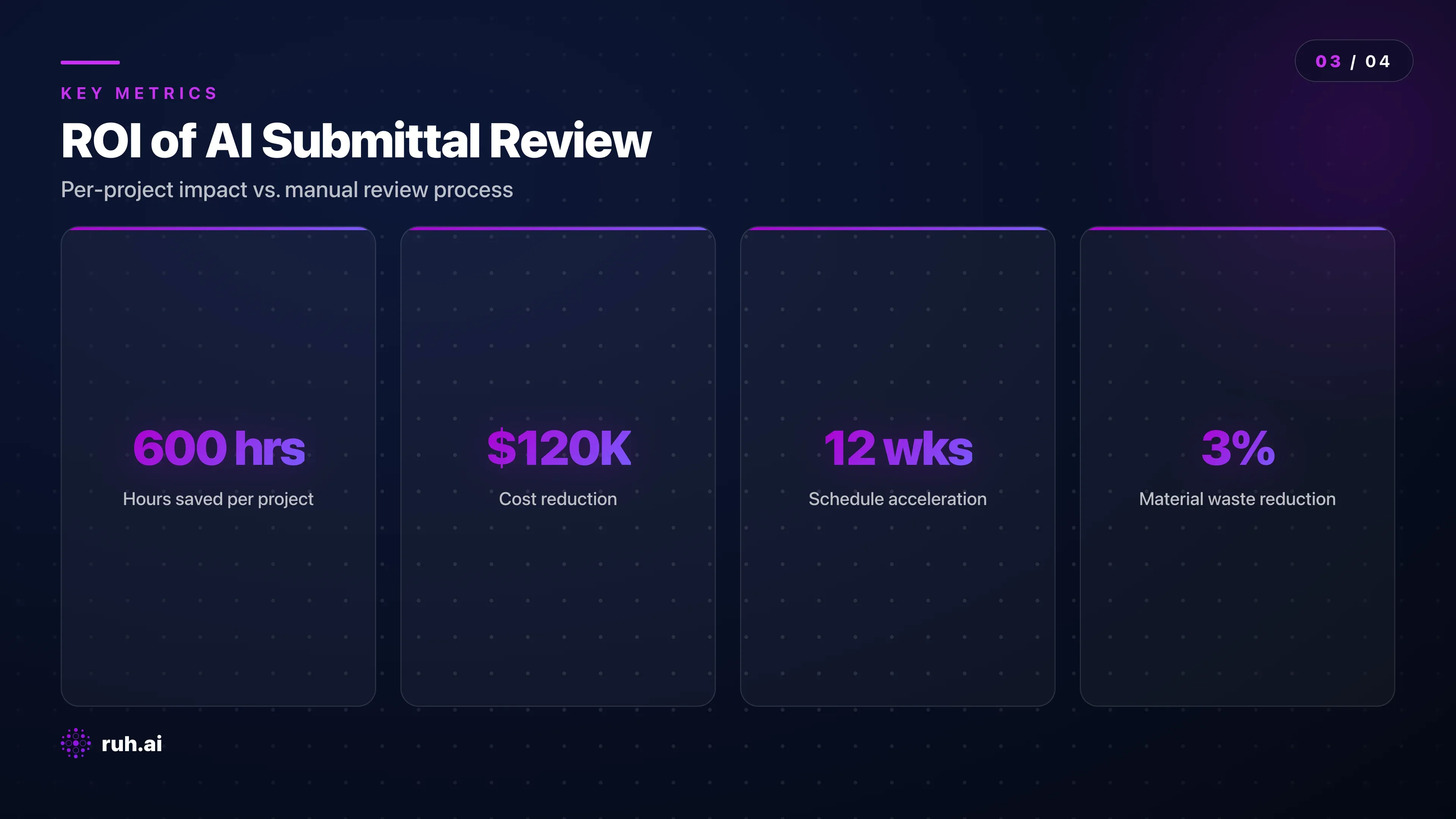
- Time savings: 400-600 hours recovered per project. That's the equivalent of 1.5-2 full-time reviewer positions per project annually, or 2-3 staff redirected to higher-value work.
- Cost reduction: $65K-$120K in labor costs avoided. At $75/hour all-in for a QA engineer or admin reviewer, recovering 400-600 hours is real money.
- Schedule acceleration: 8-12 weeks of total project schedule compressed. Material procurement starts on time. Delivery happens on schedule. Crews don't sit idle. On a $50M construction project, every week of acceleration saves $250K-$500K in carrying costs and overhead.
- Material cost savings: 2-3% reduction in procurement spend. Faster submittal approval opens competitive bidding windows. Vendors bid harder when they know they're getting a narrow 2-week window instead of a 6-week window. That adds up to $300K-$1M in material savings on large projects.
- Team retention improves 35-50%. Your QA team is no longer burning 20-30 hours a week on manual PDF review. They're doing analysis, problem-solving, and exception handling. Job satisfaction goes up. Burnout goes down. Turnover stays low.
Payback timeline: 18 months. Setup costs $15K-$35K depending on integration complexity. On a project that saves $100K, you're ROI-positive within 4-5 months. After that, every submittal is pure margin.
Getting Started: Implementation for Your Team
Implementation isn't plug-and-play, but it's straightforward. Here's the 4-phase timeline:
Phase 1: Setup and Integration (2-3 weeks)
- Identify your submittal workflow: Which teams review? In what order? What's your current approval process?
- Connect the AI agent to your document management system (Procore, Touchplan, AutoCAD, or manual PDF uploads).
- Extract your project specifications, BIM models, and historical submittal approvals. Feed them to the AI for training.
- Define your approval thresholds: Which deviations are auto-approved? Which trigger human review? Which route to specific experts?
Phase 2: QA Team Training (1-2 weeks, parallel to Phase 1)
- Train your review team to interpret AI confidence scores and override recommendations when needed.
- Establish human-AI handoff protocols: When does the AI route to an expert? How does the expert override an AI flag?
- Test the system on 10-15 historical submittals to validate accuracy before going live.
Phase 3: Pilot Project (4-6 weeks)
- Run a single small-to-medium project through the AI submittal system.
- Process 50-100 submittals. Measure accuracy, cycle time, and team productivity.
- Refine the AI training based on real-world edge cases and misses.
- Validate that the 48-hour cycle is achievable with your team's schedules and standards.
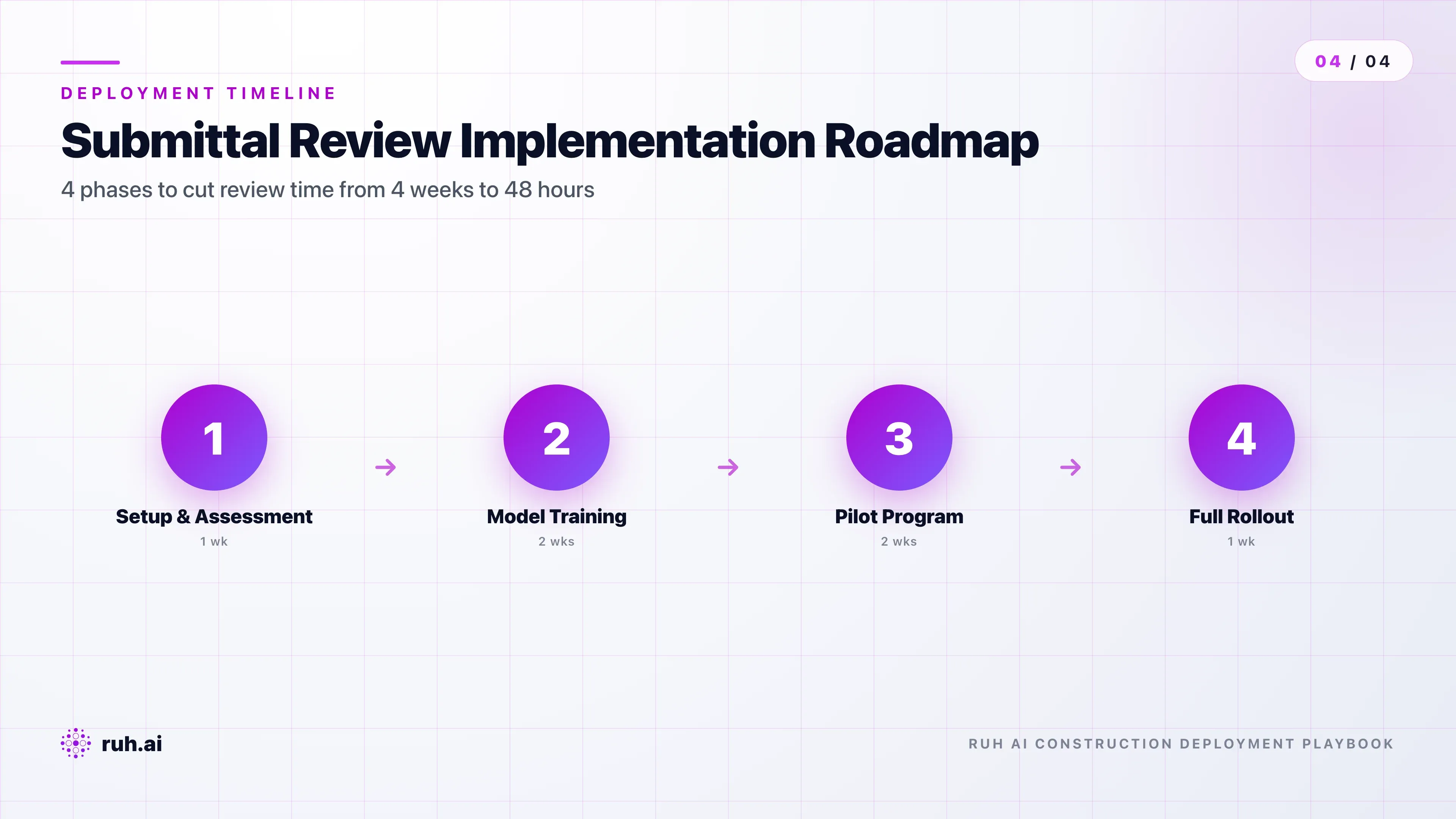
Phase 4: Rollout and Scaling (Weeks 10-12 onward)
- Deploy to your next 2-3 projects. Expand the AI training as you encounter new submittal types.
- Monitor performance: Are you hitting 48-hour cycles? Are accuracy rates holding?
- Gradually shift your QA team's workload. Reduce time spent on routine reviews. Increase time on exception handling and design coordination.
Don't rush rollout. One successful pilot is worth three failed deployments. Pilots reveal the edge cases, the integration friction, and the team friction that a generic playbook misses.
How Ruh.AI Fits Into AI-Powered Construction Workflows
This is where a lot of construction firms get stuck: building a custom AI submittal system requires machine learning expertise, OCR infrastructure, and continuous model training. That's a 6-12 month engineering project for most teams.
Ruh.AI simplifies this with Ruh Work-Lab — a no-code platform for deploying AI agents without hiring a data science team. You can define your submittal review workflow, connect it to your document management system, and deploy an AI agent that handles OCR parsing, compliance checking, and parallel routing.
For construction firms that want more customization — embedding the AI submittal agent into a broader construction automation system — Ruh Developer provides API access to build custom agents and integrate them directly into your existing tools (Procore, Touchplan, project management systems).
The difference between building this yourself and using Ruh is the difference between hiring a data science team ($2M+ annually) and deploying a pre-built AI agent ($500-1500/month). Both solve the problem. One solves it in 2-3 weeks. The other takes 12 months and requires you to become an AI company.
Frequently Asked Questions
Q: Will AI replace construction submittal reviewers? A: No. AI handles document parsing and routine compliance checking — the repetitive, time-intensive part. Humans still do the judgment calls, exception handling, and coordination between trades. You're augmenting your reviewers, not replacing them. The best firms will use AI to free up their best people to focus on complex decisions instead of checkbox work.
Q: What's the accuracy rate on AI submittal review? A: On standard submittals (75% of volume), AI agents achieve 94-98% accuracy on compliance flagging. Humans catch the remaining edge cases. On complex, custom submittals, accuracy is lower (80-90%) because the AI has fewer historical patterns to learn from — these submittals still benefit from faster triage and routing. End-to-end hybrid accuracy (AI + human review) exceeds 99%.
Q: What if the AI misses a critical issue? A: That's where the human review layer matters. The AI flags known deviations and routes to subject matter experts. Experts catch misses. And because every decision is logged with AI reasoning, you have a complete record of why something was approved or rejected. In a dispute, that documentation protects you legally.
Q: How long does implementation actually take? A: Setup and integration: 2-3 weeks. Team training: 1-2 weeks (overlaps with setup). Pilot project: 4-6 weeks. Full rollout: 2-4 weeks. Total: 10-14 weeks from decision to production. Some firms do it faster with simpler workflows; others take longer if their document systems are fragmented.
Q: What's the cost comparison to current manual processes? A: Setup costs $15K-$35K (one-time). Ongoing AI service costs $500-$1,500/month depending on submittal volume. Your current manual process costs $150K-$250K annually in labor (2 full-time reviewers @ $75-80/hr). Payback happens in 3-6 months on typical large projects.
Q: Can AI handle completely custom or engineered submittals? A: Yes, but with lower confidence. AI benefits are highest on repeatable submittal types (standard equipment, materials, timelines). Custom engineered solutions still need expert review — the AI's job is faster data extraction and issue highlighting, not elimination of the review. Think of it as "read faster, catch deviations automatically, route to the right expert immediately."
Moving Forward
Construction submittal review is one of the last great bastions of manual, analog process in an industry that's otherwise been digitizing for 20 years. That's not because paper and PDFs are better than automation. It's because the alternative — building custom AI systems from scratch — was always too expensive.
That changed in 2026.
AI agents are now accessible enough, pre-trained enough, and cost-effective enough that a construction firm can compress a 28-day submittal cycle to 48 hours without becoming a software company. The question isn't whether this works. It works. The question is how quickly your team can implement it and recapture weeks of schedule and six figures of cost savings.
Start small. Pick one pilot project. Process 50-100 submittals through an AI system. Measure the cycle time and accuracy. Then decide whether your entire portfolio should follow.
Schedule a 15-minute demo of AI submittal automation →
Explore Ruh Work-Lab and deploy your first AI agent today →