
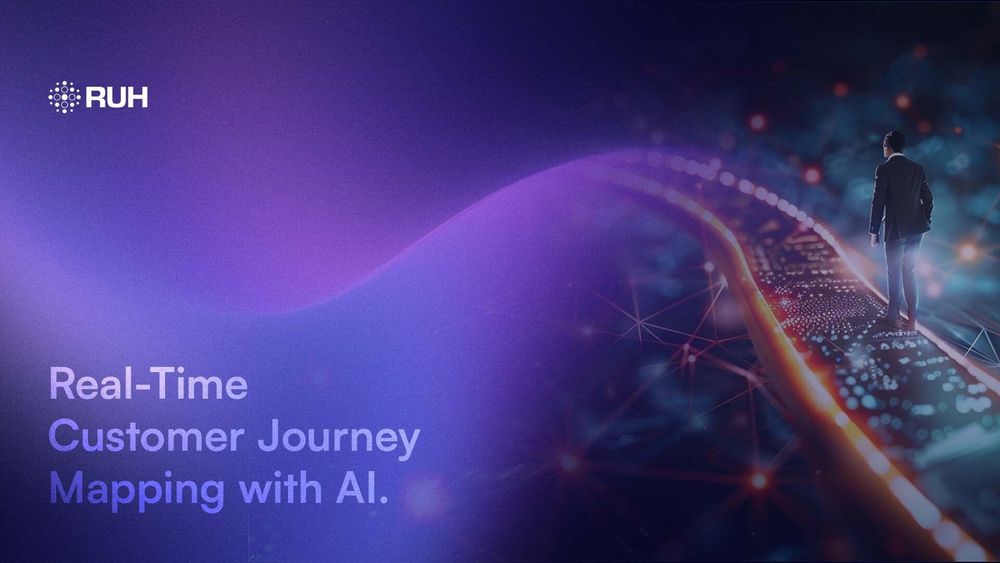
Customer journey mapping has always been about understanding how people move from first contact to long-term loyalty.
What has changed—fundamentally—is speed, scale, and precision.
With AI, journeys are no longer static diagrams reviewed once a quarter. They are living systems, adapting in real time to behavior, intent, and context.
As the global customer journey analytics market grows from USD 20.87 billion in 2025 to an expected USD 48.40 billion by 2030, organizations are realizing that competitive advantage no longer comes from collecting more data—but from acting on it instantly.
Yet despite 88% of organizations using AI in at least one business function, only 6% achieve meaningful enterprise-level financial impact.
The gap lies not in adoption, but in execution.
This blog explores how AI-powered customer journey mapping works across awareness, consideration, decision, and advocacy—why real-time optimization matters, and what separates high performers from everyone else.
Understanding AI-Powered Stages
Traditional customer journey mapping assumes linear progression.
AI reveals something different: customers move through micro-moments, often looping, pausing, or skipping stages entirely.
AI-driven journeys adapt dynamically, recognizing patterns early and responding instantly.
Awareness: AI Ad Targeting and Sentiment Analysis
The awareness stage is no longer about reach alone—it’s about relevance at first exposure.
AI-powered sentiment analysis now reaches 85–90% accuracy, enabling brands to understand emotional context across thousands of conversations in real time.
This capability directly impacts performance: sentiment-optimized ads show 2.3X higher engagement, and targeted sentiment-driven campaigns deliver up to 20% ROI uplift.
Programmatic advertising reflects this shift.
Today, 90% of display ad spend flows through AI-driven systems, enabling predictive bidding, real-time optimization, and contextual relevance at scale.
Combined with sentiment signals, these systems ensure awareness campaigns resonate emotionally, not just demographically.
Even early email touchpoints benefit.
Welcome emails—often the first owned interaction—achieve 54.3% open rates, while personalized subject lines increase opens by 26%, establishing momentum for the journey ahead.
Consideration: Dynamic Content Personalization
During consideration, customers expect brands to understand them.
Personalization is no longer optional—71% of consumers expect it, and 80% are more likely to purchase when experiences feel tailored.
AI enables dynamic content personalization, adjusting messaging, recommendations, and offers in real time based on behavior pattern analysis.
The results are dramatic:
- Behavior-driven emails deliver 22.6X higher click-to-open rates
- Conversion rates increase by up to 60.7X in journey-matched campaigns
- Personalized emails achieve 41% higher click-through rates
Crucially, consideration now spans channels.
43.6% of customers engage across three to four channels before purchasing.
AI-powered journey mapping maintains context across these touchpoints, preventing friction caused by disjointed experiences and enabling true customer experience intelligence.
Decision: Predictive Segmentation and A/B Testing
The decision stage is where hesitation turns into action—or abandonment. AI excels here by identifying which signals actually predict conversion, not just correlating activity.
Organizations using AI-powered conversion optimization report 15–25% average conversion lifts, with top performers exceeding 30%.
Predictive audience modeling replaces static segments, continuously recalibrating based on real-time behavior.
A key shift is the move from traditional A/B testing to multi-armed bandit algorithms, which dynamically allocate traffic toward higher-performing variants.
This approach delivers 25% higher conversion rates than fixed tests by learning faster and minimizing wasted exposure.
Conversational AI further accelerates decisions.
Shoppers who interact with AI chatbots convert at 12.3%, compared to 3.1% for non-interacting users—a fourfold improvement driven by real-time objection handling and contextual guidance.
Advocacy: Post-Purchase Engagement Tracking
Most customer journeys fail after conversion. AI-driven journey mapping extends beyond purchase to focus on lifetime value and advocacy.
Real-time post-purchase personalization increases customer satisfaction by 25% and drives 15% revenue growth through better engagement timing and relevance. Customers receiving high-quality omnichannel experiences are 3.6X more likely to make repeat purchases, turning transactions into relationships.
AI-powered churn prediction reshapes retention economics.
Predictive models reduce churn by up to 50%, identifying at-risk customers early enough for meaningful intervention. Organizations leveraging AI-driven CLV optimization report:
At the advocacy stage, AI turns Net Promoter Score into an execution engine—automating referral timing, incentive selection, and follow-up based on behavioral signals rather than static campaigns.
Real-Time Tools and Implementation
What differentiates AI-powered journeys is real-time orchestration.
Customers make an average of 47 micro-decisions throughout their journey, yet traditional analytics track only a fraction of these moments.
AI systems detect intent within the first three interactions, adapting pathways dynamically. This requires:
- Unified customer profiles updated continuously
- Sentiment and intent recognition via natural language processing
- Real-time decision engines selecting next-best actions
- Cloud-based infrastructure supporting low-latency inference
High-performing organizations don’t treat this as a tooling problem. They redesign workflows around AI, enabling automation to act—not just observe.
This is where platforms built around AI employees, rather than isolated tools, begin to matter.
Systems like Ruh AI’s approach to agent-driven orchestration reflect this shift—where AI doesn’t just analyze journeys, but actively manages them across channels with shared memory and continuous optimization.
Measuring Advocacy Impact
AI-driven journey mapping demands new measurement models.
Final-touch attribution is insufficient when influence spans dozens of interactions.
High performers track:
- Conversion rate improvement (15–25% average, 30%+ for leaders)
- Retention and CLV growth (10–25% improvements)
- Email engagement uplift (40–70% open rates for triggered campaigns)
- Operational efficiency gains (25–30% reduction in service volume)
- Revenue impact (20–40% uplift from real-time personalization)
Critically, advocacy metrics—referrals, repeat purchases, and lifetime value—become primary indicators of journey health, not lagging outcomes.
What Separates AI High Performers
Research consistently shows that only 6% of organizations achieve significant financial impact from AI.
These high performers share common traits:
- Clear strategy focused on growth and innovation, not just efficiency
- Workflow redesign, not surface-level automation
- Strong leadership ownership, with active executive involvement
- Robust data infrastructure, unifying touchpoints in real time
- Governance and trust, addressing privacy and explainability proactively
Technology alone is not the differentiator. Commitment is.
Conclusion: From Mapping to Momentum
AI-powered customer journey mapping transforms marketing from reactive analysis to real-time execution.
The data is unambiguous: when implemented correctly, AI drives substantial improvements across awareness, consideration, decision, and advocacy—compounding over time.
But value remains concentrated among organizations willing to rethink how work gets done.
Customer journey mapping with AI is not a dashboard upgrade. It is a shift toward living, adaptive experiences, where every interaction informs the next.
This is where platforms like Ruh AI signal a broader transition in how organizations operate.
AI employees can own journey execution end-to-end—monitoring behavior, adapting messaging, and coordinating across channels continuously.
As customer expectations for personalization and immediacy continue to rise, real-time AI-driven journeys will move from advantage to necessity.
Organizations that invest now—in systems, talent, and orchestration—will define the next era of customer experience.
Book a Free 1:1 Demo Today to watch AI in action!
The real-time orchestration that carries customers from awareness to advocacy offers a useful model for thinking about coordinated construction workflows with Ruh AI.