
TL: DR / Summary
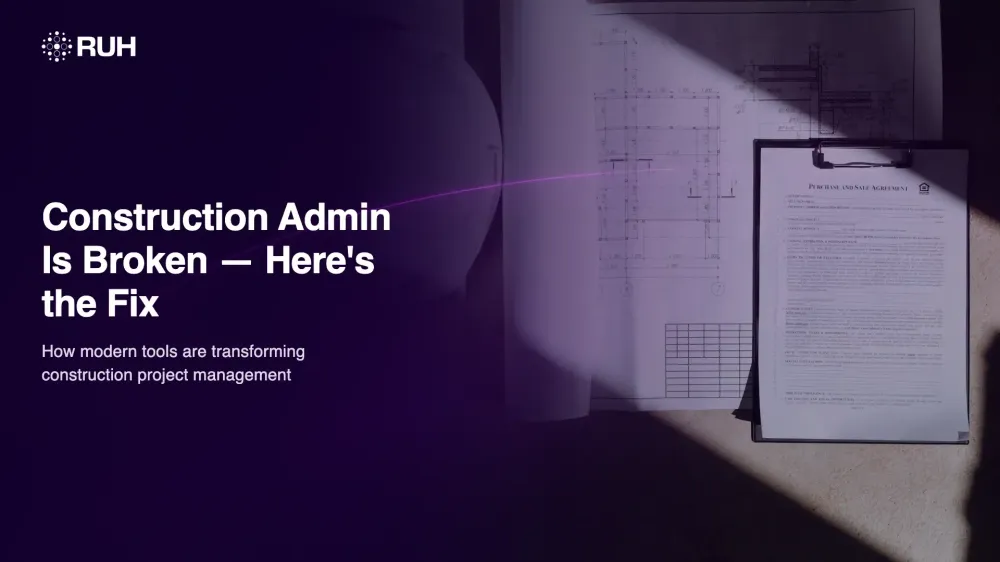
Construction admin is broken because traditional software can't handle the industry's complexity, forcing humans to do manual, high-volume work like AP, compliance, and scheduling. This leads to hidden costs, high turnover, and lost institutional knowledge.
In this blog we will discuss how Ruh AI fixes this not with another software tool, but by deploying "Human Emulators", digital employees that work inside your existing systems (like Vista and QuickBooks) to autonomously handle administrative chaos, turning AP into a non-issue and ensuring knowledge stays with the company forever.
Ready to see how it all works? Here's a breakdown of the key elements:
- The Problem: Administrative Chaos Is Costing Construction Companies More Than They Know
- Then Comes Ruh AI
- What Changes When You Bring Ruh AI In
- The Honest Trade-Offs
- Who This Is Actually For
- The Shift That's Happening
- Ready to See It in Action?
- Frequently Asked Questions
The Problem: Administrative Chaos Is Costing Construction Companies More Than They Know
Accounts Payable Is a Daily Crisis
Walk into the AP department of most large construction companies. You'll find the same scene: invoices arriving by email, fax, mail, and vendor portals — each formatted differently, each needing to be manually keyed into Vista or QuickBooks, coded to the right job and GL account, matched against a purchase order, and routed for approval.
When the volume is in the thousands per month, mistakes are inevitable. Duplicate invoices get paid. Price variances slip through. Invoices get approved without a matching PO. Each error seems small — until it compounds across hundreds of jobs and dozens of divisions.
The worst part? Nobody knows exactly how much it's costing. The losses are diffuse, buried in project budgets, written off as cost of doing business.
According to McKinsey's Global Institute, construction is one of the least digitized industries in the world — and administrative inefficiency sits at the heart of the productivity gap.
Vendor & Subcontractor Compliance Falls Through the Cracks
Insurance certificates expire. W-9s go missing. Subcontractor agreements get signed and then forgotten in a shared drive. Nobody is watching the calendar on hundreds of active vendor relationships.
Until something goes wrong. A lien gets filed. A claim gets denied. A compliance audit reveals months of gaps.
The Associated General Contractors of America identifies vendor and subcontractor management as one of the most persistent operational headaches across contractors of all sizes, not because companies don't care, but because the tracking burden is simply too large for manual processes to sustain.
Scheduling Is Still Living on a Whiteboard
In a world of GPS-tracked fleets and real-time job site communication, most construction companies still schedule crews in spreadsheets or on physical boards. When a delivery doesn't arrive, a crew member calls in sick, or a weather delay hits, someone has to manually call through a list, reassign jobs, and push updated sheets to field supervisors.
This costs hours every single day. It creates downstream errors in payroll, equipment allocation, and client billing. And it burns out the people doing it.
The Admin Staff Problem Has No Good Solution
Hiring more administrative staff is not the answer. Good AP clerks, compliance coordinators, and scheduling administrators are hard to find, expensive to train, and frequently burned out by the volume and repetitiveness of the work. When they leave — and they do leave — the institutional knowledge walks out with them.
The U.S. Bureau of Labor Statistics consistently reports high turnover in administrative support roles, and construction is no exception. The cycle of hiring, training, losing, and re-hiring administrative staff is one of the industry's most quietly expensive problems.
And the cost of each new hire goes far beyond salary. As Ruh AI's research on AI employee adoption costs breaks down, when you factor in onboarding, training, benefits, and time-to-productivity, the real cost of replacing an administrative employee is far higher than most companies account for.
Then Comes Ruh AI
Ruh AI didn't build another software product. It built something the construction industry has never had before: digital employees — Human Emulators that work inside your existing tools, follow your processes, and handle the administrative work your team shouldn't have to do.
No migration. No new system to learn. No integration project. They work in Vista, QuickBooks, your email, your spreadsheets exactly as they are today.
The frame isn't "buy software." It's "hire people." And that distinction changes everything about how construction executives respond to it.
This isn't a narrow use case either. The same model that's transforming back-office operations in construction is already reshaping how companies handle customer support and financial services — industries that share the same core problem: high-volume, process-dependent work that traditional software can't handle and humans burn out doing.
What Changes When You Bring Ruh AI In
AP Becomes a Non-Issue
Human Emulators receive invoices in every format — scanned PDFs, emails, handwritten documents, vendor portals — and process them completely. They extract the data, code it to the right job and GL account, match it against the purchase order, and route it for approval. When something doesn't match, they flag it. When they're confident, they move it through.
What used to sit in a pile on one person's desk now flows through a system that never gets tired, never rushes, and never makes the same mistake twice.
Every invoice gets the same level of scrutiny. Every time.
The AICPA has documented how AP automation fundamentally changes the error profile of finance departments — fewer duplicates, fewer missed variances, fewer compliance lapses.
Vendor Compliance Runs Itself
Human Emulators monitor expiration dates on insurance certificates, W-9s, subcontractor agreements, and required certifications. When something is approaching expiration, the agent sends the alert and initiates the follow-up. Documentation gets collected and logged without anyone having to remember to check.
Your vendor relationships stay compliant. Your exposure shrinks. And the person who used to spend their Fridays chasing documents gets to do something more valuable.
Scheduling Becomes Adaptive, Not Reactive
When a supply delay hits or a crew member calls out, a Human Emulator doesn't wait for someone to notice. It receives the update, assesses the impact, re-evaluates crew assignments based on skills, certifications, and geography, and pushes revised job sheets to field supervisors — in minutes.
The manual cascade of calls and reassignments that used to eat your operations manager's morning gets handled without them.
Financial Visibility Becomes Real-Time
Human Emulators pull actuals from Vista or QuickBooks, compare them against project budgets, and surface overruns before they become disasters. Division-level P&L summaries can be generated on demand rather than waiting for month-end close.
For companies making major decisions based on incomplete financial pictures, this changes the quality of every decision downstream.
Deloitte's Engineering & Construction practice has noted that real-time project financial visibility is one of the clearest differentiators between construction firms that scale profitably and those that don't.
Institutional Knowledge Stops Walking Out the Door
When a Human Emulator is corrected, it updates its own operating procedures — permanently. It never makes the same mistake again.
That's the opposite of what happens when a human employee leaves. With digital employees, the knowledge accumulates. It doesn't evaporate.
This is the core premise of the hybrid workforce model that forward-thinking companies are adopting: humans and digital employees working alongside each other, each doing what they're actually built for. The humans handle judgment, relationships, and exceptions. The digital employees handle volume, consistency, and process.
The Honest Trade-Offs
This Is a Custom Build, Not a SaaS Subscription
Ruh AI doesn't offer a plug-and-play product. Each deployment is built to your specific processes, your tools, your GL codes, your approval thresholds. That means the upfront investment is real and the build takes time. If you need something operational in two weeks for under five figures, this isn't the solution.
Your Processes Need to Be Articulable
To train a Human Emulator, someone has to be able to explain how the work gets done. If your current AP process lives entirely in one person's head with no documentation, the discovery phase takes longer. The value on the other side is significant, but the front-end investment of time is real.
It's Built for Enterprise Scale
The model is designed for construction companies large enough to have administrative complexity worth solving at this level. Smaller operations may find more immediate ROI in simpler point solutions before graduating to a platform like this.
Change Management Takes Intention
Introducing digital employees to a team that's been doing the work manually requires honest communication. People need to understand that Human Emulators handle the repetitive, high-volume tasks and that the humans on the team move up, not out. When that message is communicated well, adoption is fast. When it isn't, resistance slows everything down.
Who This Is Actually For
Ruh AI works best for multi-division construction companies with significant invoice volume and vendor complexity, operations and finance leaders who have tried SaaS solutions and been let down, companies running Vista or QuickBooks without a complex ERP in place, and leadership teams ready to invest in a real solution rather than another workaround.
If you recognize the problems described at the top of this piece and you've been living with them long enough to know that hiring more people isn't the fix this is worth a serious look.
Ruh AI also offers Sarah, an AI SDR, for companies looking to extend digital workforce capabilities into their business development function another area where repetitive, high-volume work eats human time that could be spent on higher-value activity.
The Shift That's Happening
The construction industry's administrative burden isn't going away. Complexity grows as companies scale. Vendor networks expand. Divisions multiply. Invoice volume climbs.
The question is whether that growth gets handled by an ever-larger team of people doing repetitive manual work or by a digital workforce that handles it reliably, at scale, without burning out.
As Harvard Business Review has consistently argued, the organizations that win the next decade are the ones that deploy human talent on judgment-intensive work and automate everything else. Construction is finally getting the infrastructure to do exactly that.
And if you're wondering how digital employees fit into your broader outreach and growth strategy, Ruh AI's take on AI in cold outreach for 2026 is worth reading — because the same principles that apply to automating admin work apply to scaling business development intelligently.
Ready to See It in Action?
The best way to understand what a Human Emulator can do for your construction operation is to watch one work. Book a conversation with the Ruh AI team and bring your ugliest invoice — the most complicated, most non-standard one you've got. If the system can't handle it, they'll tell you. But it probably can.
You can also explore the full library of Ruh AI resources and case studies to see how the platform is being applied across industries and use cases — or visit ruh.ai to get a full picture of what the platform covers.
Frequently Asked Questions
What is a Human Emulator and how is it different from construction management software?
Ans: A Human Emulator is a digital employee that works inside your existing tools — Vista, QuickBooks, spreadsheets, email — to handle administrative tasks the way a trained person would. Unlike construction management software, which organizes data but requires humans to act on it, a Human Emulator actually does the work: processing invoices, matching POs, tracking vendor compliance, and flagging exceptions — autonomously. It reasons through variability rather than breaking when something doesn't fit a predefined template.
How long does it take to deploy Ruh AI in a construction company?
Ans: Most deployments follow an 8–12 week timeline from discovery to go-live. The first two weeks focus on mapping your specific processes and pain points. Weeks two through eight are the build phase, where a specialized team trains digital employees on your GL codes, approval thresholds, vendor list, and workflow rules. After go-live, additional agent sets for new departments — scheduling, procurement, HR — are scoped and deployed in subsequent cycles.
Does Ruh AI require us to replace our current software like Vista or QuickBooks?
Ans: No. This is one of the most important distinctions. Ruh AI's Human Emulators work inside whatever tools you already use. There is no migration, no new system for your team to learn, and no integration project. If your crews live in spreadsheets and your AP team lives in Vista, the digital employees work there too. You gain capability without disruption.
What kinds of administrative tasks can Ruh AI handle for construction companies?
Ans: The platform covers a wide range of construction back-office functions including accounts payable processing and PO matching, vendor compliance tracking such as insurance certificates and W-9s, crew scheduling and dispatch adjustments, fleet and equipment maintenance tracking, job costing and budget variance reporting, and subcontractor agreement monitoring. Most companies start with AP and expand from there as they see results. You can explore more use cases across industries on the Ruh AI blog.
Is Ruh AI suitable for mid-size construction companies or only large enterprises?
Ans: Ruh AI is currently built for construction companies with significant administrative volume — typically $500M or more in annual revenue with 1,000+ invoices per month and multi-division operations. The custom build model and upfront investment are most justified at that scale. Smaller contractors may find the economics more favorable as the platform matures. If you're unsure whether your company is a fit, the best next step is a direct conversation with the team at ruh.ai/contact.