
TL: DR / Summary
Imagine you're managing a busy kitchen in a restaurant. You have two options: hire one head chef who tells everyone exactly what to do and when to do it, or let each cook make their own decisions based on what they see happening around them.
This simple choice is similar to what software architects face every day when building modern applications. It's called the orchestration problem, and getting it right can make or break your entire system.
In this guide, we'll break down centralized and decentralized orchestration in plain English. No unnecessary jargon, just practical information you can actually use. Whether you're building traditional microservices or exploring AI orchestration for multi-agent systems, understanding these fundamental patterns is essential.
Ready to see how it all works? Here’s a breakdown of the key elements:
- What Is Orchestration Anyway?
- Understanding Centralized Orchestration
- Understanding Decentralized Orchestration (Choreography)
- Side-by-Side Comparison: The Real Differences
- How to Choose: A Practical Decision Framework
- Popular Tools and Technologies
- Getting Started: First Steps
- Common Mistakes to Avoid
- Looking Ahead: Future Trends
- Your Next Steps
- Conclusion: There's No Universal "Best" Choice
- Frequently Asked Questions (FAQs)
What Is Orchestration Anyway?
Before we dive into the debate, let's get clear on what orchestration actually means.
Think about ordering something online. Behind the scenes, multiple things need to happen:
- Your payment gets processed
- The warehouse gets notified
- Shipping gets arranged
- You receive a confirmation email
- Inventory gets updated
Someone (or something) needs to coordinate all these steps. That's orchestration making sure different parts of a system work together smoothly.
This same principle applies whether you're coordinating traditional software services or coordinating AI agents in a multi-agent system. The fundamental challenge remains: how do you get independent components to work together effectively?
Understanding Centralized Orchestration
The Boss Model
Centralized orchestration works like having one manager calling all the shots. There's a single controller often called an orchestrator that knows the entire workflow and tells each service exactly when to do its job.
Here's how it works in practice:
When you place that online order, a central orchestration engine follows a specific plan:
- First, it calls the payment service
- Once payment succeeds, it notifies the warehouse
- Then it triggers the shipping service
- Finally, it sends you that confirmation email
Everything flows through one control point. The orchestrator knows the complete picture and manages each step from start to finish.
This approach mirrors how centralized AI systems work. Just as a central orchestrator directs microservices, a single-agent AI system centralizes all decision-making in one intelligent component.
Why People Choose Centralized Orchestration
It's easier to understand and debug
When something goes wrong, you know exactly where to look. The orchestration engine logs everything that happens, making it straightforward to trace problems. According to research from IEEE Xplore, centralized systems offer superior visibility for debugging complex workflows.
This visibility advantage is why many companies start with centralized approaches, whether in software architecture or AI-powered sales systems. When you can see the entire workflow in one place, training teams and identifying bottlenecks becomes significantly easier.
You get better control over the workflow
Need to add a new step? Change the order of operations? With centralized orchestration, you update one place and you're done. The entire workflow lives in a single, manageable location.
Error handling becomes simpler
If the payment fails, the orchestrator immediately knows to stop and not trigger the next steps. It can retry failed operations, send alerts, or roll back changes—all from one coordinated spot.
Compliance and auditing are straightforward
For industries like healthcare and finance, having a clear audit trail matters. Centralized orchestration creates detailed logs of every action, making compliance checks easier. This is particularly important for AI systems handling lead qualification where regulatory compliance and data handling transparency are crucial.
The Drawbacks You Should Know About
The single point of failure problem
Here's the big concern: if your orchestrator goes down, everything stops. It's like that head chef calling in sick—suddenly, nobody knows what to do. Your entire workflow depends on one component staying healthy.
Performance bottlenecks can appear
As your system grows, the orchestrator handles more and more traffic. Eventually, it can become overwhelmed, slowing down everything that depends on it. According to Amazon Web Services documentation, this scalability challenge affects many growing applications.
This is why many organizations eventually explore decentralized approaches, similar to how competitive multi-agent systems distribute decision-making to avoid single points of congestion.
Services become tightly connected
When every service needs to report back to the central orchestrator, they're no longer truly independent. This tight coupling makes it harder to update individual services without affecting the whole system.
Understanding Decentralized Orchestration (Choreography)
The Self-Organizing Team Model
Decentralized orchestration often called choreography works completely differently. Instead of one boss giving orders, each service knows its own job and watches for signals that it's time to act.
Going back to our order example, here's how choreography works:
- The payment service processes the payment
- When done, it publishes an event: "Payment completed for order #123"
- The warehouse service watches for these events and automatically starts preparing the order
- When the warehouse publishes "Order #123 packed," the shipping service picks it up
- Each service acts independently based on what it observes
No central controller is needed. Services communicate through events, like team members leaving notes for each other.
This decentralized approach is conceptually similar to collaborative multi-agent AI systems, where multiple intelligent agents work together through shared communication rather than central control. Modern platforms like Ruh.ai leverage these principles to create autonomous AI systems that coordinate effectively without bottlenecks.
Why Choreography Appeals to Many Teams
Better scalability
Without a central bottleneck, each service can scale independently. If your payment processing needs to handle more traffic, scale just that service. The rest of the system carries on unaffected.
This scalability advantage is crucial for modern applications. Whether you're building multi-channel SDR strategies that need to handle varying loads across different communication channels, or processing high volumes of sales data, decentralized systems adapt more gracefully to demand spikes.
True service independence
Teams can update and deploy their services without coordinating with a central orchestration team. This autonomy speeds up development and reduces dependencies, as highlighted in research from ResearchGate.
Higher resilience
If one service fails, it doesn't bring down the entire workflow. Other services continue operating. The failed service can catch up later by processing queued events.
Performance improvements
Services can work in parallel rather than waiting for a central controller to tell them what to do next. This asynchronous approach often delivers better overall performance—a key factor in shortening B2B sales cycles where speed-to-response matters significantly.
The Challenges That Come With Freedom
Visibility becomes tricky
Without a central view, understanding what's happening across your entire workflow gets harder. You need to piece together the story from multiple services' logs.
Debugging is more complex
When something goes wrong, you can't just look at one orchestrator's log. You need to trace events across multiple services to find the problem. Tools like distributed tracing help, but add complexity.
Testing requires more effort
Testing orchestrated workflows is straightforward—you test the orchestrator's logic. With choreography, you need to verify that all services respond correctly to events, which requires more comprehensive test scenarios.
Managing distributed transactions gets complicated
What happens if the payment succeeds but the warehouse system fails? In centralized orchestration, the orchestrator handles rollbacks. With choreography, you need patterns like the SAGA pattern to manage these situations, as documented by Microsoft Azure.
Side-by-Side Comparison: The Real Differences
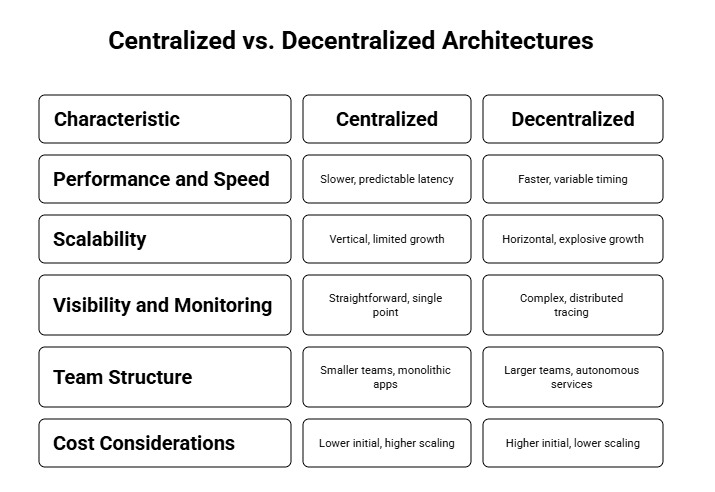
Let's look at how these approaches compare on key factors:
How to Choose: A Practical Decision Framework
Rather than asking "which is better," ask "which fits my situation?"
Choose Centralized Orchestration When:
- You're building your first microservices application
- Your workflows have complex sequencing requirements
- You work in a regulated industry needing clear audit trails
- Your team is relatively small (under 20 developers)
- Workflow visibility is your top priority
- You're migrating from a monolithic application
- Your traffic patterns are predictable and moderate
Real example: A healthcare appointment scheduling system needs strict ordering of steps and clear compliance records. Centralized orchestration makes perfect sense.
Similarly, if you're implementing AI SDR systems that need predictable, auditable lead qualification workflows, centralized orchestration provides the control and transparency required.
Choose Decentralized Choreography When:
- You need to scale to very high traffic volumes
- Service independence is crucial for your organization
- You have multiple autonomous development teams
- Your workflow is naturally event-driven
- Services need to evolve independently and quickly
- You can invest in sophisticated monitoring tools
- Resilience matters more than simplicity
Real example: A social media platform processing millions of user events per second benefits from choreography's ability to scale each component independently.
This pattern also works well for multi-agent AI systems where different AI agents need to specialize in specific tasks (like prospecting, qualification, and nurturing) while coordinating through events rather than central control.
Consider a Hybrid Approach For:
Many successful systems use both approaches. You might orchestrate critical transactional workflows centrally while using choreography for less critical, high-volume events.
Real example: An e-commerce platform might orchestrate the checkout process (payment, order creation) centrally for control, but use choreography for events like updating recommendations, sending marketing emails, and tracking analytics.
Modern AI platforms often use this hybrid model too. For instance, AI-powered SDR systems might centrally orchestrate the core qualification logic while using choreography for parallel tasks like enriching lead data, sending multi-channel outreach, and updating CRM systems.
Popular Tools and Technologies
For Centralized Orchestration
Camunda is a widely-used open-source workflow engine that provides visual workflow design and strong monitoring capabilities.
Apache Airflow excels at data pipeline orchestration, originally built by Airbnb and now an Apache project.
AWS Step Functions offers a fully managed orchestration service in the Amazon Web Services ecosystem.
Temporal provides fault-tolerant workflow execution with excellent debugging tools.
For Decentralized Choreography
Apache Kafka leads the event streaming space, capable of handling millions of events per second.
RabbitMQ offers a reliable message broker for event-driven architectures with great community support.
Amazon SQS/SNS provides managed message and notification services within AWS.
Azure Service Bus delivers enterprise messaging for Microsoft Azure environments.
Specialized Orchestration Platforms
For specific use cases like AI agent coordination, specialized platforms provide higher-level abstractions. These tools handle the complexity of orchestrating intelligent agents while you focus on business logic. Learn more about AI orchestration platforms and how they simplify building complex automated systems.
Getting Started: First Steps
If You're Starting With Centralized Orchestration:
- Map your workflow clearly - Document every step and decision point before coding anything
- Choose an orchestration tool - Don't build your own initially; use proven tools
- Start simple - Begin with one workflow and expand gradually
- Implement comprehensive logging - Your logs become your primary debugging tool
- Plan for the orchestrator's high availability - Address the single point of failure from day one
If You're Starting With Decentralized Choreography:
- Set up your event infrastructure first - You need reliable event streaming before building services
- Define clear event contracts - Services must agree on event formats and meanings
- Implement distributed tracing early - Tools like Jaeger or Zipkin become essential
- Use correlation IDs - Track events across services by including unique identifiers
- Start with the SAGA pattern - Learn to handle distributed transactions properly from the beginning
Common Mistakes to Avoid
Mistake #1: Mixing concerns without a plan
Some teams accidentally create messy hybrids by not clearly defining which parts use which approach. Be intentional about your architecture decisions.
Whether you're building traditional microservices or AI-powered automation systems, clearly document which components use centralized coordination and which use event-driven choreography.
Mistake #2: Ignoring the monitoring gap
Especially with choreography, teams often underestimate the monitoring infrastructure needed. Budget time and resources for observability from the start.
Mistake #3: Choosing choreography for the wrong reasons
"Netflix does it" isn't a good reason. Choose based on your actual needs, not industry trends.
Mistake #4: Not planning for failure
Whether centralized or decentralized, services fail. Design your orchestration with failure in mind, not as an afterthought.
Mistake #5: Skipping the documentation
Centralized orchestration workflows and event choreography patterns both need clear documentation. Future you (and your teammates) will be grateful.
Real-World Success Stories
Company A: E-Commerce Platform (Hybrid Approach)
A mid-sized e-commerce company handles checkout through centralized orchestration—the sequence matters too much to leave to events. But they use choreography for inventory updates, recommendation engines, and email notifications. This hybrid approach gives them control where needed and scalability where it matters.
Results: 99.9% uptime for checkout, while scaling inventory updates to handle Black Friday traffic spikes.
Company B: Financial Services (Centralized)
A payment processing company chose centralized orchestration for regulatory compliance and audit requirements. Their orchestrator provides complete workflow visibility and detailed logs for every transaction.
Results: Passed compliance audits easily, reduced debugging time by 60%, clear audit trails for every transaction.
Company C: Social Media Analytics (Decentralized)
A social media analytics startup processes millions of user events daily. They built a fully choreographed system where services independently process events they care about.
Results: Scaled from 10,000 to 10 million events per day without architectural changes, teams deploy independently multiple times per day.
Company D: AI-Powered Sales Automation (Hybrid)
A B2B company implemented a hybrid orchestration model for their sales automation. Core qualification workflows run through centralized orchestration for auditability, while multi-agent collaboration for research, outreach, and follow-ups uses choreography.
Results: Shortened their sales cycle by 40%, improved lead response times, and maintained full visibility into qualification decisions.
Looking Ahead: Future Trends
The orchestration landscape keeps evolving. Here are trends worth watching:
Serverless orchestration is making centralized orchestration easier by removing infrastructure management concerns. AWS Step Functions and Azure Durable Functions exemplify this trend.
Service mesh technologies like Istio blur the lines between orchestration and choreography by providing infrastructure-level coordination.
AI-assisted orchestration may soon optimize workflow paths automatically based on performance patterns and business rules. We're already seeing this in AI orchestration platforms that intelligently route tasks between specialized agents.
Edge computing introduces new choreography challenges as services run closer to users across distributed locations.
Multi-agent AI systems represent an emerging application of these orchestration patterns, where instead of coordinating microservices, you're coordinating intelligent agents with different capabilities and specializations.
Your Next Steps
Now that you understand both approaches, here's what to do:
- Assess your current situation - What are your actual requirements? Don't just follow trends.
- Start small - Pick one workflow to orchestrate or choreograph. Learn from that experience.
- Measure what matters - Track performance, debugging time, and team velocity. Let data guide your decisions.
- Stay flexible - Your needs will change. Build in the ability to evolve your orchestration approach.
- Keep learning - Both orchestration and choreography have deep technical details worth exploring as you gain experience.
If you're specifically interested in how these patterns apply to AI systems, explore resources on multi-agent AI systems and modern orchestration platforms designed for intelligent automation.
Conclusion: There's No Universal "Best" Choice
Centralized and decentralized orchestration aren't right or wrong they're tools for different jobs. Understanding your specific needs, team structure, and constraints matters far more than following what's trendy.
Start with your requirements. Be honest about your team's capabilities. Choose the approach that solves your actual problems, not theoretical ones.
Most importantly, remember that your architecture can evolve. Many successful systems started with simple centralized orchestration and gradually introduced choreography where it made sense.
The best orchestration architecture is the one that lets your team ship reliable software efficiently while meeting your business goals. Everything else is just details.
Whether you're building traditional microservices, implementing AI-powered workflows, or creating sophisticated automation systems, these fundamental orchestration patterns provide the foundation for scalable, maintainable architectures.
Ready to explore how orchestration patterns apply to AI? Check out our comprehensive guide to AI orchestration in multi-agent systems or learn how competitive and collaborative approaches impact system design.
Want to see these patterns in action? Ruh.ai applies these orchestration principles to create intelligent AI systems that coordinate multiple specialized agents. Contact us to learn how modern orchestration patterns can transform your workflows.
For developers: Explore our developer resources to see how you can build orchestrated AI systems using proven patterns and best practices.
Frequently Asked Questions (FAQs)
What is the difference between centralized and decentralized architectures?
Ans : Centralized architecture uses a single control point (orchestrator) that manages and coordinates all services by directing their actions step-by-step. Decentralized architecture (choreography) allows services to work independently, communicating through events without a central controller. Think of centralized as a conductor leading an orchestra, while decentralized is like a jazz ensemble where musicians respond to each other's cues.
Is it better to be centralized or decentralized?
Ans : Neither is universally better—it depends on your specific needs. Choose centralized orchestration when you need clear visibility, strict sequencing, and simpler debugging. Choose decentralized choreography when you need high scalability, service independence, and resilience. Many successful systems use a hybrid approach, centralizing critical workflows while decentralizing high-volume or independent operations.
What is the difference between orchestration and choreography in microservices?
Ans : Orchestration involves a central coordinator that explicitly calls each service and manages the workflow sequence. Choreography allows services to react to events autonomously without central coordination. In orchestration, services are told what to do; in choreography, services know their responsibilities and act when they see relevant events. Learn more about how these patterns apply to AI systems.
Are microservices centralized or decentralized?
Ans : Microservices architecture is inherently distributed, but the orchestration pattern can be either centralized or decentralized. The microservices themselves are decentralized components, but how they coordinate can follow either pattern. Many organizations use hybrid models depending on the specific workflow requirements.
What are the advantages of decentralization over centralization?
Ans : Decentralization offers superior scalability since services scale independently, higher resilience because failures are isolated, faster parallel processing, true service autonomy allowing independent deployments, and elimination of single bottlenecks. These advantages are particularly valuable for shortening response times in time-sensitive applications.
What are two benefits of decentralized decision-making?
Ans : First, decentralized decision-making enables faster responses since services don't wait for a central authority to coordinate actions they react immediately to events. Second, it promotes better scalability because decision-making distributes across multiple services rather than concentrating in one component that could become overwhelmed.
When should I use centralized orchestration vs choreography?
Ans : Use centralized orchestration for complex business processes requiring strict sequencing, regulated environments needing audit trails, smaller teams, and predictable workflows. Use choreography for high-scale event processing, when service independence is crucial, with multiple autonomous teams, and for naturally event-driven workflows. Consider hybrid approaches for systems with both critical controlled workflows and high-volume independent operations.
Can I migrate from centralized to decentralized orchestration?
Ans : Yes, migration is possible and common as systems scale. Start by identifying high-volume, independent workflows suitable for choreography. Implement event infrastructure alongside your orchestrator. Gradually migrate workflows one at a time, maintaining the orchestrator for complex transactional processes. Many organizations settle on hybrid models rather than fully converting. Learn more about AI system architecture decisions.
What tools are best for centralized orchestration?
Ans : Popular centralized orchestration tools include Camunda (open-source workflow engine), Apache Airflow (data pipeline orchestration), AWS Step Functions (serverless orchestration), Temporal (fault-tolerant workflows), and Zeebe (cloud-native orchestration). For AI-specific workflows, specialized platforms like Ruh.ai provide higher-level orchestration capabilities for coordinating intelligent agents.
How does the SAGA pattern work in choreography?
Ans : The SAGA pattern manages distributed transactions by breaking them into smaller local transactions, each publishing events when complete. If a step fails, compensating transactions undo previous changes. Each service knows its compensation logic, allowing the system to maintain consistency without a central transaction coordinator. This pattern is essential for reliable choreographed workflows.