
Enterprise AI has reached an inflection point—not because adoption is slow, but because returns have stalled.
Most leadership teams have already deployed AI: copilots for employees, chatbots for customers, assistants embedded across workflows.
Usage is high. Spend is justified.
Yet when executives review outcomes, the results feel incremental at best.
Productivity nudges upward, but operating models remain intact. Headcount pressure does not ease.
Work does not disappear.
Despite heavy investment, conversational AI has delivered only 5–10% marginal productivity gains across organizations
That is not transformation—it is optimization at the edges.
The core mistake is not technological. It is conceptual.
Most enterprises have used AI to improve how humans work, rather than questioning why humans are still required to execute the work at all.
Why Chat-Based AI Plateaus by Design
Conversational AI succeeds because it feels intuitive.
It mirrors human communication, lowers adoption friction, and creates visible “wins” quickly.
But this familiarity conceals a structural limitation: chat-based systems preserve humans as the primary execution layer.
Multiple reports describe this interaction model precisely: human prompts → AI responds → human verifies → human executes
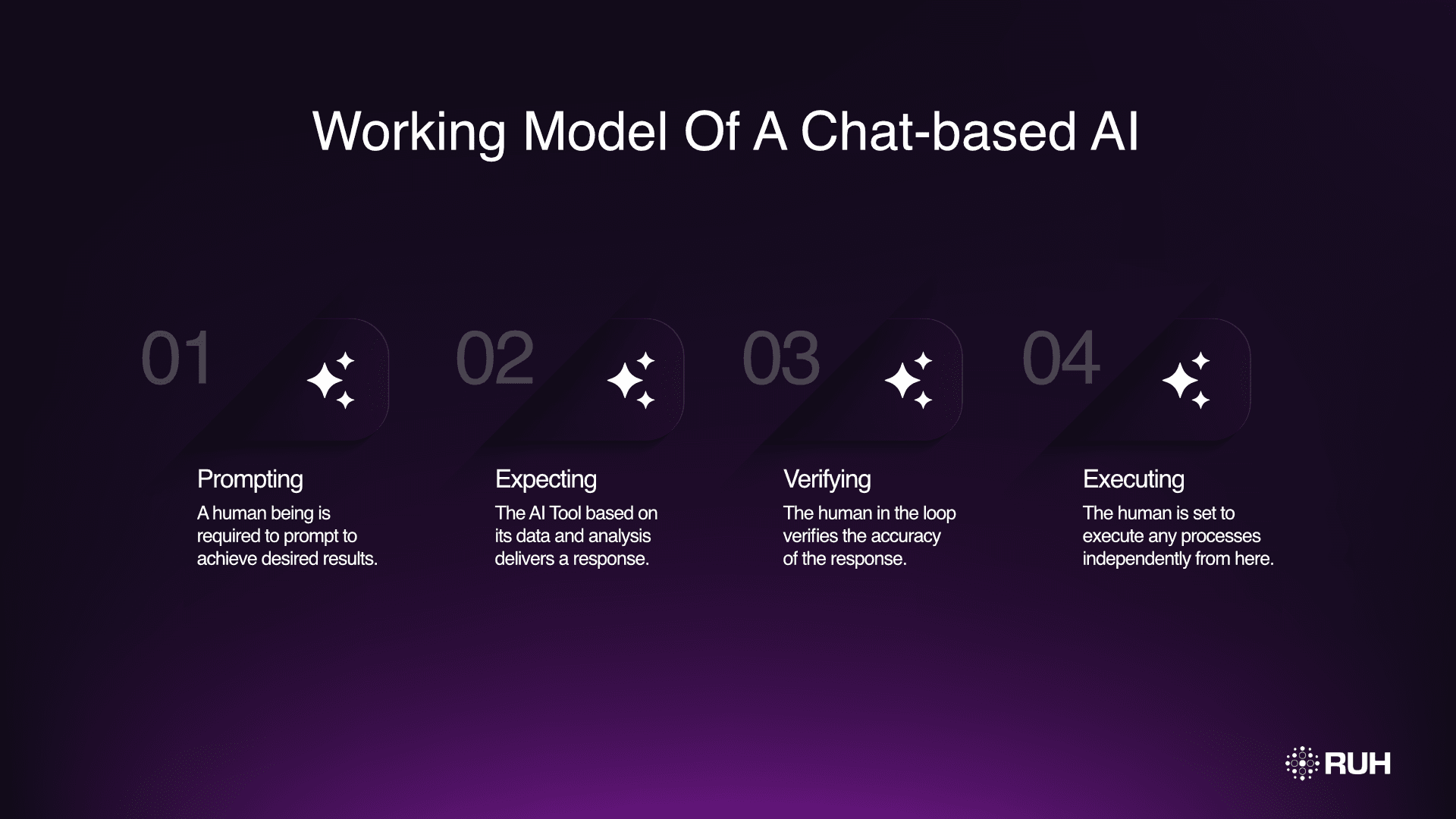
This loop introduces three unavoidable constraints.
First, cognitive load is not eliminated—it is merely shifted. Instead of performing tasks, employees now spend time crafting prompts, interpreting outputs, validating accuracy, and deciding next steps.
Mental effort remains constant, only redistributed.
Second, scalability remains human-bound.
Each interaction still requires attention and judgment. No matter how capable the model becomes, throughput is limited by human bandwidth.
Third, operational complexity compounds over time.
Every new conversational workflow adds monitoring, tuning, and maintenance overhead. What begins as “automation” quietly becomes another system humans must manage.
A study across 7,000 workplaces showed no significant impact on earnings or recorded work hours from chatbot adoption
Organizations talked to AI more—but they did not structurally reduce labor.
For executives, the implication is clear: productivity gains without labor displacement do not create leverage.
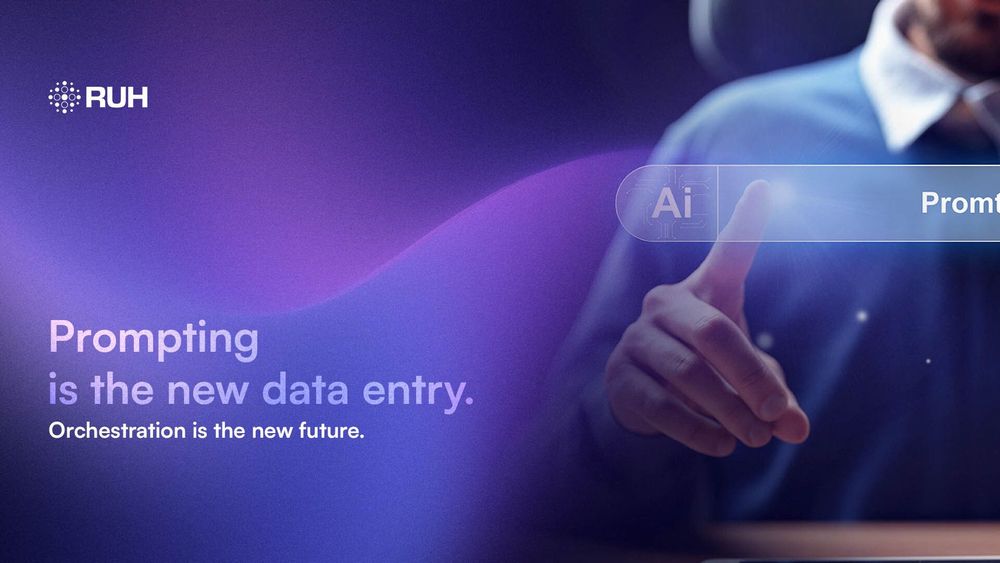
Prompting Is the New Data Entry
Historically, every major software wave created an invisible tax. ERP systems reduced chaos but created armies of analysts. CRMs centralized data but required constant manual updates.
Value was unlocked—but only with sustained human input.
Prompting is becoming the next version of that tax.
Each prompt represents manual coordination between intent and execution. It requires context reconstruction, translation into instructions, evaluation of output, and downstream action across systems.
This is not free work—it is cognitively expensive labor.
“Prompting is the new data entry. Agent orchestration is the new leadership.”
This framing matters because it exposes the economic ceiling of chat-based AI.
When human prompting remains central, costs scale with usage. Licensing fees rise. Oversight increases. Escalations multiply. ROI flattens.
By contrast, systems that eliminate prompting eliminate a category of labor entirely.
The Evolution of Work Is a Human Role Shift, Not a Tool Upgrade
The transition underway is often described as AI maturity. In reality, it is a redefinition of what humans are for inside the enterprise.
There are three stages of work evolution we are certain about:
Manual Execution: Humans as the System
In traditional operations, humans execute workflows end-to-end. Systems record activity, but people perform coordination, judgment, and follow-through.
Costs scale linearly, errors are human-bound, and speed is constrained by availability.
Chat / Copilot: Humans as the Bottleneck
Chat-based AI improves local efficiency but preserves global constraints. Humans still bridge systems, verify outputs, and move work forward.
The result is a 5–10% productivity plateau—useful, but fundamentally limited
Agentic Work: Humans as Orchestrators
Agentic AI removes humans from execution paths. Autonomous agents pursue objectives across systems, complete workflows independently, and determine when work is finished.
Humans shift to goal-setting, oversight, and exception handling.
This delivers 20–50% efficiency improvements with compounding returns over time
This is not about faster execution.
It is about eliminating execution as a human responsibility.
What Agentic AI Looks Like in Practice
The difference between chat and agents becomes clearest when examining real deployments.
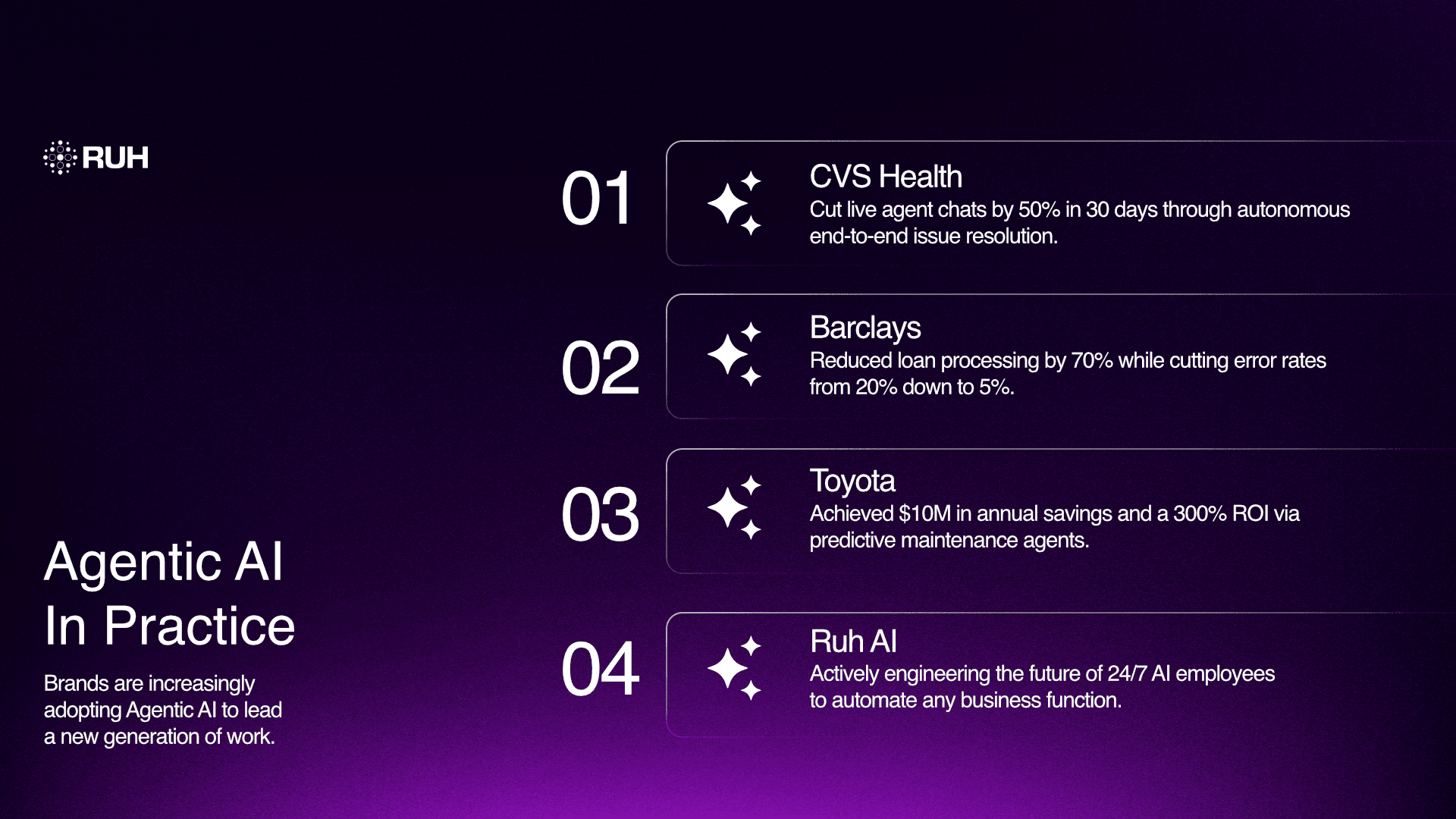
At CVS Health, agentic AI cut live agent chats by 50% within 30 days—not by deflecting conversations, but by resolving issues autonomously end-to-end. Human agents were not faster; they were needed less often
At Barclays, agentic systems reduced loan processing time by 70%, collapsing timelines from 10–15 days to just 3–4 days while simultaneously reducing error rates from 20% to 5%. This was not incremental efficiency—it was workflow replacement
At Toyota, predictive maintenance agents delivered a 25% reduction in downtime and a 15% increase in equipment effectiveness, generating $10M in annual savings and 300% ROI.
No amount of conversational assistance could have achieved this outcome because the value came from autonomous execution, not better answers
These examples share a pattern: agents did not assist humans.
They removed humans from execution loops entirely.
Why Agentic Systems Compound While Chat Systems Plateau
Chatbots optimize interactions. Agents optimize systems.
Agentic AI operates across applications, not within a single interface.
Agents call tools, reconcile data, coordinate workflows, and close loops without waiting for human input.
Each successful execution improves future performance, creating compounding returns rather than linear gains.
The agentic AI market is projected to grow from $7.38B in 2025 to $47B by 2030, with agents expected to handle up to 80% of customer interactions end-to-end.
This trajectory mirrors past operating-model shifts. Once work can be executed autonomously, scale no longer requires proportional headcount.
The Leadership Implication Most Miss
Agentic AI does not simply change tools—it changes what leadership is responsible for.
In chat-based environments, leaders manage people who manage tools. In agentic environments, leaders design systems that manage work.
Data indicates that organizations adopting agentic AI experience:
- 50–60% reductions in mean time to resolution
- Automation rates exceeding 40% across operational functions
- Human time savings equivalent to direct FTE reductions
- Decision velocity collapsing from days to minutes
This forces a shift from task supervision to system orchestration. Leadership becomes less about monitoring effort and more about defining outcomes, guardrails, and escalation logic.
Where Ruh AI Fits in This Transition
Ruh AI is designed explicitly for organizations moving beyond conversational productivity.
Ruh AI delivers AI Employees—autonomous agents that:
- Accept objectives rather than prompts
- Navigate enterprise systems independently
- Execute workflows end-to-end
- Update CRMs, coordinate actions, and close loops
- Escalate only true exceptions for human judgment
This is not assistance. It is delegation.
And delegation is where economic leverage emerges.
The Question That Actually Matters
The strategic question facing leadership is no longer whether AI “works.”
It is this:
Do we want AI to make our people slightly faster—or do we want entire categories of work to disappear?
Because the evidence is clear. Conversational AI has reached its ROI ceiling.
Organizations that remain trapped in prompting, verifying, and executing will optimize effort, not outcomes.
The next generation of competitive advantage belongs to leaders who redesign work itself—who move from interrogating systems to orchestrating autonomous digital workforces.
Prompting is the new data entry. Agent orchestration is the new leadership.
And the organizations that internalize this shift now will define how work gets done next.
Book a demo today to watch AI Employees in action >>
The move from prompting to orchestration becomes easier to evaluate in a project-based setting, where Ruh AI connects the agentic-work idea to construction.