
AI Employees Are On: The List of Work You Should Stop Doing(Anubhav)
Most organizations don’t have a productivity problem. They have an allocation problem.
Highly capable people still spend large portions of their day doing work that is repetitive, rules-based, and cognitively draining—work that no longer requires human judgment.
With the rise of AI employees and Agentic AI, that mismatch is becoming impossible to justify.
By 2026, research shows that 30–50% of knowledge-work hours can already be automated, with routine managerial and operational tasks among the most exposed
The question for leaders is no longer if this work should move to AI—but why it hasn’t already.
Below is a practical “stop-doing” list: the categories of work humans should actively step away from as AI employees take ownership.
1. Data Drudgery and Digital Paperwork
If your organization still relies on humans to move, clean, or normalize data, you are burning expensive cognitive cycles on mechanical labor.
Humans should stop:
- Copy-pasting data between CRMs, ERPs, spreadsheets, inboxes, and internal tools
- Re-keying information from PDFs, scans, images, and forms
- Cleaning and standardizing CSV or Excel files manually
- Reading long documents solely to locate specific fields like IDs, dates, or amounts
- Manually tagging documents, records, or emails with metadata
- Reconciling near-duplicate contacts, accounts, or SKUs by hand
Why humans shouldn’t do this:
This work has no strategic upside. It requires attention but not judgment, concentration but not thinking. Every hour spent here is an hour not spent interpreting data, making decisions, or solving problems.
How AI employees do it instead:
AI employees combine OCR, LLM extraction, validation rules, and confidence scoring to ingest data once and propagate it everywhere it’s needed. They normalize formats, deduplicate records, tag content, and flag only uncertain cases for review.
2. Managerial Busywork and Status Overhead
One of the most underappreciated drains on organizational effectiveness is managerial friction.
Humans should stop:
- Chasing updates via Slack or email that already exist in project tools
- Manually compiling weekly or monthly status reports
- Spending 1:1 meetings reciting updates instead of coaching or decision-making
- Rebuilding the same KPI decks with slightly different numbers
- Writing meeting minutes, summaries, and action items by hand
- Maintaining RAID logs and coordination spreadsheets manually
Why humans shouldn’t do this:
This work creates the illusion of control, not actual leadership. It fragments attention, crowds calendars, and turns managers into human middleware. Research suggests up to ~69% of routine managerial coordination work is automatable.
How AI employees do it instead:
AI employees continuously pull signals from Jira, Asana, Salesforce, calendars, and communication tools. They generate real-time summaries, highlight risks, surface bottlenecks, and maintain living dashboards automatically.
3. Low-Complexity Customer Support
Customer operations represent one of the largest immediate value pools for AI employees.
Humans should stop:
- Answering repetitive FAQ questions
- Manually routing tickets to queues or specialists
- Searching internal knowledge bases for standard answers
- Repeating identical troubleshooting steps
- Copying issues from messages into ticket fields
- Sending routine follow-ups or satisfaction checks
- Translating standard replies into multiple languages
Why humans shouldn’t do this:
This work is high-volume, emotionally draining, and offers little opportunity for human differentiation. It creates burnout without improving customer outcomes.
How AI employees do it instead:
AI employees classify intent, retrieve precise answers, guide users through workflows, auto-fill ticket fields, monitor SLAs, and escalate only when thresholds are crossed. They operate across languages and channels consistently, 24/7.
4. Sales Ops and SDR Drudge Work
Sales organizations don’t suffer from a lack of effort. They suffer from execution drag.
Humans should stop:
- Researching firmographics and tech stacks manually
- Re-entering leads from forms or events into CRM
- Logging call notes and updating deal fields after every call
- Setting follow-up reminders and pipeline hygiene nudges
- Writing repetitive proposal covers and standard deal emails
- Monitoring trigger events manually
- Rebuilding list filters repeatedly
Why humans shouldn’t do this:
None of this improves persuasion or trust. It simply delays revenue and drains seller energy. Sales is one of the most text-heavy, rules-based functions in the enterprise.
How AI employees do it instead:
AI SDRs enrich accounts automatically, log calls, update CRM, monitor triggers, draft follow-ups, and maintain pipeline hygiene continuously. AI SDRs don’t replace sellers. They remove everything that prevents selling
5. Marketing’s Repetitive Execution Layer
Much of modern marketing is not strategy—it’s mechanical execution.
Humans should stop:
- Generating endless ad or social variants manually
- Reformatting assets for every platform
- Building UTM links one by one
- Copying content between tools
- Repurposing the same content repeatedly
- Segmenting lists using static rules
- Tagging assets manually
Why humans shouldn’t do this:
This work scales poorly and creates diminishing returns. It consumes creative energy without producing differentiation.
How AI employees do it instead:
AI marketing employees generate variants, manage distribution, auto-tag assets, maintain dynamic segments, and report performance continuously. Humans focus on positioning, narrative, and creative direction where marketing actually wins.
6. HR, Recruiting, and People Operations Admin
People teams are overloaded not with people problems, but with process noise. Gartner predicts 60% of HR work tasks will be completed through an intelligent agent by 2026
Humans should stop:
- Screening resumes via keyword heuristics
- Re-typing candidate data into ATS systems
- Writing repetitive candidate emails
- Coordinating interviews via email threads
- Compiling feedback summaries manually
- Triggering onboarding tasks one system at a time
- Answering routine policy questions repeatedly
Why humans shouldn’t do this:
This work slows hiring, frustrates candidates, and distracts HR from culture and leadership.
How AI employees do it instead:
AI employees screen, schedule, summarize, onboard, and answer routine questions consistently—leaving humans to focus on judgment, coaching, and organizational health.
7. Finance, Legal, and Compliance Routines
Many finance and legal workflows are governed by clear rules and thresholds.
Humans should stop:
- Coding expenses and reconciling transactions manually
- Extracting invoice data and matching POs
- Running standard close checklists line-by-line
- Performing basic contract clause checks
- Diffing contract versions manually
- Tagging contracts and renewal dates
- Drafting routine notices and summaries
Why humans shouldn’t do this:
Manual handling increases risk, delay, and inconsistency—especially at scale. 90% of finance functions will deploy at least one AI-enabled technology solution by 2026
How AI employees do it instead:
AI employees extract, reconcile, compare, monitor, and flag exceptions. Humans intervene where risk, interpretation, and accountability matter.
8. Research, Reading, and Reporting Drudgery
A surprising amount of “knowledge work” is actually information handling.
Humans should stop:
- Reading long documents just to summarize them
- Extracting facts manually from large document sets
- Building basic comparison tables
- Clustering open-text survey responses by hand
- Translating research materials for internal use
- Reformatting notes across templates
Why humans shouldn’t do this:
This work delays insight and adds no analytical value. Furthermore, it consumes a lot of time that could’ve been spent on something valuable.
How AI employees do it instead:
AI employees synthesize, extract, cluster, translate, and summarize instantly—leaving humans to interpret, challenge assumptions, and decide.
9. Monitoring, Surveillance, and Numbing Oversight
Some of the most dehumanizing work is continuous monitoring. AI enables up to 90% reductions in manual audits and 60% faster incident response
Humans should stop:
- Watching dashboards for threshold breaches
- Monitoring CCTV feeds continuously
- Performing routine inspections manually
- Tracking environmental or machine metrics by hand
Why humans shouldn’t do this:
Humans are bad at sustained vigilance. Fatigue leads to missed signals. In the age of AI, deploying humans to monitoring tasks is a waste of talent.
How AI employees do it instead:
AI employees monitor relentlessly and escalate selectively. Humans intervene only when judgment or action is required.
The Pattern Leaders Should Recognize
Across every domain, the work humans should stop doing shares the same characteristics:
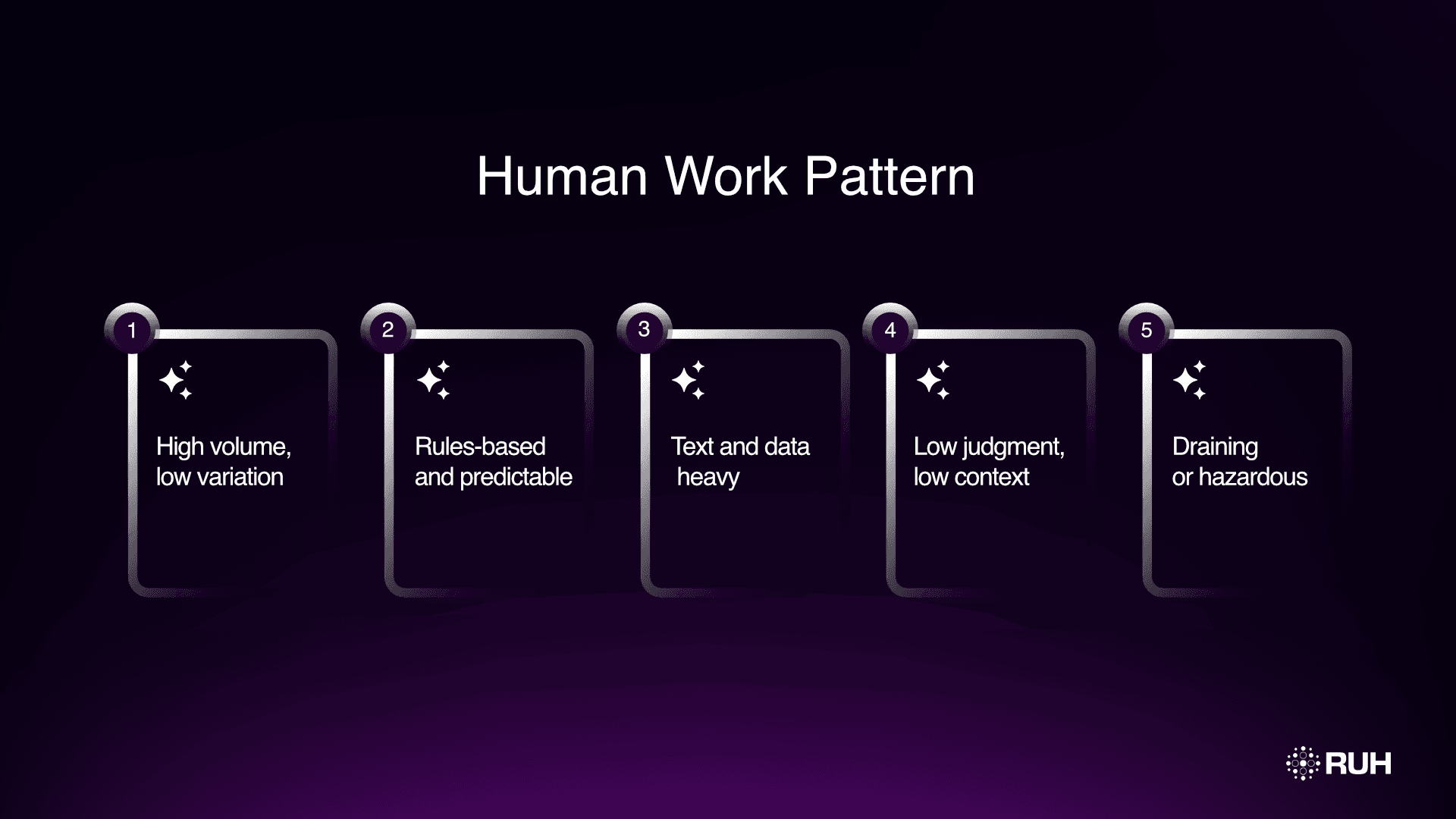
- High volume, low variation
- Rules-based and predictable
- Text and data heavy
- Low judgment, low context
- Mentally draining or hazardous
The opportunity is not just efficiency. It’s organizational leverage.
When AI employees absorb this work, humans reclaim time for strategy, creativity, empathy, leadership and decision-making.
Organizations that deliberately remove these tasks from human roles will outpace those that simply “add AI tools”.
AI Employees Will Complete Humans.
The goal of AI employees is not to eliminate human work. It is to remove the wrong work from humans—so human capability can finally compound.
In every function described above, the dividing line is not human vs. machine.
It is judgment vs. execution.
AI employees take ownership of:
- Repetitive execution
- Rules-based coordination
- Continuous monitoring
- High-volume, low-variation tasks
Humans retain ownership of:
- Judgment under ambiguity
- Strategic decision-making
- Creative direction and narrative
- Relationship-building and trust
- Leadership, coaching, and accountability
This is not a replacement model. It is a rebalancing model.
The future is humans doing the work only humans can do, while AI employees handle everything else.
Organizations that get this right won’t just be more efficient. They will be calmer, more focused, and structurally more resilient.
Because the real promise of AI isn’t cost reduction. It’s cognitive liberation.
How Ruh AI Will Enable Human-AI Synergy
At Ruh AI, we are not building features, copilots, or chat interfaces.
We are building AI employees—digital workers that:
- Own workflows end-to-end
- Operate autonomously across systems
- Coordinate tasks like real team members
- Escalate intelligently, not constantly
- Work continuously without burnout
This distinction matters.
Tools still require humans to manage work. AI employees take responsibility for it.
The world needs humans + AI employees, working together in a rebalanced system where humans focus on judgment and leadership—and AI handles the rest.
The most important leadership question of this decade is not “How do we use AI?”
It is “What work should humans never do again?”
Ruh AI exists to help organizations answer that question—and to build the AI workforce that follows.
Book a free 1:1 demo and watch AI employees in real-life settings.