
TL;DR / Summary
Your team is drowning in repetitive work—email routing, lead qualification, invoice processing, meeting scheduling—while the work that actually drives revenue sits in a backlog. AI agents in 2026 are finally mature enough to handle these workflows autonomously, freeing your teams to focus on strategy and relationships instead of busywork.
What you'll learn:
- How AI agents differ from traditional automation tools and why that matters
- Four core workflows where agents deliver immediate ROI (sales, finance, operations, customer support)
- A step-by-step implementation strategy that reduces adoption risk
- Real cost comparisons: manual work vs. AI agent stack
- How to identify which workflows in your organization should go first
The numbers upfront: McKinsey's 2025 AI adoption study found that organizations using AI agents for internal workflows report 40-80% time savings in routine tasks. Gartner projects that by 2027, AI agents will handle 30% of enterprise business processes—but the competitive advantage goes to early adopters who build organizational literacy now.
The Work You're Leaving on the Table
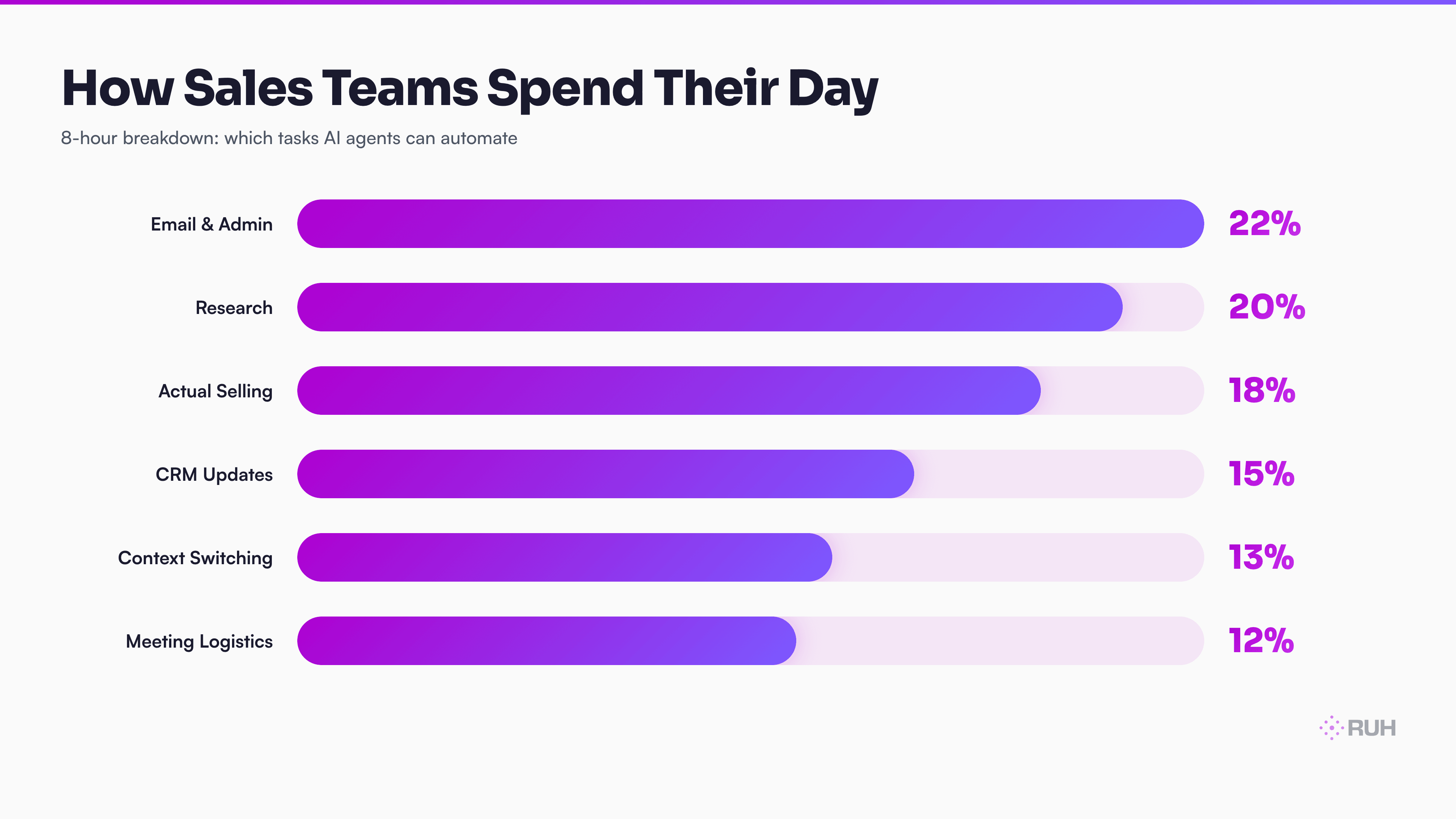
Your sales team spends 72% of their time on things that aren't selling. Harvard Business Review quantified this: prospecting, research, CRM updates, email sequences, meeting logistics. An AI agent does all of this 24/7 without fatigue or context-switching penalties. By the time your SDR wakes up, 15 leads have been qualified, 30 outreach emails have gone out, and discovery calls are booked.
Your finance team is hand-touching every invoice. Someone extracts the PO number, someone else categorizes it, someone validates it against the purchase order, someone codes it for GL, someone routes it for approval. Each invoice touches five people. At 200 invoices per month, that's 1,000 manual touches. An AI agent processes all 200 invoices in 3 hours, codes them correctly 99% of the time, and flags the exceptions for human review.
Your operations team is manually monitoring contracts, vendor SLAs, and budget spend. When a vendor misses an SLA, nobody knows until the impact shows up in a customer complaint. An AI agent monitors all of this continuously, surfaces anomalies before they matter, and triggers exception workflows automatically.
This isn't vision-of-the-future thinking. This is 2026. The tooling exists. The organizations starting with these workflows now are pulling ahead.
What AI Agents Actually Are (And How They're Different)
AI agents are autonomous software systems that perceive their environment, make decisions, and take actions without constant human intervention. The key word is autonomous. Not "rule-based" — autonomous.
Traditional automation tools work like this: IF [specific condition], THEN [specific action]. If invoice total > $10K, then route to VP approval. If lead matches [criteria], then assign to sales rep. Every possible scenario needs explicit programming. When something unexpected happens — an invoice for $10.2K, a lead that matches 80% of criteria but not all — the tool breaks or escalates to a human. Automation is brittle.
AI agents work differently. They understand context, make decisions in ambiguous situations, and adapt when the unexpected happens. An AI agent reads an invoice, understands the purchase order it maps to, recognizes the vendor relationship, identifies which GL codes apply (even if the naming is inconsistent), flags the one line item that looks unusual, and routes the entire package to the right approver — all without a human writing a single IF statement.
When something unexpected happens — a new vendor, an unusual purchase category, a pricing edge case — the agent reasons through it. It doesn't escalate. It decides.
That's the difference between automation and agents. Automation says "I don't know." Agents say "Here's my reasoning. Here's what I did."
In 2026, AI agents are transitioning from research labs and venture-backed startups to enterprise production. Salesforce has embedded agents into CRM. Microsoft has agents in the Microsoft 365 ecosystem. AWS, Google Cloud, and Azure all have agent frameworks. Fortune 500 companies are moving beyond pilots into scaled deployment. The hype cycle has burned off. What remains is real utility.
How AI Agents Streamline Your Workflow (Without Breaking Things)
Here's what agents actually do for you:
First, they eliminate decision fatigue. Your teams don't make fewer decisions — they make better ones because they only get involved when the stakes are high. The agent handles the easy stuff. "This lead is cold, these three are hot, these two need one more touchpoint." Your SDR looks at the hot ones and the ones that need one more push. Time spent on actual selling: up 300%.
Second, they catch exceptions before they become problems. Most workflows break at exception points. A vendor misses an SLA but nobody knows for 3 weeks. A customer payment lands in the wrong GL code and a reconciliation takes 40 hours to track down. An unusual purchase order doesn't match the invoice and it sits in a queue waiting for someone to look at it. AI agents monitor continuously and surface exceptions in real time. Your finance team doesn't process 200 invoices — they review the 5 that have issues.
Third, they handle context-switching for you. Your team doesn't jump between five different systems, five different tabs, five different sets of decision-making rules. The agent owns the full context. It reads from the CRM, maps it to the accounting system, understands the customer relationship from email history, ties it to the contract, and makes a coherent decision. Your people don't do that coordination work. The agent does.
Fourth, they integrate with your existing stack. You don't rip out Salesforce, HubSpot, QuickBooks, or Stripe. The agent plugs into what you have. It reads from your systems, writes back to your systems, and participates in your existing workflows. This matters because integration cost is usually 60-70% of automation project budgets. Agents reduce that from "6 months of custom engineering" to "2 weeks of configuration."
AI Agents in Sales: How Your Revenue Team Actually Scales
Most SDRs are not salespeople. They're data-entry clerks. They copy names from LinkedIn into Salesforce. They look up company info on Crunchbase. They write email sequence #47 because it performed 3% better than sequence #46. They check email deliverability. They schedule meetings.
An AI agent does all of this. Now your SDR is a actually a salesperson — someone who reads the brief the agent prepared, understands why this prospect is interesting, jumps on a call, and builds the relationship that turns into a deal.
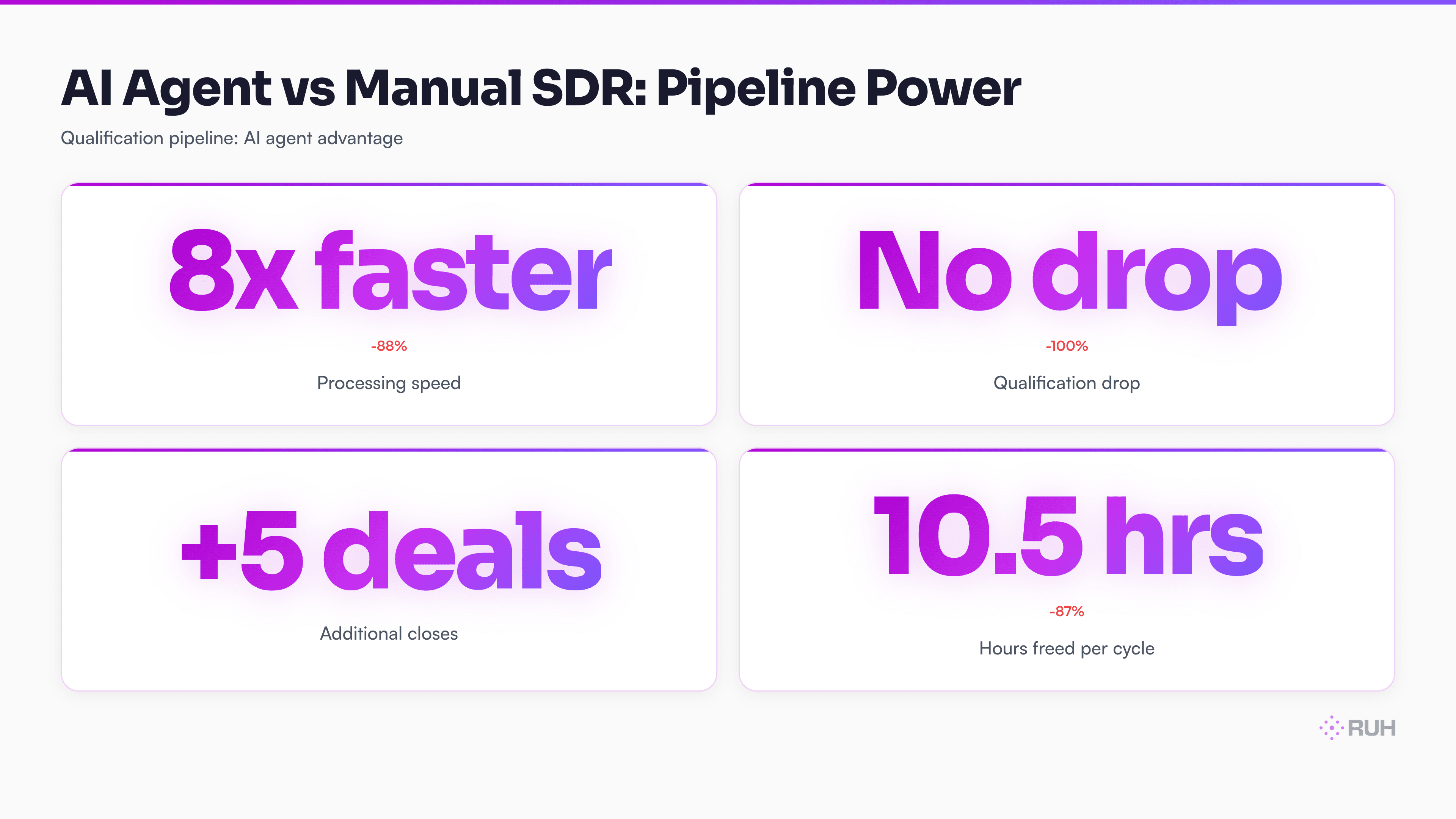
Concretely: Ruh's AI SDR Sarah qualifies 3-5x more leads than a human SDR, books discovery calls 24/7, and costs $3.6K/month vs. $12.5K/month for a human hire. Sarah reads your ideal customer profile, monitors your prospect list, understands which signals indicate buying intent, prioritizes high-intent leads for your team, and prepares discovery context before the call even happens. Your SDRs go from "spend 30 minutes researching this prospect" to "here's your 2-minute brief, here's the context, let's talk."
Deal cycles compress. Your sales team reports back to your finance team that average deal cycles dropped from 6 weeks to 4 weeks. That's not magic — that's the time savings from automating admin work across the entire journey.
According to a Forrester report on AI-augmented sales processes, teams using AI agents for qualification and follow-up report 40-60% faster deal cycles and 15-20% higher close rates. The reason: better lead quality (agents prioritize right), faster response times (agents work 24/7), and less deal decay (agents maintain momentum in the pipeline).
AI Agents in Operations and Finance: The ROI That Pays for Itself
Finance and ops teams deal with volume. Hundreds of invoices monthly. Thousands of expense reports. Contract portfolios across dozens of vendors. The opportunity is massive because the manual work is massive.
Invoice processing: Accounts payable teams spend 15-30 minutes per invoice — extracting data, validating, categorizing, coding, routing. At 200 invoices per month, that's 50-100 hours of labor. An AI agent processes all 200 invoices in 3-4 hours, achieves 99%+ accuracy, and flags the 5-10 that need human review (unusual vendors, missing POs, pricing mismatches). Your AP team goes from "process 200 invoices" to "review 8 exceptions." The cost savings are immediate: 200 invoices × 20 minutes × $30/hour loaded cost = $2,000/month in labor reclaimed. For a $500K company, that's meaningful. For a $50M company, it's transformational.
Vendor and contract monitoring: Most companies don't actively monitor vendor SLAs. They find out a vendor is failing when a customer complains. An AI agent reads your contracts, sets up continuous monitoring, and alerts you when a vendor is trending toward SLA violation. Response time drops from "3 weeks after failure" to "before the failure happens." You renegotiate terms or switch vendors before it impacts revenue.
Financial forecasting and variance analysis: Controllers get a monthly P&L and spend days figuring out why actuals diverged from forecast. An AI agent monitors continuously. It flags unusual spend within 24 hours. It surfaces trends before they compound. If sales are tracking 8% below forecast at day 15, the agent surfaces it and your team adjusts (hire more salespeople, cut marketing spend, adjust quarterly guidance) while there's still time to act.
According to PWC's 2025 CFO survey, finance teams deploying AI agents for routine processing and monitoring report 70-80% labor reduction in invoice processing and 15-25% improvement in forecast accuracy. The labor freed up shifts from "keep up with data" to "interpret data and make decisions."
How to Actually Implement AI Agents Without Disaster
Theory is easy. Implementation is where most teams stumble. Here's what works:
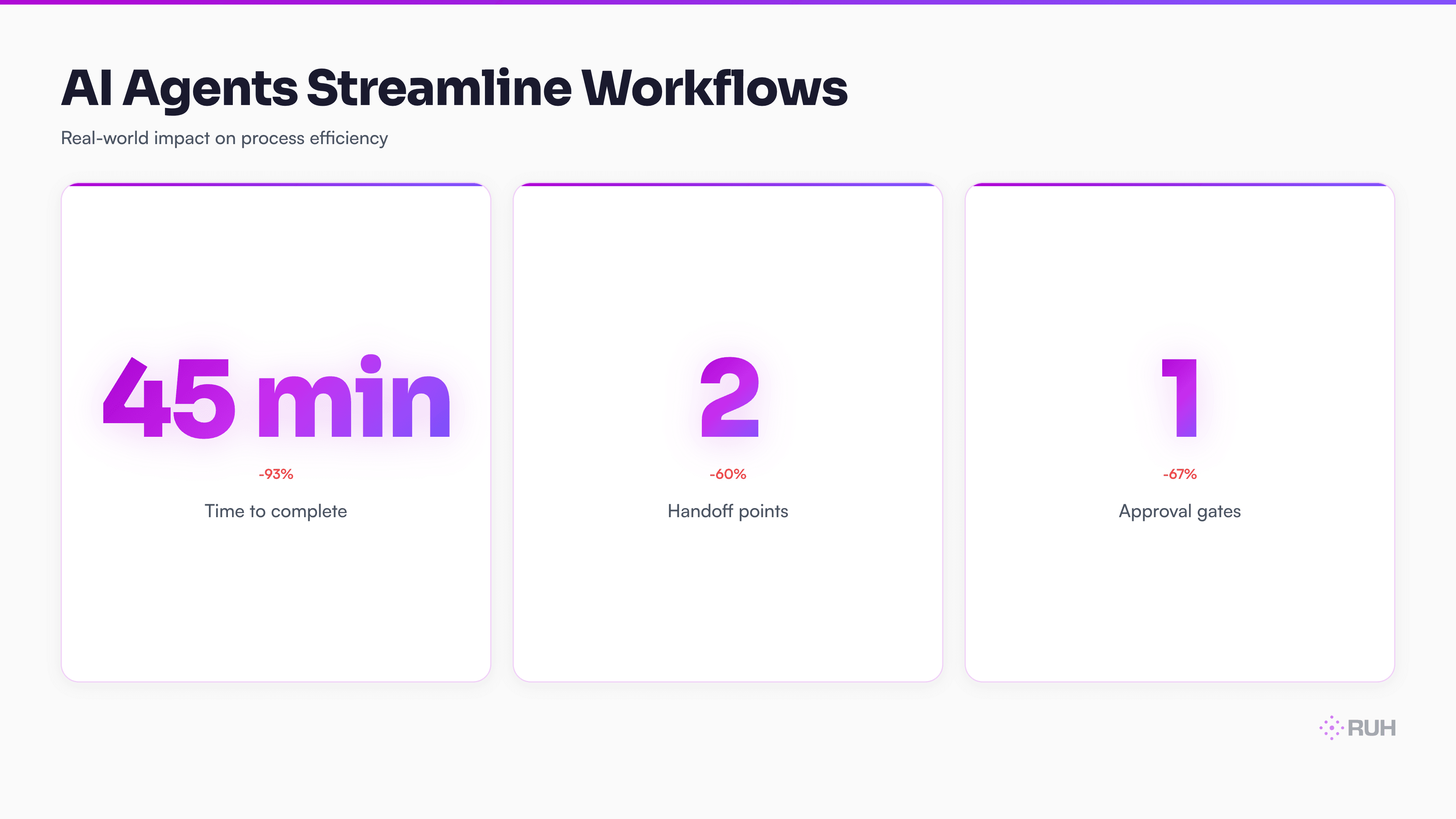
Step 1: Start with internal workflows, not customer-facing processes. Deploy agents on your own invoice processing before deploying them on customer support. Deploy them on lead enrichment and qualification before deploying them on outbound sales calls. Internal workflows have lower risk, faster feedback loops, and higher tolerance for edge cases. You learn fast, build team confidence, and iterate.
Step 2: Map your current process. Where are the decision points? What rules drive them? What exceptions exist? Where do handoffs happen? Where do approvals bottle up? This isn't a week-long exercise. It's a 2-hour conversation with the team doing the work. You'll find 5-7 decision points. Agents excel at automating 3-5 of them.
Step 3: Define what "good" looks like. What are you optimizing for? Time saved? Error reduction? Throughput? Cost avoidance? Cost per transaction? Define baseline metrics before deploying the agent. Measure week-one status quo, deploy the agent, measure week-eight. If you improve on the metrics that matter, you've proven ROI. If not, you iterate and try a different workflow.
Step 4: Pick systems that integrate with your stack. This is non-negotiable. An agent that can't read from Salesforce and write back is almost useless. An agent that requires manual data entry defeats the purpose. Integration cost is usually 60-70% of the project budget for traditional automation. For modern AI agents, it's closer to 20-30% because the agents handle ambiguity and don't need custom coding for every edge case.
Step 5: Set guard rails, not restrictions. You don't need to trust the agent 100%. You need to trust the agent for the decisions you've delegated to it. If the agent is classifying invoices, set rules: approve anything under $5K automatically, flag everything over $25K for human review, require VP sign-off for anything unusual. The agent operates within those boundaries. You maintain control and compliance.
Step 6: Measure everything. What changed? Time per transaction? Error rate? Throughput? Employee satisfaction? Customer wait times? You deployed the agent to improve something specific. Measure it. Share results with your team. Build momentum for the next workflow.
The Honest Assessment: What Still Falls Short
AI agents are not magic. They are not AGI. They are not magic.
Agents are terrible at nuanced, ambiguous, creative decisions. You wouldn't deploy an AI agent to decide whether to fire an employee, whether to abandon a 5-year customer relationship, or whether to enter a new market. These decisions require judgment, context, and accountability. Humans make these decisions. Agents support humans making these decisions by handling the data gathering, option analysis, and pattern flagging.
Agents are only as good as the data they're trained on. If your training data is incomplete, inconsistent, or biased, your agents will make bad decisions at scale. You have to clean your data before deploying agents. This takes effort. Many teams skip it. Those teams get bad results.
Agents can fail silently. A traditional rule-based system gives you an explicit error when it breaks. "This invoice doesn't match PO." An AI agent might misclassify an invoice by 5% without telling you. You have to audit agent decisions regularly, especially in the early stages. Monitor accuracy. Review exceptions. Learn from mistakes.
Agents need governance and audit trails. Regulatory environments (finance, healthcare, legal) require that you prove what decisions were made and why. Black-box machine learning models can't do this. Good AI agents can. They show their reasoning. You log their decisions. You maintain audit trails. But you have to build this in. It doesn't come for free.
Regulatory risk is real but manageable. Some industries are moving slowly on AI adoption because of regulatory uncertainty. But the regulations are maturing. Your legal team can probably approve agent deployment in compliance-sensitive workflows — as long as you maintain human oversight, audit trails, and transparent decision logic. Don't avoid agents because of regulation. Instead, ask your legal team what guardrails you need and build them in.
Where Ruh AI Fits Into This
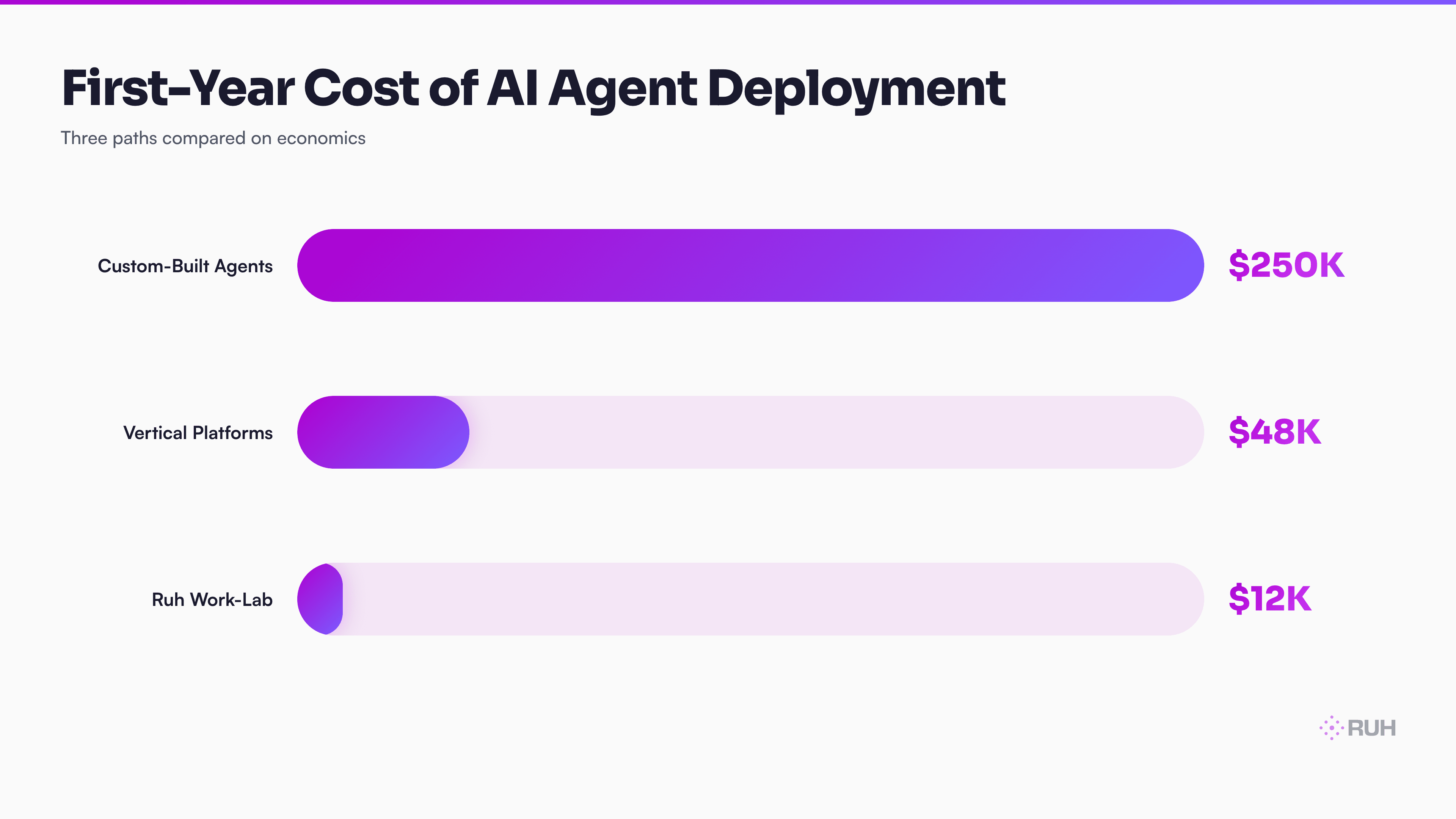
If you're serious about deploying AI agents, you have three choices: build custom agents, use a vertical-specific platform, or use a horizontal platform and customize it yourself.
Building custom agents is expensive ($200K-$500K+ depending on complexity) and requires AI expertise on your team. Most companies don't have that expertise internally.
Vertical-specific platforms (AI solutions for accounting, legal, healthcare) exist but are narrow. They solve specific problems. They don't work across your entire workflow.
Horizontal platforms (tools that let you build agents for any workflow) exist, but most require coding. Ruh's Work-Lab is the exception. It's a no-code platform where you describe the workflow, connect your systems, define decision logic, and deploy. No Python. No API calls. No developer queue. Finance teams, sales operations teams, and HR teams are building agents in Work-Lab without writing a single line of code.
For sales specifically, Ruh's AI SDR Sarah is already built. You don't customize Sarah. You activate her on your Salesforce account, upload your ideal customer profile, and she works. You get 24/7 prospecting, lead qualification, outreach, and meeting booking. Cost: $3.6K/month. Equivalent human SDR: $12.5K/month + 3-4 month ramp time. Sarah is ready to work on day one.
For building custom agents, Ruh Developer provides API access to Ruh's reasoning engine — the same model powering Sarah and Work-Lab agents. You get full customization, team collaboration, and deploy agents into your own systems.
The Trajectory of AI Agents Beyond 2026
Single agents are useful. Multi-agent systems are transformational.
Imagine an AI agent ecosystem in your organization: a sales agent, a finance agent, an ops agent, a customer success agent, and a product feedback agent all collaborating on the same customer record. When a deal closes, the finance agent automatically creates the customer in accounting, sets up payment terms, and schedules billing. The ops agent provisions services. The customer success agent starts onboarding. The product agent flags feature requests from the sales call. Nobody coordinated this. The agents coordinated it.
This is coming. Not "in 10 years." In 2-3 years. Agentic reasoning is improving rapidly. Next-generation agents will handle longer chains of reasoning (thinking through multi-step problems), adapt to novel situations without retraining, and solve problems without human intervention in 80% of cases instead of 60%.
Organizational roles will shift. You won't hire task executors. You'll hire agent designers (people who understand workflow design), agent overseers (people who monitor agent performance), and exception handlers (people who handle the 5-10% of cases agents can't solve). The skills you need are different. The training you need to invest in is different. But the cost is lower and the output is higher.
Industries that adopt agents first will have significant competitive advantages. Your manual-heavy competitors will be struggling with the same cost structure in 2028 while you've already automated and iterated twice. The advantage compounds.
Frequently Asked Questions About AI Agents
Q: Are AI agents the same as agentic AI systems? A: Related but not identical. An "AI agent" is a single autonomous system that handles a specific workflow (like Sarah the SDR). "Agentic AI" is the broader paradigm where multiple agents collaborate on complex problems. In 2026, most deployments are single agents. Multi-agent systems are coming.
Q: What's the minimum viable setup to deploy an AI agent in my organization? A: A defined workflow (map your current process), a system to integrate with (Salesforce, QuickBooks, etc.), and a decision framework (what the agent decides vs. what humans decide). You don't need new infrastructure or a data science team. Most teams can get started in 2-4 weeks.
Q: How much does it cost to deploy an AI agent vs. hiring people? A: For sales prospecting: AI SDR ($3.6K/month) vs. human SDR ($12.5K/month) = ~$110K/year savings. For finance: invoice processing agent ($500-1.5K/month) vs. AP clerk ($50K/year) = ~$40-50K/year savings. ROI is typically 3-6 months. For complex custom agents, expect $250K upfront cost and 12-18 month payback period.
Q: Can legacy systems integrate with AI agents without a rip-and-replace migration? A: Yes. Modern AI agents are designed to integrate with existing systems via APIs, webhooks, and data connectors. You don't replace Salesforce or QuickBooks. The agent reads from them and writes back to them. This is a core design principle for platforms like Ruh Work-Lab and Sarah.
Q: What if the AI agent makes a bad decision? How do I maintain compliance and audit trails? A: Good agents are transparent. They show their reasoning and log their decisions. You review agent decisions regularly, especially in the early stages. You set guardrails (approve transactions under $X automatically, flag everything over $Y for human review). Regulatory compliance is maintained through transparent decision logic and human oversight.
Q: Should I pilot one workflow or deploy agents across my entire organization at once? A: Pilot one workflow. Pick a high-impact, low-risk internal process (invoice processing, lead enrichment, expense categorization). Measure the results. Build team confidence. Then expand to a second workflow. After 2-3 successful workflows, your organization understands how agents work and you can accelerate rollout. Big-bang deployments fail because teams don't trust the agents yet.
Q: What skills do I need on my team to maintain and improve AI agents? A: For no-code platforms like Work-Lab: workflow design and business process knowledge. For API-based agents: basic integration skills and API documentation literacy. You don't need AI experts or data scientists. You need people who understand your business processes and can translate them into agent logic.
The Next Move Is Yours
AI agents in 2026 are not theoretical. They are in production at thousands of companies. They are handling millions of business processes daily. The competitive advantage belongs to organizations that move from "interesting research" to "active deployment" — not in 2027, but now.
You have three options:
Wait and see. Most companies do this. They'll reassess in 2027. By then, their competitors will have already deployed agents, optimized their workflows, and built institutional knowledge. Waiting is the riskiest move.
Pilot one workflow. Pick invoice processing, lead qualification, or expense categorization. Deploy an agent. Measure results. Expand. This costs $500-$5K/month and delivers results in 8-12 weeks.
Go all-in on multi-agent architecture. Hire an agent designer. Build an organizational vision for 5-10 agents across sales, finance, operations, and support. Plan for 18-24 months of buildout. This costs $250K-$500K but positions you as an agentic organization.
The question is no longer "Are AI agents ready?" The question is "Is my organization ready to move beyond email and spreadsheets into autonomous, learning systems?"
Explore Ruh Work-Lab and build your first AI agent today →
Meet Sarah, the AI SDR built for enterprise sales scale →
Learn about Ruh Developer and deploy custom agents →
Talk to the Ruh AI team about agents in your organization →
Moving beyond email and spreadsheets becomes concrete when the agent model reaches quantity and pricing workflows through an AI construction takeoff and cost estimator.