
TL;DR / Summary
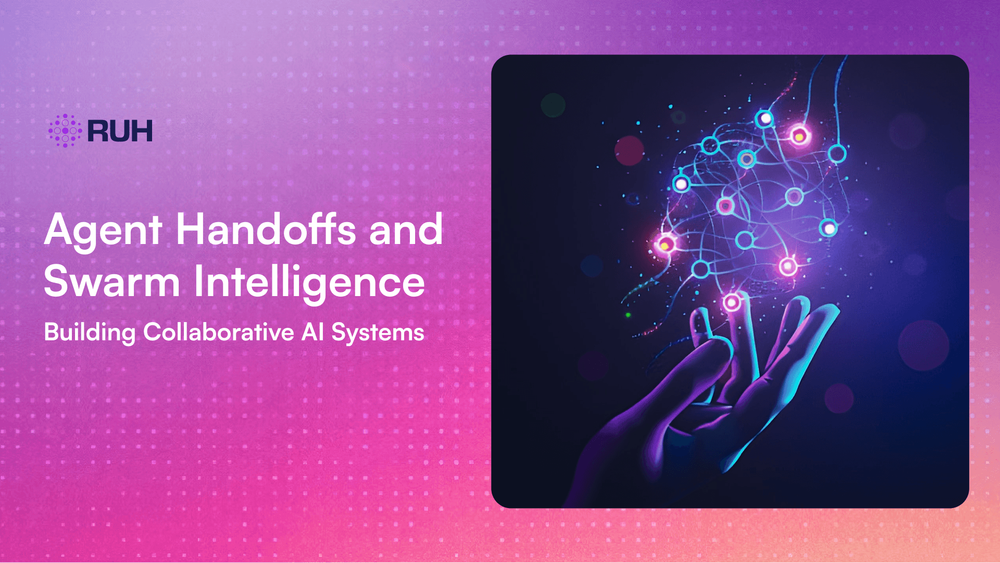
Remember group projects where everyone had a special skill? One person researched, another wrote, someone else presented. Together, you accomplished more than anyone could alone. That's exactly what's happening in AI development today.
Microsoft CEO Satya Nadella said the future isn't about single AI agents—it's about "swarms" collaborating to solve complex problems. Research from Microsoft shows multi-agent systems achieve 70% higher success rates than single-agent approaches.
Ready to see how it all works? Here’s a breakdown of the key elements:
- What Are Agent Handoffs?
- Understanding Swarm Intelligence
- Four Agent Organization Patterns
- Building Your First Agent Swarm
- Framework Comparison
- Real-World Success Stories
- Best Practices
- The Future of Multi-Agent Systems
- Getting Started
- Final Thoughts
- Frequently Asked Questions
What Are Agent Handoffs?
Think about calling customer support. You speak with someone who gathers information, then says, "Let me transfer you to a specialist." That's a handoff—passing the task to someone better qualified.
Agent handoffs work identically. When one AI agent reaches its limit, it transfers control to another agent specialized for the next step. According to Nature Machine Intelligence, specialized agents outperform generalist models by 40-60% on domain-specific tasks.
Three Types of Handoffs
1. Explicit Handoffs: Agent A directly tells Agent B to start. Using OpenAI's Swarm: python
def transfer_to_billing():
    return billing_agent
2. Context-Based: Passes background information, like nurses sharing patient history during shift changes.
3. Conditional: Uses if-then logic to route to different agents based on the situation. Platforms like Ruh.AI use intelligent conditional routing to match user needs with specialized agents.
Real Example: Customer Support
Customer: "I was charged twice."
- Reception Agent identifies billing issue
- Billing Agent verifies duplicate charge
- Refund Agent processes correction
- Confirmation Agent notifies customer
Resolution time drops from hours to minutes through specialization.
Understanding Swarm Intelligence
Watch ants building an anthill. No single ant understands the master plan, yet thousands working together create something remarkable. That's swarm intelligence.
Core Principles
Decentralized Control: No single leader. Each agent makes local decisions.
Local Communication: Agents share information with nearby agents, creating knowledge networks.
Emergent Behavior: Simple rules produce complex intelligence. Stanford AI Lab research shows swarms solve problems no individual agent could tackle.
Self-Organization: When one agent fails, others compensate automatically.
OpenAI research demonstrates swarm architectures provide:
- 70% higher success rates on complex problems
- 50% fewer errors through cross-checking
- 3x faster completion via parallel processing
- 99% uptime through redundancy
Four Agent Organization Patterns
Pattern 1: Agents as Tools
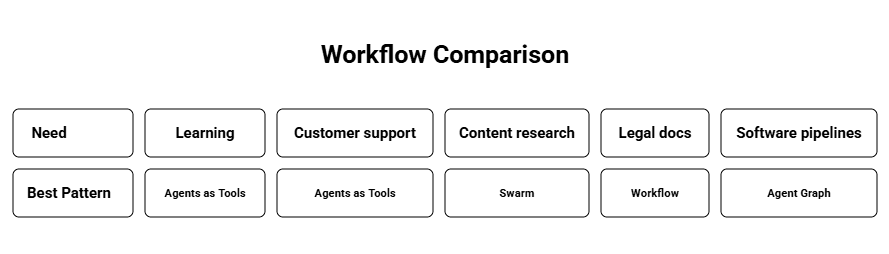
Structure: One orchestrator manages specialists Best for: Clear hierarchies, task delegation Example: Personal assistant routing to calendar, email, research agents
Pattern 2: Swarm Pattern
Structure: Peer agents self-organize without hierarchy Best for: Complex, unpredictable problems Example: Research teams exploring multiple angles
python
swarm = Swarm(
    agents=[research_agent, analysis_agent, writer_agent],
    max_handoffs=5,
    timeout=300
)
Pattern 3: Agent Graph
Structure: Assembly line stations Best for: Multi-stage workflows Example: Software development pipeline
Requirements → Design → Code → Test → Document → Deploy
Pattern 4: Workflow
Structure: Strict sequential steps Best for: Compliance-heavy processes Example: Document processing, order fulfillment
Building Your First Agent Swarm
Let's build a research assistant in 30 minutes.
Prerequisites: Python 3.10+, OpenAI API key
The Architecture
- Research Agent finds information
- Analysis Agent extracts insights
- Writer Agent creates reports
Implementation
python
from swarm import Swarm, Agent
import os

os.environ["OPENAI_API_KEY"] = "your-key"
client = Swarm()

research_agent = Agent(
    name="Research Specialist",
    instructions="Find credible information. Cite sources. Transfer to Analysis when done.",
    functions=[transfer_to_analysis]
)

analysis_agent = Agent(
    name="Analysis Specialist",
    instructions="Identify themes and patterns. Transfer to Writer when complete.",
    functions=[transfer_to_writer]
)

writer_agent = Agent(
    name="Writing Specialist",
    instructions="Create clear reports. Use simple language."
)

def transfer_to_analysis():
    return analysis_agent

def transfer_to_writer():
    return writer_agent

def research_topic(topic):
    response = client.run(
        agent=research_agent,
        messages=[{"role": "user", "content": f"Research: {topic}"}]
    )
    return response.messages[-1]["content"]
Safety Features:
python
client = Swarm(max_turns=10, timeout=300)
For production deployment with monitoring and error handling built-in, Ruh.AI's technology platform handles infrastructure so you can focus on building great agents.
Framework Comparison
OpenAI Swarm: Learning and prototyping - Docs AWS Strands: Enterprise production - Docs LangGraph: Complex workflows - Docs CrewAI: Role-based teams - Docs AutoGen: Research projects - Docs
Real-World Success Stories
Customer Support Automation
Challenge: 24/7 support across multiple domains
Solution: Specialized agent swarm with triage, billing, technical, and escalation agents
Results (Harvard Business Review):
- Response time: 4 hours → 8 minutes (60% reduction)
- 40% cost decrease
- 85% customer satisfaction
Similar results achieved with Ruh.AI's AI SDR solutions, where agents like SDR Sarah handle initial customer interactions intelligently.
Financial Analysis Swarm
Challenge: Process massive real-time data streams
Solution: Parallel agents monitoring market data, news, social media, risk, and recommendations
Results (McKinsey):
- Real-time insights vs. end-of-day delays
- 70% better risk prediction
- Automated portfolio rebalancing
Supply Chain Coordination
Challenge: Dynamic coordination across inventory, demand, routes
Solution: Self-organizing swarm with AWS integration
Results (Deloitte):
- 30% logistics cost reduction
- 25% faster deliveries
- 99.5% on-time delivery rate
Best Practices
1. Specialize Agents
MIT CSAIL research shows specialized agents reduce errors by 45% vs. generalists.
Bad: Agent that "does everything" Good: Email Agent (only email), Data Agent (only analysis)
2. Clear Handoffs
python
def transfer_to_technical_support(issue, user_info, fixes_tried):
    """Transfer when: bug reported, basic fixes failed"""
    return tech_agent
3. Set Safety Limits
Google AI Safety guidelines:
- Max handoffs: 5-10
- Timeouts: 2-5 min (simple), 10-15 min (complex)
- Retries: 2-3 before escalation
4. Monitor Everything
Track agents, handoffs, errors, response times, costs using Amazon CloudWatch.
5. Optimize Costs
Anthropic study shows unoptimized swarms consume 5-10x more tokens. Use shorter instructions, cache responses, choose appropriate models.
6. Keep Humans in Loop
Stanford HAI best practice: Agents handle 80-90% of routine cases, escalate tricky 10-20% to humans.
For teams building customer-facing agents, explore Ruh.AI's marketing solutions and developer tools that include human oversight features.
The Future of Multi-Agent Systems
Standardization (2025-2026): Linux Foundation developing universal protocols for cross-framework compatibility.
Edge Deployment (2026): Agents moving to devices for millisecond responses and offline functionality via AWS IoT Greengrass.
Self-Organization (2026-2027): DeepMind research shows swarms learning to optimize division of labor autonomously.
Enterprise Adoption (2025-2026): Gartner predicts 80% of Fortune 500 companies will deploy multi-agent systems by 2026.
Multi-Modal Integration (2025-2026): Swarms processing text, images, video, audio simultaneously using models like Google Gemini.
Getting Started
Week 1: Foundation
- Install OpenAI Swarm
- Build the tutorial assistant
- Experiment with handoffs
Week 2: Experimentation
- Add specialists
- Try different patterns
- Test error scenarios
Week 3: Real Application
- Identify a problem
- Design specialized swarm
- Deploy and iterate
Resources
- OpenAI Swarm
- AWS Bedrock
- LangGraph
- Microsoft AutoGen
- Ruh.AI Blog for more insights
Final Thoughts
Multi-agent systems shift AI from monolithic models to collaborative teams. The frameworks are maturing rapidly. What's experimental today becomes standard tomorrow.
Start small—build a two-agent system for a work problem. Add specialists. Before long, you'll have sophisticated swarms automating hours of work.
The future of AI is collaboration.
Ready for production deployment? Ruh.AI provides managed agent orchestration with monitoring, error handling, and scaling built in. Explore our Work Lab to see agent collaboration in action, or contact us to discuss your specific needs.
Frequently Asked Questions
What's the difference between single agents and swarms?
Ans: Single agents do everything themselves. Swarms distribute work among specialists, achieving 40-70% better results on complex tasks.
How much does it cost?
Ans: Expect 3-5x more API calls than single agents, but faster completion with fewer retries. Typical costs: $0.10-$0.50 per simple conversation, $1-$5 for complex research.
How do I prevent infinite loops?
Ans: Configure max_handoffs (5-10) and timeouts (2-15 minutes). Include loop detection. Test thoroughly.
When should I use swarms vs. single agents?
Ans: Use swarms when tasks require multiple expertise domains, need parallel processing, demand resilience, or involve complex unpredictability.
How long to build production swarms?
Ans: Prototype: 1-2 days. Production MVP: 1-2 weeks. Enterprise-grade: 1-3 months. Platforms like Ruh.AI reduce this to days.
What about security?
Ans: Encrypt communications, implement role-based access, audit all actions, store data securely, comply with GDPR/HIPAA.
Can agents learn over time?
Ans: Yes, through storing successful patterns, learning from corrections, A/B testing strategies, and reinforcement learning.
What happens when agents fail?
Ans: Well-designed swarms include retry logic, fallback agents, human escalation, and graceful degradation.