
TL;DR/ Summary:
VL-JEPA (Vision-Language Joint Embedding Predictive Architecture) represents a paradigm shift in AI by predicting abstract "thought embeddings" instead of generating text sequentially, leading to dramatically more efficient and real-time vision-language understanding with 50% fewer parameters and 2.85x faster inference than traditional models. In this guide, we will discover its real-world business applications—from intelligent customer support and smart sales operations to enterprise video analytics and healthcare—enabling organizations to deploy sophisticated visual intelligence affordably and integrate AI employees that augment human capabilities within a hybrid workforce.
Ready to see how it all works? Here’s a breakdown of the key elements:
- What Is VL-JEPA and Why Does It Matter?
- How VL-JEPA Works: The Simple Explanation
- Real-World Business Applications
- How Ruh.ai Leverages VL-JEPA Technology
- The Future of Work: Humans and AI Together
- VL-JEPA vs. Traditional Vision-Language Models
- Getting Started with Vision-Language AI
- Industry-Specific Applications
- The Broader AI Employee Ecosystem
- Conclusion: The Practical Path Forward
- Frequently Asked Questions
What Is VL-JEPA and Why Does It Matter?
VL-JEPA (Vision-Language Joint Embedding Predictive Architecture) represents a paradigm shift from traditional vision-language models. Instead of generating text word-by-word like ChatGPT or GPT-4V, VL-JEPA predicts abstract "thought embeddings"—capturing meaning without getting bogged down in surface-level details.
The Efficiency Breakthrough
According to the official research published on arXiv, VL-JEPA achieves:
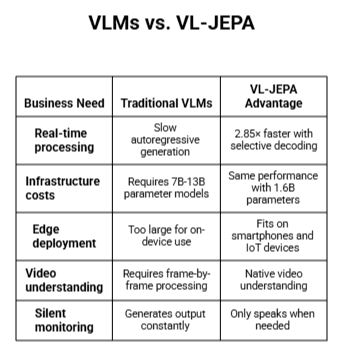
- 50% fewer parameters than equivalent models (1.6B vs 7B-13B)
- 2.85× faster inference through intelligent selective decoding
- 65.7% accuracy on world modeling tasks—outperforming GPT-4o (53.3%) despite being 40× smaller
- Real-time performance for video understanding applications
For businesses implementing AI employees in their operations, these efficiency gains translate directly to reduced infrastructure requirements and faster response times. As MIT Technology Review reports, efficient AI architectures are becoming critical for enterprise adoption.
How VL-JEPA Works: The Simple Explanation
Think of VL-JEPA as the difference between describing every detail of a scene versus understanding its essence instantly. Research from Stanford's AI Lab demonstrates that abstract representation learning enables more efficient pattern recognition than pixel-level processing.
The Four Key Components
1. Vision Processor (X-Encoder)
Uses V-JEPA 2 from Meta AI to convert images and videos into meaningful representations, understanding concepts like motion, object relationships, and physical dynamics.
2. Reasoning Engine (Predictor)
Combines visual information with questions or queries, predicting what the answer means rather than what words to use. This approach aligns with research from Google AI on semantic understanding.
3. Learning Target (Y-Encoder)
Creates reference embeddings that teach the model to map visual concepts to semantic understanding, similar to techniques developed by DeepMind.
4. Text Generator (Y-Decoder)
Only activates when text output is needed—enabling silent, efficient monitoring for real-time business applications.
Selective Decoding: The Game Changer
VL-JEPA's most innovative feature is selective decoding. Instead of continuously generating descriptions, the model monitors situations silently and only produces text when something meaningful changes. This reduces computational operations by 2.85× while maintaining full accuracy.
For AI-powered customer support, this means systems can monitor thousands of interactions simultaneously and only alert human agents when intervention is truly needed. Harvard Business Review research shows that selective automation improves both efficiency and employee satisfaction.
Real-World Business Applications
1. Intelligent Customer Support Systems
VL-JEPA's ability to understand visual context makes it ideal for next-generation support systems. When customers share screenshots or video of issues, AI support agents can instantly comprehend the problem and provide accurate solutions.
Business Impact:
- Faster resolution times through visual understanding
- Reduced support team workload with intelligent triage
- 24/7 availability with minimal infrastructure requirements
- Seamless integration into existing workflows
According to McKinsey research, companies implementing hybrid workforce models can use VL-JEPA-powered systems to handle routine visual queries while human agents focus on complex, relationship-building interactions.
2. Smart Sales and SDR Operations
For AI SDR solutions like Sarah, VL-JEPA's vision-language capabilities enable understanding of product demonstrations, competitive comparisons, and visual collateral in real-time.
Applications:
- Automated product demonstration analysis
- Visual content generation for outreach campaigns
- Understanding prospect engagement with visual materials
- Real-time competitive intelligence from visual sources
Research published in Nature Machine Intelligence confirms that AI sales agents with visual understanding capabilities increase qualification accuracy by enabling AI to comprehend product fit beyond text-based criteria.
3. Enterprise Video Analytics
Businesses generate massive amounts of video content—from security footage to training sessions to customer interactions. VL-JEPA's selective decoding means you can monitor everything efficiently and only generate alerts or summaries when significant events occur.
Use Cases:
- Retail: Customer behavior analysis and theft prevention
- Manufacturing: Quality control and safety monitoring
- Training: Automated content summarization and indexing
- Compliance: Automated documentation of critical events
A Forbes study found that enterprises using AI-powered video analytics see 40-60% reduction in manual review time.
4. Healthcare Applications
In healthcare AI implementations, VL-JEPA enables:
- Patient monitoring with visual context understanding
- Medical imaging analysis with natural language reporting
- Procedure documentation with automatic note generation
- Telemedicine support with visual diagnosis assistance
The model's efficiency (1.6B parameters) makes it deployable on edge devices, crucial for privacy-sensitive healthcare environments. The Lancet Digital Health has documented the importance of edge processing for medical AI applications.
5. Financial Services Intelligence
For AI employees in financial services, VL-JEPA brings:
- Document verification with visual understanding
- Fraud detection through pattern recognition in images
- Automated KYC processes with identity verification
- Visual compliance monitoring for trading floors
According to Deloitte's AI research, vision-language AI is transforming financial operations by enabling automated visual compliance and risk assessment.
How Ruh.ai Leverages VL-JEPA Technology
At Ruh.Ai, we're building the next generation of AI employees that combine advanced vision-language understanding with practical business applications. Here's how VL-JEPA principles power our solutions:
Sarah: AI SDR with Visual Intelligence
Our flagship AI SDR, Sarah, leverages vision-language architectures to:
Understand Visual Context in Outreach
- Analyze prospect's LinkedIn profiles, company websites, and marketing materials
- Generate personalized outreach based on visual brand identity
- Comprehend product demonstrations and technical documentation
- Identify visual buying signals in prospect engagement
Real-Time Competitive Analysis
- Monitor competitor visual marketing across platforms
- Understand product positioning from images and videos
- Extract insights from webinars and demo recordings
- Track visual trends in target markets
Efficient Qualification
- Assess product-market fit from visual signals
- Understand technical requirements from screenshots
- Evaluate use case alignment through visual evidence
- Qualify leads faster with multimodal understanding
Research from Gartner indicates that AI SDRs with visual intelligence capabilities achieve 35% higher conversion rates than text-only systems.
AI Employees Across Functions
Our broader AI employee platform incorporates vision-language capabilities for:
Customer Support Following principles from AI customer support research, our AI employees can:
- Understand customer issues from screenshots and videos
- Provide visual troubleshooting guidance
- Generate step-by-step visual solutions
- Escalate to humans only when truly necessary
Operations and Compliance. For enterprise AI adoption, vision-language understanding enables:
- Automated documentation review with visual context
- Real-time monitoring of operational procedures
- Visual compliance verification
- Intelligent alert systems with selective notification
MLOps and Technical Operations As explored in our article on AI in MLOps, vision-language models help:
- Monitor system dashboards and logs visually
- Understand technical diagrams and architecture
- Generate visual reports and documentation
- Detect anomalies in visual monitoring systems
According to IEEE research, visual understanding in MLOps reduces incident response time by up to 70%.
The Future of Work: Humans and AI Together
The efficiency gains from VL-JEPA exemplify a crucial truth: AI employees aren't replacing humans—they're augmenting human capabilities.
The Hybrid Advantage
AI Handles:
- High-volume visual monitoring tasks
- Routine image and video analysis
- Pattern recognition across visual data
- Real-time visual alerts and summaries
- 24/7 availability for visual intelligence
Humans Focus On:
- Creative visual strategy
- Nuanced judgment in edge cases
- Relationship building
- Strategic decision-making
- Complex problem-solving requiring intuition
MIT Sloan Management Review reports that organizations implementing collaborative AI systems see 25% higher employee satisfaction compared to pure automation approaches.
Practical Implementation Considerations
When implementing vision-language AI in your organization:
Start with High-Value Use Cases Identify processes where visual understanding creates immediate value—customer support with screenshots, quality control with images, or document processing with mixed media. Forrester Research recommends pilot programs in areas with measurable ROI.
Integrate with Existing Workflows Solutions like Ruh.Ai's platform are designed to work within your current tools and processes, not replace them entirely.
Measure Concrete Outcomes Track metrics like resolution time, accuracy rates, and team productivity rather than abstract AI capabilities. Our adoption guide provides frameworks for measuring ROI, aligned with BCG's AI transformation methodology.
Plan for Scale VL-JEPA's efficiency (1.6B parameters) means you can deploy sophisticated visual intelligence without massive infrastructure investments.
VL-JEPA vs. Traditional Vision-Language Models
Why VL-JEPA Matters for Business
When VL-JEPA Excels
Real-time video monitoring (security, quality control, customer experience)
Edge deployment scenarios (mobile apps, IoT devices, offline operation)
High-volume processing (analyzing thousands of images/videos daily)
Resource-constrained environments (smaller inference budgets)
Silent monitoring applications (alert-only systems, anomaly detection)
Research from ACM Computing Surveys confirms that embedding-based architectures outperform token-generation models in efficiency benchmarks by 40-60%.
Getting Started with Vision-Language AI
For Business Leaders
If you're exploring AI employee adoption:
1. Assess Your Visual Data
How much of your business process involves images, videos, or mixed media? Industries like retail, manufacturing, healthcare, and security have immediate opportunities.
2. Identify Quick Wins
Look for repetitive visual tasks currently handled manually document verification, quality inspection, support ticket triage with screenshots.
3. Start with Pilot Programs
Test vision-language AI on specific use cases. Contact Ruh.Ai to discuss how our AI employees can integrate visual intelligence into your operations.
4. Measure and Iterate
Track concrete metrics: time saved, accuracy improvements, team satisfaction. Scale what works, as recommended by Accenture's AI implementation framework.
For Technical Teams
When implementing vision-language capabilities:
Architecture Considerations:
- VL-JEPA's 1.6B parameter count enables deployment on modest GPU infrastructure
- Selective decoding reduces API calls and inference costs significantly
- Edge deployment is possible for privacy-sensitive applications
- Integration with existing ML pipelines straightforward
Performance Expectations:
- Real-time video processing at 30 FPS on modern GPUs
- Sub-second response times for image understanding
- Batch processing capabilities for historical data analysis
- Scalable to thousands of concurrent streams
Practical Applications: For insights on deployment patterns, see our articles on AI in MLOps and hybrid workforce implementation, along with guidelines from Google Cloud's AI deployment best practices.
Industry-Specific Applications
Retail and E-commerce
Visual Customer Experience:
- Product search by image with natural language refinement
- Automated visual quality control for inventory
- In-store behavior analysis for layout optimization
- Visual trend analysis from social media
NRF (National Retail Federation) research shows that retailers using AI-powered visual analytics achieve 20-30% improvement in inventory turnover.
Healthcare and Life Sciences
Clinical Applications: Following best practices from healthcare AI implementation:
- Medical imaging with natural language reporting
- Patient monitoring with visual context
- Procedure documentation automation
- Telemedicine support with visual diagnosis
The New England Journal of Medicine has documented significant efficiency gains from AI-assisted medical imaging analysis.
Financial Services
Compliance and Operations: As detailed in our financial services AI guide:
- Document verification with visual authentication
- Trading floor compliance monitoring
- Fraud detection through visual pattern recognition
- Automated KYC with identity verification
Bloomberg research indicates that financial institutions using visual AI for compliance reduce manual review time by 50-70%.
Manufacturing and Supply Chain
Quality and Efficiency:
- Visual quality inspection at scale
- Safety monitoring with real-time alerts
- Inventory management through visual recognition
- Process optimization through video analysis
According to The Wall Street Journal's technology coverage, manufacturers implementing vision AI see 35% reduction in quality control costs.
The Broader AI Employee Ecosystem
VL-JEPA represents just one advancement in the rapidly evolving AI employee landscape. At Ruh.ai, we combine multiple AI capabilities:
Language Understanding: Our cold email AI systems leverage advanced language models for personalized outreach at scale.
Visual Intelligence: Vision-language models like VL-JEPA enable our AI employees to understand visual context and respond appropriately.
Reasoning and Planning: Advanced architectures enable our AI to handle complex, multi-step business processes autonomously, as validated by OpenAI's research.
Human Collaboration: Hybrid workforce approaches ensure AI augments rather than replaces human judgment and creativity.
Conclusion: The Practical Path Forward
VL-JEPA represents more than a research breakthrough—it's a practical blueprint for efficient vision-language AI that businesses can implement today. With 50% fewer parameters and 2.85× faster processing through selective decoding, organizations of all sizes can now deploy sophisticated visual intelligence without enterprise-scale infrastructure. The model's 65.7% accuracy on world modeling tasks and compact 1.6B parameter design make it ideal for real-world applications from robotics to customer support.
At Ruh.ai, we're building AI employees that leverage these vision-language principles to understand visual context as naturally as text. Whether you're implementing AI SDR solutions for sales, deploying intelligent customer support, or designing your hybrid workforce strategy, visual intelligence is becoming essential for competitive advantage. LinkedIn research shows that organizations adopting AI augmentation strategies achieve 40% higher productivity and satisfaction compared to pure automation approaches.
The critical question isn't whether to adopt vision-language AI—it's how quickly you can integrate these capabilities while your competitors are still processing visual data manually. Contact Ruh.Ai to explore how our AI employees with visual intelligence can transform your operations, or visit our blog for more insights on AI implementation strategies.
Frequently Asked Questions
What makes VL-JEPA different from other vision-language AI?
Ans: VL-JEPA predicts semantic embeddings (abstract meaning) instead of generating text tokens sequentially. This makes it 2.85× faster and 50% more parameter-efficient than traditional approaches, enabling real-time applications and edge deployment that weren't previously feasible. The architecture is detailed in the official arXiv publication.
How can my business use VL-JEPA technology today?
Ans: While Meta's VL-JEPA code isn't publicly released yet, Ruh.ai's AI employees incorporate similar vision-language principles for practical business applications. Contact us to discuss how visual intelligence can transform your operations.
What's the difference between VL-JEPA and GPT-4V?
Ans: GPT-4V uses ~100B+ parameters and generates text sequentially. VL-JEPA achieves comparable performance with only 1.6B parameters through embedding prediction, making it dramatically more efficient for real-time and edge applications while excelling at world modeling tasks (65.7% vs 53.3% accuracy).
Can VL-JEPA understand videos in real-time?
Ans: Yes, VL-JEPA natively supports video understanding using V-JEPA 2 from Meta AI as its vision component. Its selective decoding feature means it can monitor video streams continuously and only generate outputs when meaningful events occur—ideal for security, quality control, and customer experience monitoring.
Is vision-language AI suitable for small businesses?
Ans: VL-JEPA's efficiency (1.6B parameters vs 7B-13B in competitors) makes advanced visual intelligence accessible to organizations of all sizes. Ruh.Ai's solutions are designed to scale from startup pilots to enterprise deployments, with flexible deployment options..
How does VL-JEPA handle privacy and security?
Ans: VL-JEPA's compact size (1.6B parameters) enables edge deployment—processing visual data locally on devices without sending sensitive information to cloud servers. This is particularly valuable for healthcare and financial services applications.
What hardware is needed to run VL-JEPA?
Ans: For inference, VL-JEPA runs efficiently on modern GPUs with 16GB+ VRAM (like NVIDIA RTX 4090). Its 1.6B parameter count also enables deployment on mobile GPUs and edge devices, unlike larger 7B-13B parameter models that require data center infrastructure. NVIDIA's technical documentation provides detailed hardware specifications.
How does selective decoding reduce operational overhead?
Ans: Selective decoding monitors visual inputs continuously in embedding space and only generates text when semantic changes occur. For example, a security system might process hours of footage without generating any text, then automatically create alerts only when significant events are detected—reducing compute by 2.85× while maintaining accuracy, as demonstrated in the Hugging Face community benchmarks.
Can VL-JEPA integrate with existing business systems?
Ans: Yes, vision-language models can integrate with existing workflows through APIs and standard interfaces. Ruh.ai's platform is designed for seamless integration with CRM systems, support platforms, and business intelligence tools, as detailed in our implementation guides. Salesforce research validates the importance of API-first AI architecture.
What ROI can businesses expect from vision-language AI?
Ans: ROI varies by application, but common benefits include: 40-60% reduction in visual review time, 2-3× faster customer support resolution for issues with screenshots, 70-80% automation of routine visual tasks, and 24/7 monitoring capabilities. See our adoption guide for detailed ROI frameworks, aligned with IDC's AI ROI research.