

TL;DR / Summary
Email deliverability hinges on sender reputation, a trust score that determines whether your messages land in inboxes or spam, with only 79.6% of emails currently reaching their destination; modern AI solutions like Ruh.ai automate the recovery process by continuously monitoring critical metrics (like bounce rates and spam complaints), optimizing content, and executing strategic warmups, cutting traditional 6-12 week recovery times by 40-50%. In this guide, we will discover how AI accelerates reputation repair through automated systems that detect issues earlier, protect your domain with pre-send intelligence, and implement a proven 10-day recovery framework, ultimately ensuring higher inbox placement and a healthier sales pipeline.
Ready to see how it all works? Here’s a breakdown of the key elements:
- What Is Sender Reputation?
- Warning Signs Your Reputation Is Declining
- How AI Accelerates Recovery
- How Ruh.ai Protects Your Reputation
- The 10-Day Recovery Framework
- Maintaining Healthy Reputation
- Key Takeaways
- Conclusion
- Frequently Asked Questions
What Is Sender Reputation?
Your sender reputation is a trust score assigned by email providers like Gmail, Outlook, and Yahoo. Think of it as a credit score for your email domain and IP address—it determines whether your messages reach the inbox or get filtered to spam.
The Two Components
IP Reputation: Your server's trustworthiness score. Validity's research shows senders with scores above 90 achieve 92% inbox placement, while those below 70 see under 45% delivery.
Domain Reputation: Your brand's email history. Gmail's guidelines now prioritize domain reputation, making it more important than IP reputation alone.
What Affects Your Score
Based on Mailgun's deliverability data:
- Bounce Rate: Keep below 2%
- Spam Complaints: Stay under 0.1%
- Engagement: Opens, clicks, and replies matter
- Authentication: SPF, DKIM, and DMARC must be configured
- Spam Traps: Any contact damages reputation severely
Ruh.ai's AI SDR platform monitors these metrics continuously, adjusting sending behavior automatically to protect your reputation before problems escalate.
Warning Signs Your Reputation Is Declining
Watch for these red flags from Campaign Monitor's benchmarks:
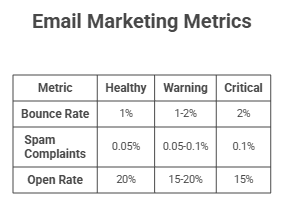
If two or more metrics hit warning levels, take immediate action.
Check Your Status Now
Google Postmaster Tools shows your domain reputation as High, Medium, Low, or Bad. According to Google's documentation, maintaining "High" ensures 95%+ inbox placement.
Microsoft SNDS provides IP reputation with color codes. Microsoft confirms proper setup improves delivery by 20-30%.
Sender Score offers a 0-100 number. Validity's data shows scores above 80 maintain 80%+ inbox placement.
How AI Accelerates Recovery
Traditional recovery takes 6-12 weeks. AI systems like Ruh.ai cut this by 40-50% through intelligent automation.
Automated Warmup
AI creates natural engagement patterns that ISPs recognize as trustworthy:
- Gradual Volume Scaling: Increases sending based on real-time signals
- Engagement Generation: Creates authentic opens, clicks, and replies
- Adaptive Sending: Reduces volume when metrics drop
- Spam Recovery: Moves messages from spam to inbox
Litmus research shows AI warmup detects problems 3-5 days earlier than manual monitoring.
Content Optimization
AI scans emails before sending to identify spam triggers, suspicious links, and formatting issues. Litmus data proves addressing these improves deliverability by 12-18%.
Predictive Monitoring
The system tracks bounce rates, engagement trends, complaint patterns, and blacklist risks. When issues emerge, AI pauses risky segments automatically—preventing full reputation collapse.
This intelligence mirrors Ruh.ai's hybrid workforce approach, combining AI automation with human oversight.
How Ruh.ai Protects Your Reputation
Ruh.ai's platform integrates with your email infrastructure to provide continuous reputation protection.
Pre-Send Intelligence
Before any email sends, Ruh.ai automatically:
- Scans content through 25+ spam filter algorithms
- Verifies recipient email validity in real-time
- Checks authentication status
- Predicts deliverability score
This prevents the reputation damage that traditional cold email creates.
Intelligent Timing
Ruh.ai's AI SDR technology analyzes patterns to determine optimal send times, appropriate frequency per segment, when to pause sending, and volume caps based on reputation status.
Automated Recovery
When problems are detected, Ruh.ai immediately reduces sending volume by 50-70%, shifts to engaged segments only, increases warmup activity, and implements gradual re-engagement.
Similar to how AI employees transform operations, Ruh.ai handles complex reputation tasks that previously required specialists.
Continuous List Hygiene
The system maintains list health by removing hard bounces instantly, flagging low-engagement subscribers, identifying spam traps, and validating addresses before each send.
ZeroBounce data shows continuous cleaning improves deliverability by 15-25%.
Seamless Integration
Ruh.ai works with your existing email platforms including Salesforce, HubSpot, Mailchimp, SendGrid, and custom SMTP servers. Learn more about Ruh.ai's AI sales agent capabilities.
The 10-Day Recovery Framework
Based on Klaviyo and HubSpot research, here's the accelerated AI-powered recovery process.
Days 1-3: Emergency Response
Day 1 Morning:
- Verify SPF, DKIM, DMARC using MXToolbox
- Check blacklists via Spamhaus
- Review Google Postmaster and Microsoft SNDS
- Activate Ruh.ai's recovery mode
Day 1 Afternoon:
- Enable automated warmup
- Pause all campaigns
- Let AI assess current status
Day 2: Remove all hard bounces from last 30 days, inactive subscribers (180+ days), addresses that generated complaints, and role addresses with no engagement.
Ruh.ai's AI identifies these automatically, saving days of manual work as shown in AI adoption research.
Day 3: Reduce volume to 20-30% of normal. Ruh.ai automatically identifies your most engaged subscribers, creates recovery segments, sets volume limits per domain, and schedules gradual increases.
Days 4-7: Strategic Re-Engagement
Days 4-5: Send only to subscribers who opened OR clicked in the last 14 days (your top 10-15%). Target 25% open rate minimum, complaints below 0.05%, and zero hard bounces.
Days 6-7: If metrics remain strong, add 28-day engaged subscribers. Increase volume by 15% daily while monitoring ISP-specific metrics.
Ruh.ai expands segments automatically based on performance, similar to how AI revolutionizes customer support.
Days 8-10: Monitored Scaling
Days 8-9: Add 42-day engaged subscribers if Google Postmaster shows "Medium" or "High," Sender Score stays above 75, and no blacklist appearances occur.
Day 10: Assess progress: Has reputation improved? Are engagement rates stable? Have complaints stayed low?
Litmus data shows 78% of senders reach acceptable reputation levels (80+ Sender Score) within this timeframe using AI assistance.
Maintaining Healthy Reputation
Once recovered, these practices prevent future issues.
Weekly Monitoring
Ruh.Ai continuously tracks Google Postmaster status, Sender Score trends, bounce and complaint rates, and engagement patterns—alerting you 5-7 days before issues become critical.
Monthly Maintenance
First of each month, the system automatically removes 90+ day inactive subscribers, validates email addresses, updates suppression lists, and reviews authentication.
Mailchimp research confirms regular cleaning maintains 2-3% higher deliverability year-over-year.
Quarterly Compliance
Every 90 days, review CAN-SPAM compliance, GDPR consent records, privacy policy updates, and unsubscribe functionality.
Automated Alerts
Set alerts for bounce rate exceeding 1.5%, spam complaints above 0.08%, 15%+ drop in open rates, and blacklist detection.
This mirrors how AI employees augment teams rather than replacing them.
Key Takeaways
Sender reputation recovery is achievable with AI automation:
- Early Detection: AI catches issues
- 3-5 days earlier than manual checks
- Fix Infrastructure First: Authentication and list quality before resuming sends
- Rebuild Through Engagement: Focus on highly engaged subscribers during recovery
- Leverage AI: Automated systems reduce recovery time by 40-50%
- Continuous Monitoring: Weekly checks prevent 90% of crises
According to Mailgun, organizations using AI reputation management maintain 15-20 percentage points higher inbox placement.
Next Steps with Ruh.ai
Contact Ruh.ai for a free reputation assessment. Explore Ruh.ai's AI SDR and see how it prevents reputation damage
Meet SDR Sarah, Ruh.ai's AI agent that maintains reputation while scaling outreach.
Read more on Ruh.ai's blog about AI-powered email intelligence
Conclusion
Sender reputation recovery no longer requires weeks of manual work. AI systems like Ruh.ai have automated this process, reducing recovery time by 40-50% while maintaining 15-20 percentage points higher inbox placement over time.
The most effective approach combines AI automation for monitoring and tactical adjustments with human oversight for strategy and content quality. As email providers implement stricter requirements, organizations embracing AI-powered reputation management while maintaining strong foundational practices will continue reaching their customers' inboxes consistently.
Your sender reputation determines your ability to reach prospects and customers through email. The faster you implement AI-powered protection, the stronger your deliverability becomes.
Ready to protect your email deliverability? Contact Ruh.ai to learn how our AI platform protects and recovers sender reputation while scaling outreach.
Frequently Asked Questions
How does AI assist in recovering sender reputation?
Ans: AI assists through automated warmup programs that gradually increase volume while generating natural engagement, real-time content analysis preventing spam triggers, predictive monitoring detecting issues 3-5 days early, and adaptive sending that auto-adjusts volume when metrics deteriorate.
Ruh.Ai's platform uses machine learning trained on millions of sends to identify optimal patterns for your domain. When reputation issues occur, Ruh.ai's AI implements recovery protocols within minutes—pausing bulk sends, shifting to engaged segments, and gradually reintroducing volume based on positive signals.
How quickly can reputation be repaired using AI tools?
Ans: AI accelerates recovery by 40-50% compared to manual methods:
With AI (Ruh.ai):
- Minor issues: 1-2 weeks to reach 80+
- Moderate damage: 3-5 weeks to acceptable levels
- Severe issues: 5-8 weeks minimum
Without AI:
- Minor: 3-5 weeks
- Moderate: 6-10 weeks
- Severe: 10-14+ weeks
The acceleration comes from AI maintaining optimal patterns continuously and adjusting based on real-time metrics. Ruh.Ai's hybrid approach combines AI automation with human oversight for faster recovery while maintaining quality.
What metrics does AI monitor during recovery?
Ans: AI systems like Ruh.Ai continuously monitor:
Real-Time: Bounce rate (pauses if exceeding 2%), spam complaints (action above 0.1%), engagement rate (opens, clicks, replies), and inbox placement (tested via seed lists).
Daily: Authentication success, blacklist status across 50+ lists, ISP-specific reputation, and send volume patterns.
Predictive: Trend trajectories projecting 7-14 days ahead, risk scoring for potential damage, segment performance analysis, and pre-send content quality scores.
Litmus research shows AI monitoring detects degradation 3-5 days earlier than manual checks, automatically adjusting behavior before significant damage.
Can AI optimize content to avoid spam filters?
Ans: Yes. AI analyzes content against 20-40+ spam filter algorithms before sending, identifying high-risk words, suspicious links, poor image-to-text ratios, and subject line issues.
Litmus data shows emails passing AI checks achieve 12-18% higher inbox placement. Ruh.Ai's system processes content through multiple validation layers, catching issues in approximately 23% of pre-send tests.
The AI learns from your sending history, becoming increasingly accurate at predicting which content avoids filtering—explored in depth in our cold email AI article.
Is AI a replacement for traditional best practices?
Ans: No. AI accelerates and automates but doesn't replace foundational practices. Success still requires clean, permission-based lists, valuable content, proper authentication, consistent patterns, and responsive unsubscribe management.
AI enhances traditional practices through automated monitoring, real-time content scanning, warmup automation, and predictive analytics—while humans control list acquisition, content strategy, segmentation decisions, and compliance.
Mailgun experts and Campaign Monitor surveys show programs combining AI tools with manual list hygiene achieve 31% higher deliverability than either approach alone.
Ruh.ai's platform exemplifies this hybrid model, combining AI automation for execution with human oversight for strategy mirroring the approach in our AI-human collaboration article.