


TL;DR
Email infrastructure scaling requires strategic multi-domain architecture, AI agent orchestration, and disciplined warm-up protocols. Organizations moving from 1,000 to 1 million daily sends need 20-40 authenticated domains with proper SPF, DKIM, and DMARC configuration. Ruh.ai's AI SDR platform automates the entire email infrastructure workflow from prospect research to reply classification maintaining 95%+ deliverability rates while reducing manual workload by 70-80%. Modern AI employees handle reply processing in under 5 minutes, making email scaling accessible to businesses of all sizes.
Ready to see how it all works? Here's what we'll cover:
- Why Email Infrastructure Matters at Scale
- Understanding Email Infrastructure Architecture
- The 30-Day Warm-Up Protocol
- How Ruh AI Scales Your Email Infrastructure
- The 60/40 Rule for Sustainable Growth
- Advanced Infrastructure Optimization
- Implementation: Your 90-Day Roadmap
- Measuring Infrastructure Success
- Common Challenges and Solutions
- Future-Proofing Your Infrastructure
- Conclusion: Scaling Email Infrastructure with Intelligence
- Frequently Asked Questions
Why Email Infrastructure Matters at Scale
Most organizations fail at email scaling not because of poor messaging, but because their infrastructure can't support volume. According to Upler’s 2024 Email Deliverability Report, 16.9% of legitimate emails never reach recipient inboxes—a direct result of infrastructure limitations.
When sending 100 emails per day, a single inbox works fine. At 1,000 sends, you need multiple accounts. At 10,000+, you require sophisticated multi-domain architecture with AI orchestration managing the complexity.
The Infrastructure Challenge
Traditional email scaling hits three critical barriers:
Technical Complexity: Managing authentication protocols (SPF, DKIM, DMARC) across dozens of domains becomes overwhelming without automation. Ruh.Ai eliminates this complexity through automated DNS configuration and continuous monitoring.
Reputation Management: Poor sender reputation destroys deliverability. One spam complaint can blacklist an entire domain, taking 3-6 months to recover. AI-powered infrastructure prevents these catastrophic failures through intelligent domain rotation and engagement monitoring.
Operational Overhead: Manual reply handling, sequence management, and deliverability monitoring consume 15-20 hours weekly per team member. AI employees are transforming this landscape, automating repetitive tasks while humans focus on strategy and relationship-building.
This is where AI revolutionizes not just customer support, but the entire email infrastructure ecosystem.
Understanding Email Infrastructure Architecture
Professional email infrastructure consists of four interconnected layers that work together to enable reliable, scalable sending.
Layer 1: Domain and Authentication Foundation
Your infrastructure starts with properly configured domains separate from your primary brand domain. If you own company.com, your outreach operates from reach.company.com or company.io.
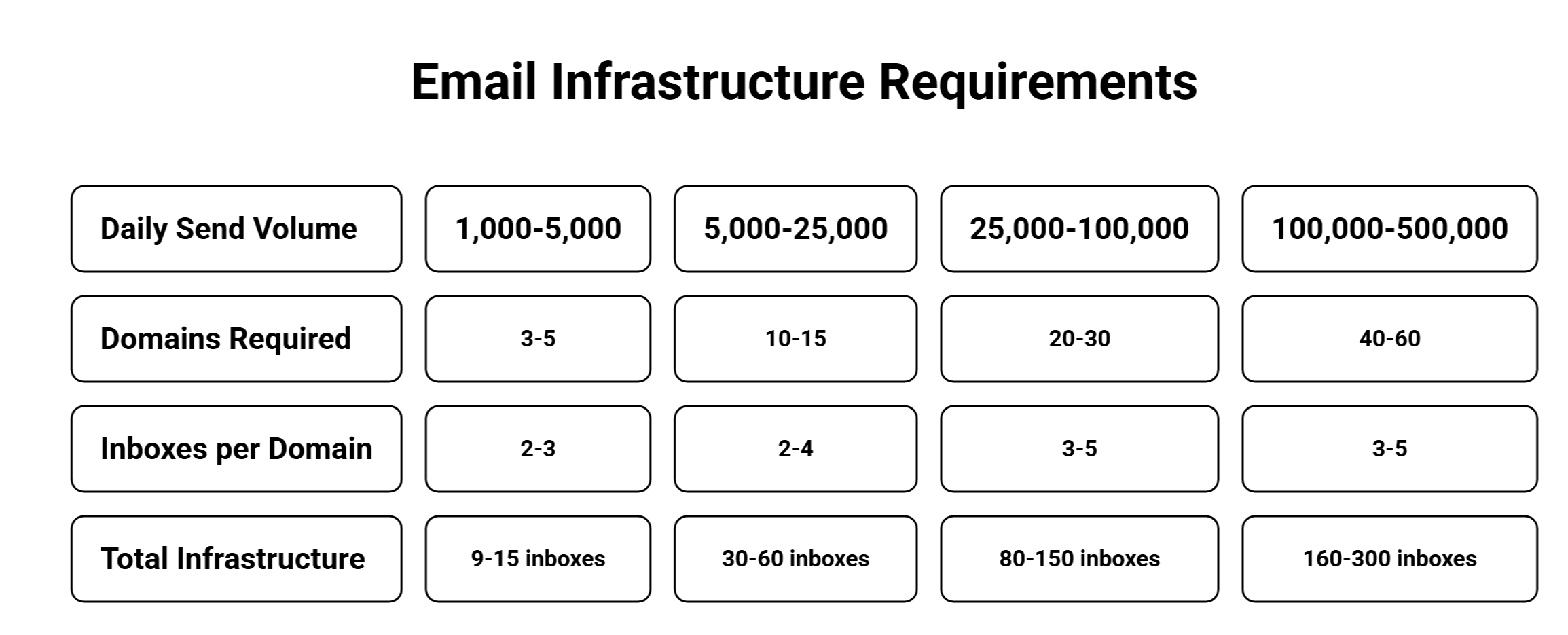
Domain requirements by volume:
Each domain requires three critical authentication protocols:
SPF (Sender Policy Framework): Authorizes which servers can send from your domain
DKIM (DomainKeys Identified Mail): Cryptographically signs your emails for verification
DMARC (Domain-based Message Authentication): Instructs receiving servers how to handle authentication failures
Google's 2024 sender requirements mandate these protocols for anyone sending 5,000+ daily emails. Without them, Microsoft data shows delivery rates drop 40-60% on major providers.
Layer 2: IP Infrastructure Strategy
Choose between shared and dedicated IP infrastructure based on your volume:
Shared IPs: Suitable for under 50,000 sends daily, no warm-up required, immediate deployment
Dedicated IPs: Required for 50,000+ sends daily, full reputation control, 30-day warm-up mandatory
According to Amazon SES documentation, dedicated IPs achieve 15-20% better inbox placement for high-volume senders.
Layer 3: AI Agent Orchestration
Modern email infrastructure relies on specialized AI agents coordinating seamlessly. Ruh.Ai's platform orchestrates five critical agents:
Research Agent: Enriches prospect data from 50+ sources, processing 500 leads hourly
Personalization Agent: Generates custom content at scale, maintaining brand voice consistency
Send Orchestration Agent: Manages timing, domain rotation, and rate limits across all infrastructure
Reply Classification Agent: Analyzes responses using NLP with 89-95% accuracy
Meeting Scheduling Agent: Coordinates calendar bookings autonomously
This multi-agent architecture mirrors the hybrid workforce model emerging across industries, where AI handles systematic tasks while humans manage strategic decisions.
Layer 4: Monitoring and Optimization
Continuous monitoring prevents infrastructure degradation. Real-time tracking includes:
- Domain reputation scores across all sending domains
- Bounce rate and spam complaint monitoring
- Authentication verification (SPF, DKIM, DMARC pass rates)
- Engagement metrics by domain and inbox
- AI agent performance and accuracy rates
SDR Sarah, Ruh.ai's AI SDR specialist, continuously monitors these metrics and automatically adjusts sending patterns to maintain optimal deliverability.
The 30-Day Warm-Up Protocol
Domain warm-up is non-negotiable for email infrastructure success. Mailgun's deliverability research proves gradual volume increases build sender reputation 3x faster than aggressive scaling.
Week-by-Week Implementation
Week 1: Foundation Building (Days 1-7)
- Daily volume: 10-20 emails per inbox
- Target: Highly engaged contacts with 60%+ historical open rates
- Focus: Establish positive engagement patterns
- Monitor: Bounce rate (<2% threshold)
Week 2: Controlled Expansion (Days 8-14)
- Daily volume: 20-40 emails per inbox
- Add: Moderately engaged contacts from previous campaigns
- Focus: Maintain strong engagement metrics
- Monitor: Spam complaint rate (<0.1% threshold)
Week 3: Scale Preparation (Days 15-21)
- Daily volume: 40-60 emails per inbox
- Include: New verified prospects with ICP match
- Focus: Domain rotation implementation
- Monitor: Overall engagement trends
Week 4: Production Ready (Days 22-30)
- Daily volume: 60-100 emails per inbox
- Launch: Full campaign infrastructure
- Focus: Consistent sending patterns
- Monitor: All deliverability KPIs continuously
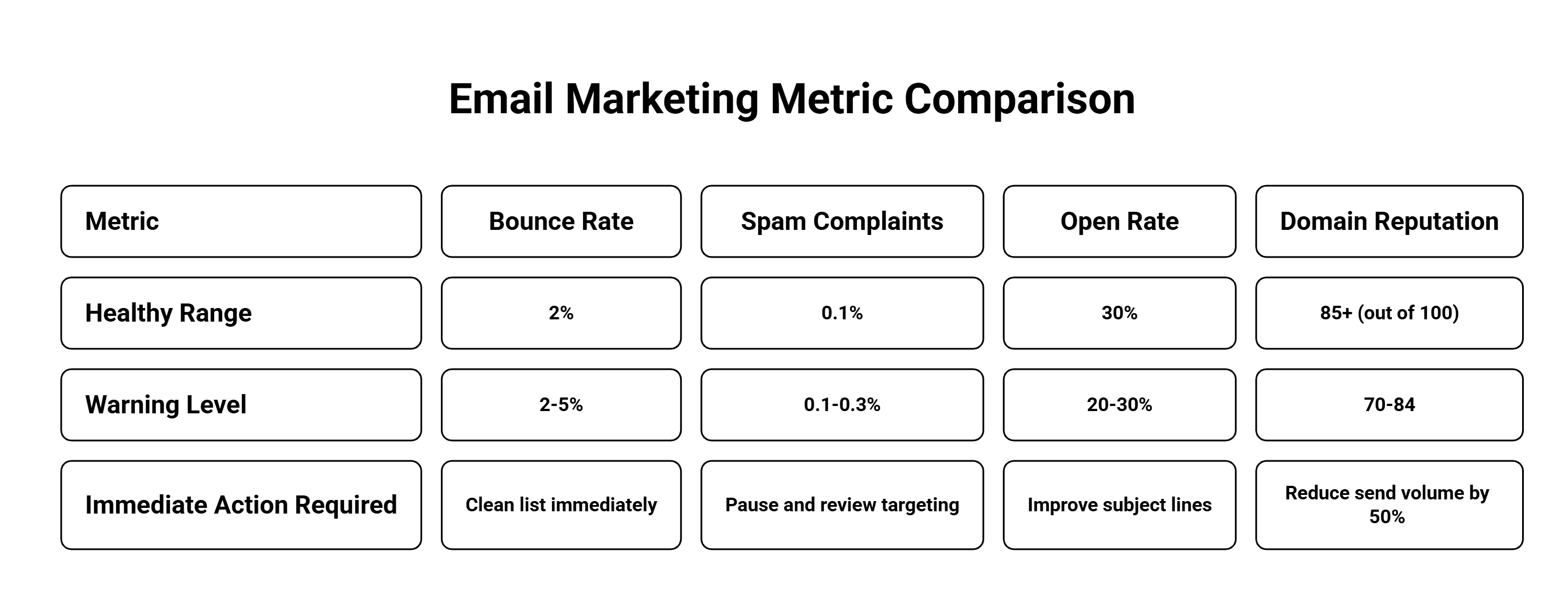
Critical success metrics:
Ruh.ai's infrastructure management automates this entire warm-up process, adjusting daily volumes based on real-time performance data and ensuring each domain develops optimal sender reputation.
How Ruh AI Scales Your Email Infrastructure
Ruh.ai's AI SDR platform transforms email infrastructure from a technical challenge into a strategic advantage. Here's how the platform manages infrastructure at scale:
Automated Domain Management
Instead of manually configuring DNS records for dozens of domains, Ruh.ai automates:
- Instant DNS Setup: SPF, DKIM, and DMARC records configured automatically
- Continuous Verification: Daily checks ensure authentication remains valid
- Smart Rotation: AI distributes sends across healthiest domains
- Reputation Monitoring: Real-time tracking prevents deliverability issues
Intelligent Warm-Up Orchestration
SDR Sarah manages warm-up protocols across your entire infrastructure simultaneously:
- Gradually increases volume per domain following proven schedules
- Selects highest-engagement contacts for initial sends
- Monitors engagement patterns and adjusts approach
- Flags domains requiring attention before problems emerge
Multi-Agent Email Operations
Rather than managing separate tools for each email function, Ruh.ai orchestrates a unified workflow:
Prospect Research: AI agents enrich contact data, verify emails, and identify optimal targets
Content Personalization: Generate custom emails maintaining your brand voice at unlimited scale
Send Optimization: Intelligent timing, domain selection, and volume distribution
Reply Management: Classify responses, route conversations, book meetings autonomously
This integration delivers what best AI sales agents achieve: end-to-end automation without sacrificing personalization or quality.
Real-Time Deliverability Protection
Ruh.ai prevents infrastructure problems before they impact performance:
- Proactive Monitoring: Continuous checks of domain reputation and authentication
- Automatic Adjustments: Reduces volume or pauses domains showing degradation
- Engagement Optimization: Routes high-value prospects through highest-reputation domains
- Compliance Management: Handles unsubscribes, opt-outs, and GDPR requests automatically
Performance at Scale
Organizations using Ruh.ai for email infrastructure achieve:
- 95%+ inbox placement rates across all sending domains
- <5 minute response time for reply classification and routing
- 70-80% reduction in manual email management time
- 90%+ AI accuracy in intent detection and reply categorization
These results parallel achievements seen in AI employees transforming financial services and healthcare operations—specialized AI handling systematic processes with superhuman consistency.
The 60/40 Rule for Sustainable Growth
The 60/40 rule maintains infrastructure health during scaling: allocate 60% of sending volume to existing contacts and 40% to new prospects.
Why This Balance Works
According to reports, senders maintaining this ratio achieve:
- 23% higher inbox placement compared to new-prospect-heavy campaigns
- 35% better domain reputation scores with ISPs
- 40% lower spam complaint rates
Practical Application
For 10,000 daily sends:
- 6,000 emails to contacts who previously opened (re-engagement, follow-ups, newsletters)
- 4,000 emails to new verified prospects (cold outreach, warm referrals)
For 100,000 daily sends:
- 60,000 emails to existing engaged contacts across multiple campaigns
- 40,000 emails to new prospects distributed across your domain infrastructure
Email service providers (Gmail, Outlook, Yahoo) monitor engagement as their primary reputation signal. Consistent positive engagement from 60% of your volume protects the 40% going to new prospects with naturally lower initial engagement rates.
Ruh.ai automatically manages this balance, segmenting your contact database and distributing sends to maintain optimal ratios across all domains.
Advanced Infrastructure Optimization
Dynamic Send Time Intelligence
Rather than sending all emails at fixed times, AI analyzes recipient timezone, historical engagement patterns, and behavioral signals to determine optimal send windows for each contact.
HubSpot's 2024 Email Marketing Report shows send time optimization increases open rates by 15-23%.
Predictive Domain Health Management
Ruh.ai monitors domain reputation continuously and makes intelligent routing decisions:
- Real-time reputation scoring via multiple monitoring services
- High-value prospects automatically routed through highest-reputation domains
- Temporary quarantine of domains showing reputation decline
- Automatic recovery protocols when reputation improves
Behavioral Trigger Sequences
AI agents monitor prospect behavior and trigger perfectly-timed follow-ups:
Email opened: Wait 4 hours → Send relevant case study
Link clicked: Wait 2 hours → Share calendar booking link
Website visited: Immediate → Send personalized video message
This creates the seamless experience cold email needs in 2025—intelligent, responsive, and highly personalized at scale.
Implementation: Your 90-Day Roadmap
Phase 1: Foundation (Days 1-14)
Domain Acquisition and Configuration
- Purchase 5-10 domains aligned with your brand
- Ruh.ai automatically configures all DNS records
- Verification and testing of authentication protocols
- Initial inbox setup and integration
Infrastructure Testing
- Small test sends to verify configuration
- Deliverability checks across major providers
- Authentication verification via monitoring tools
- Performance baseline establishment
Phase 2: Warm-Up (Days 15-44)
Structured Reputation Building
- 30-day warm-up protocol across all domains
- Gradual volume increases managed by AI
- Continuous engagement monitoring
- Domain health tracking and optimization
During warm-up, Ruh.ai handles:
- Daily volume adjustments per domain
- Contact selection for optimal engagement
- Performance monitoring and issue flagging
- Automated protocol adjustments based on results
Phase 3: Scale to Target Volume (Days 45-90)
Progressive Volume Growth
- Week 1-2: 25% of target volume
- Week 3-4: 50% of target volume
- Week 5-6: 75% of target volume
- Week 7+: 100% of target volume
Continuous Optimization
- Daily deliverability performance reviews
- Weekly infrastructure health audits
- Monthly strategy and optimization sessions
- Ongoing AI model refinement and improvement
Support Throughout Implementation
Ruh.ai's platform provides comprehensive support during scaling:
- Technical setup and configuration guidance
- Best practice recommendations for your industry
- Performance monitoring and issue resolution
- Strategic consultation for optimization
This hands-on approach mirrors the support structure successful AI adoption requires across organizations—combining powerful technology with expert guidance.
Measuring Infrastructure Success
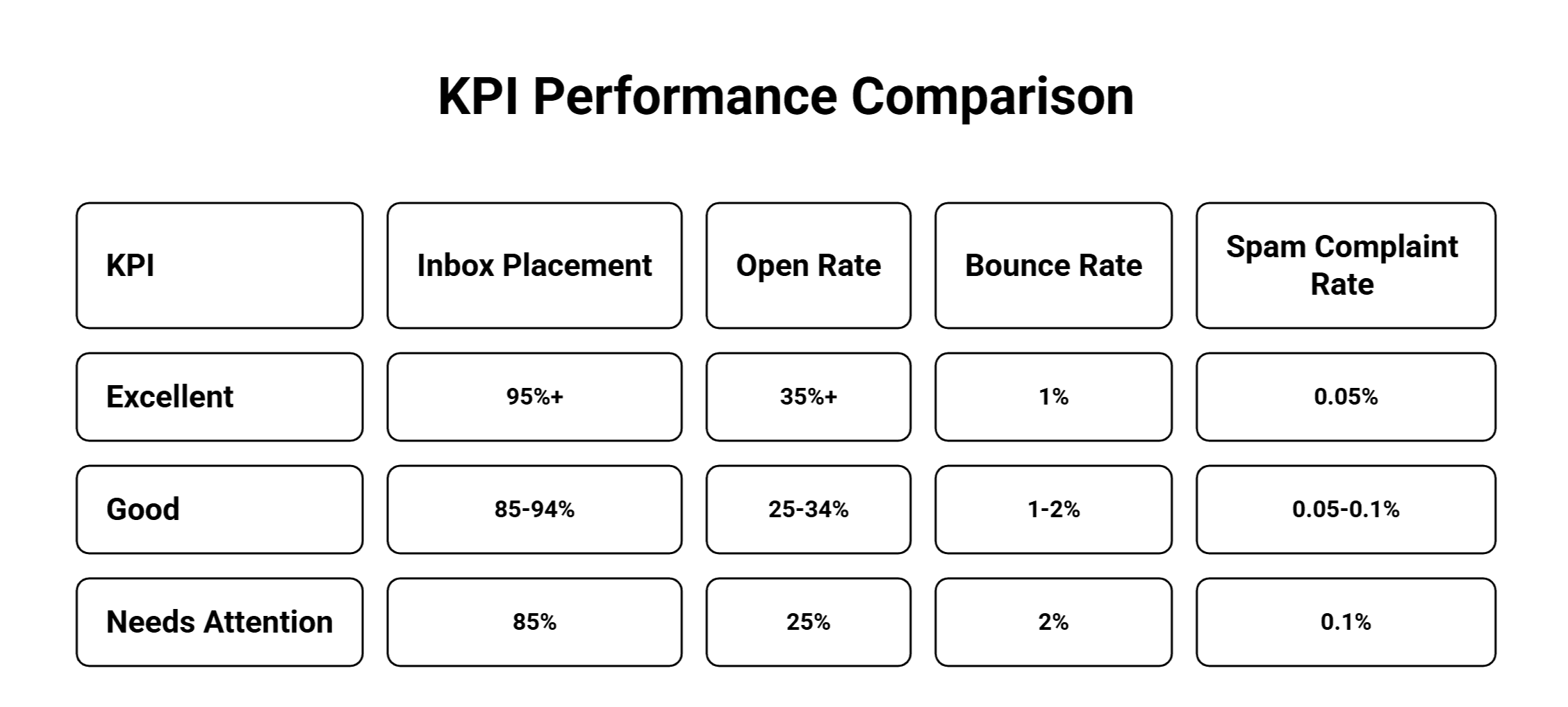
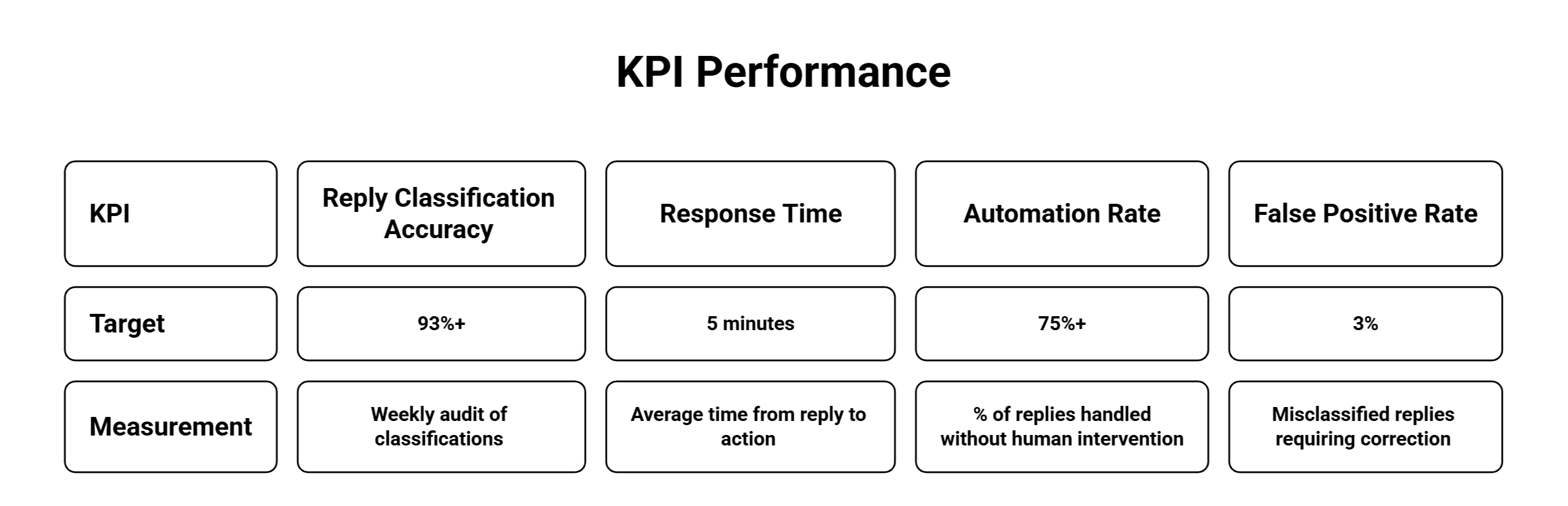
Track these critical KPIs to ensure infrastructure health and optimal performance.
Deliverability Metrics
AI Agent Performance
Business Impact
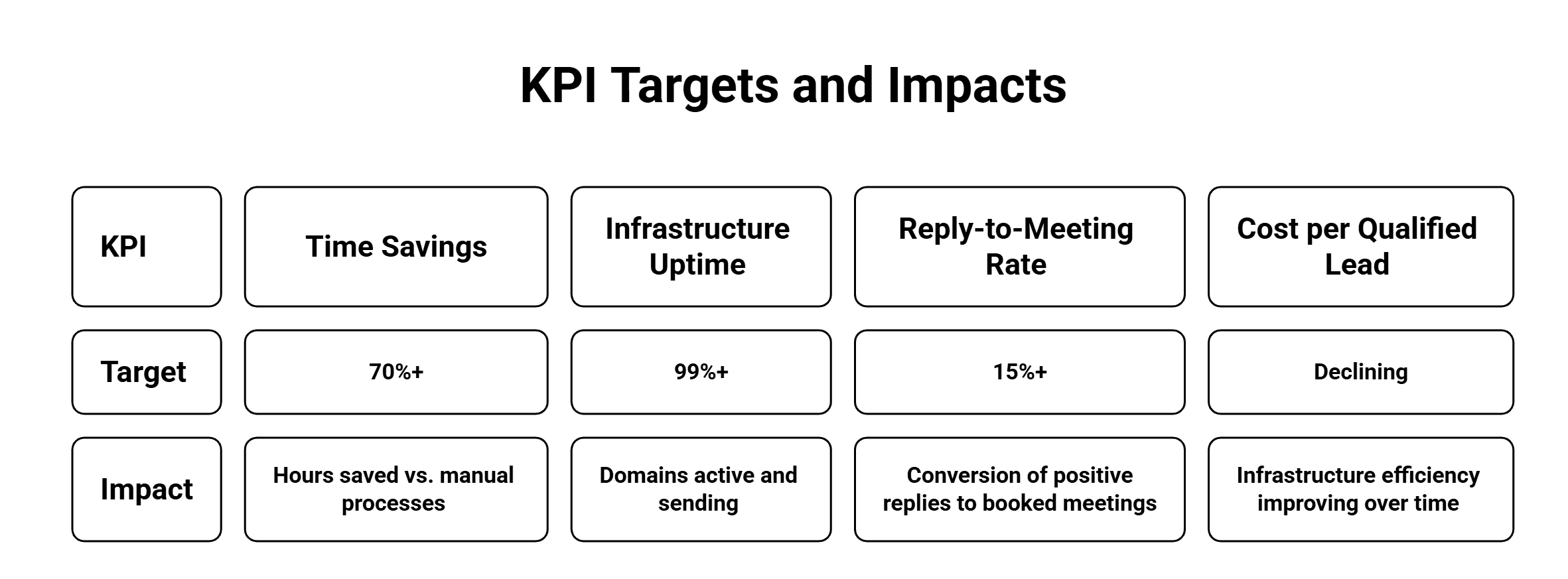
Ruh.ai's dashboard provides real-time visibility into all these metrics, enabling data-driven decision making and continuous optimization.
Common Challenges and Solutions
Challenge 1: Reputation Degradation
Symptoms: Open rates dropping from 35% to under 15% over 2-3 weeks
Root Causes:
- Insufficient list verification (bounce rates exceeding 3%)
- Aggressive volume increases without proper warm-up
- Poor targeting leading to low engagement
Ruh.ai's Solution:
- Automatic bounce detection and list cleaning
- AI-managed volume adjustments based on engagement
- Predictive analytics flagging at-risk domains before problems emerge
- Immediate pause and recovery protocols when issues detected
Challenge 2: Inconsistent AI Performance
Symptoms: Reply classification accuracy below 85%
Root Causes:
- Insufficient training data for specific industry/vertical
- Ambiguous category definitions in classification logic
- Evolving language patterns not captured in model
Ruh.ai's Solution:
- Continuous learning from your specific email patterns
- Human-in-the-loop refinement during initial deployment
- Regular model updates incorporating latest language trends
- Industry-specific training data from similar organizations
Challenge 3: Scaling Complexity
Symptoms: Managing 20+ domains becomes operationally overwhelming
Root Causes:
- Manual tracking of domain health across infrastructure
- Inconsistent application of warm-up protocols
- No centralized visibility into performance
Ruh.ai's Solution:
- Unified dashboard providing complete infrastructure visibility
- Automated health monitoring and alerting
- Consistent protocol application across all domains
- Intelligent load balancing and domain selection
Similar to how AI transforms MLOps operations, Ruh.ai brings operational intelligence to email infrastructure management.
Future-Proofing Your Infrastructure
Evolving ISP Requirements
Email service providers continuously update their sender requirements. Yahoo's January 2025 policy update requires one-click unsubscribe headers. Google followed with similar requirements in Q2 2025.
Ruh.ai stays ahead by:
- Automatically implementing new authentication standards
- Updating infrastructure to meet evolving ISP requirements
- Monitoring policy changes across all major providers
- Proactively adjusting configurations before mandates take effect
AI-Powered Spam Filters
Microsoft's security blog details new machine learning models detecting AI-generated content patterns.
Our approach:
- Focus on genuine personalization, not template variation
- Human-quality content generation avoiding obvious AI patterns
- Continuous testing against latest spam filter algorithms
- Behavioral engagement signals prioritized over content tricks
Privacy and Compliance
GDPR enforcement has increased substantially, with GDPR.eu data showing 340% more fines since 2023.
Ruh.ai ensures compliance through:
- Automatic unsubscribe processing within required timeframes
- Comprehensive consent record maintenance
- Data retention policies aligned with regional requirements
- Privacy-by-design architecture throughout the platform
This mirrors the compliance rigor required in AI employees handling sensitive data across industries.
Conclusion: Scaling Email Infrastructure with Intelligence
Email infrastructure scaling from 1,000 to 1 million sends is no longer a technical challenge reserved for enterprises with large engineering teams. AI orchestration democratizes sophisticated email operations, making enterprise-grade infrastructure accessible to organizations of all sizes.
Success requires three foundational elements:
Strategic Architecture: Multi-domain setup with proper authentication, warm-up protocols, and ongoing reputation management.
AI Orchestration: Specialized agents handling research, personalization, send optimization, reply classification, and meeting scheduling in coordinated workflows.
Continuous Optimization: Real-time monitoring, predictive analytics, and automatic adjustments maintaining peak deliverability.
Ruh.ai transforms email infrastructure from a technical obstacle into a strategic advantage. Rather than managing dozens of tools, monitoring countless metrics, and troubleshooting deliverability issues, organizations deploy an intelligent system that handles complexity automatically.
The platform's multi-agent architecture—featuring SDR Sarah and specialized AI employees—orchestrates every aspect of email infrastructure. From initial domain configuration through continuous reputation management, AI handles systematic processes with superhuman consistency while humans focus on strategy, messaging, and relationship building.
This represents the broader transformation happening across industries: AI employees augmenting human capabilities rather than simply replacing them. In email infrastructure, AI manages the technical complexity, deliverability monitoring, and systematic optimization—freeing teams to focus on what humans do best: creative thinking, strategic planning, and authentic relationship development.
Your next steps:
Organizations ready to scale email infrastructure should begin with these actions:
Assess current infrastructure: Document existing domain portfolio, authentication status, and deliverability metrics to establish baseline performance.
Define scaling objectives: Determine target send volume, timeline for reaching that volume, and success metrics for measuring progress.
Implement AI orchestration: Deploy an integrated platform handling the technical complexity rather than assembling fragmented tools.
Connect with Ruh.ai to discuss your email infrastructure scaling requirements. Our team evaluates your current setup, designs architecture aligned with your objectives, and deploys AI agents managing the complete workflow.
The path from 1,000 to 1 million sends doesn't require more manual effort—it requires smarter infrastructure that scales automatically. With AI orchestration, email infrastructure becomes an enabler of growth rather than a constraint on it.
Frequently Asked Questions
How to send millions of emails daily?
Ans: Sending millions of emails daily requires 80-100+ authenticated domains, 320-500 email accounts, and dedicated IP pools with AI orchestration. The key is gradual scaling—increase volume 20-30% monthly while maintaining 90-95% inbox placement and sub-1% bounce rates. Ruh.ai's platform automates this complexity, managing domain rotation, reputation monitoring, and reply processing in under 10 minutes.
Can an AI agent send an email?
Ans: Yes. Modern AI agents autonomously send emails through API integrations, generating personalized content, scheduling optimal send times, and classifying replies with 89-95% accuracy. SDR Sarah from Ruh.ai handles complete workflows from outreach to meeting scheduling. Best practice: start with human-in-the-loop mode and maintain 10-15% human review even in full automation.
What is the email infrastructure for AI agents?
Ans: AI email infrastructure consists of five layers: authenticated domains with SPF/DKIM/DMARC, CRM and data integration, AI agent orchestration (research, personalization, send management, reply classification), inter-agent communication systems, and real-time monitoring with automated optimization. Ruh.ai provides this as an integrated platform.
What is the 60/40 rule in email?
Ans: Send 60% of emails to existing contacts (previous engagers) and 40% to new prospects. This maintains sender reputation—when 60% of emails generate consistent engagement, ISPs protect the 40% going to cold prospects. This ratio achieves 23% higher inbox placement and 40% lower spam complaints. Adjust to 70/30 for new infrastructure or 80/20 during reputation recovery.