
TL;DR / Summary
AI lead scoring uses machine learning to automatically rank leads by their conversion likelihood, transforming how SaaS companies prioritize sales efforts. By analyzing hundreds of behavioral, firmographic, and engagement signals in real-time, it replaces guesswork with data-driven accuracy, boosting conversion rates by 30–50%, reducing time wasted on unqualified leads, and scaling efficiently as lead volume grows.
In this guide, we will discover exactly how AI lead scoring works, why it’s essential for SaaS sales teams, step-by-step implementation strategies, common pitfalls to avoid, and what the future holds for AI-driven sales intelligence. Ready to upgrade your sales process? Explore how AI can turn your lead data into your strongest revenue engine.
Ready to see how it all works? Here’s a breakdown of the key elements:
- What is AI Lead Scoring? (And Why Should You Care?)
- Why SaaS Companies Need AI Lead Scoring More Than Anyone
- How One SaaS Company Transformed Their Sales Process
- The Key Advantages of AI-Powered Lead Scoring
- What Data Does AI Lead Scoring Actually Use?
- How to Implement AI Lead Scoring: A Practical Roadmap
- Common Mistakes to Avoid (Learn from Others' Pain)
- Measuring Success: KPIs That Actually Matter
- The Future is Already Here: What's Next for AI Lead Scoring
- Getting Started: Your Next Steps
- The Bottom Line
- Frequently Asked Questions
What is AI Lead Scoring? (And Why Should You Care?)
Think of AI lead scoring like having a really smart assistant who's analyzed thousands of your past customers and can now spot patterns you'd never see on your own.
In simple terms: AI lead scoring uses machine learning to automatically rank your leads based on how likely they are to become paying customers. Instead of guessing which leads to call first, the AI tells you—with surprising accuracy.
Traditional lead scoring relied on simple rules: "Give 10 points if they visited the pricing page, 5 points if they downloaded an ebook." But AI? It looks at hundreds of signals simultaneously and learns from every single outcome.
According to Salesforce's 2024 State of Sales Report, companies using AI lead scoring see conversion rates improve by 30-50% on average. That's not a small difference—that's transformational.
How AI Lead Scoring Actually Works
Let's break this down without the technical jargon.
Imagine you're teaching a friend how to identify which customers are most likely to make a purchase from you. You'd show them examples: "See this person? They visited our site five times, requested a demo, and work at a company with 200 employees. They became a customer. But this other person only visited once and left—they didn't convert."
AI does exactly that, but with thousands of examples. It learns patterns like:
- Companies in the tech industry with 50-500 employees convert 3x more often
- Leads who watch your product demo video are 5x more likely to buy
- Decision-makers who engage within 48 hours of their first visit have better conversion rates
The AI then assigns each new lead a score typically between 0-100 showing how closely they match your best customers.
Here's what makes it powerful: The AI keeps learning. Every time a lead converts (or doesn't), the model gets smarter. This continuous improvement is something manual scoring simply can't match.
Why SaaS Companies Need AI Lead Scoring More Than Anyone
SaaS has a unique challenge. Unlike selling a physical product, you're dealing with:
1. Longer sales cycles: B2B SaaS deals can take 3-9 months to close 2. Multiple decision-makers: You're rarely selling to just one person 3. Complex pricing models: Subscriptions, tiers, add-ons—it gets complicated 4. High volume of inquiries: Free trials and demos generate tons of leads
Without AI, your team drowns in data. With it, they focus on what matters.
This is exactly why forward-thinking companies are implementing AI for sales personalization at scale—they need systems that can handle complexity without sacrificing the personal touch that closes deals.
Real Numbers from Real Companies
A Forrester Research study from 2024 found that B2B SaaS companies implementing AI lead scoring reported:
- 40% reduction in time wasted on unqualified leads
- 58% increase in MQL-to-SQL (Marketing Qualified Lead to Sales Qualified Lead) conversion
- 300% ROI within the first year of implementation
- 2.5x higher win rates when sales teams prioritize AI-scored leads
Let me share a story that makes this real.
How One SaaS Company Transformed Their Sales Process
CloudSync (name changed for privacy), a mid-sized project management SaaS with 80 employees, was struggling. Their sales team of 12 reps was receiving 400+ leads per month from their website, webinars, and content downloads.
The problem? Only about 15-20 of those leads were actually ready to buy. But which ones?
Their sales reps were spending 4-5 hours daily calling leads who either:
- Were students researching for a school project
- Worked at companies too small for their enterprise product
- Were just comparing options with no intent to switch
- Weren't decision-makers at all
Before AI lead scoring:
- Lead-to-opportunity conversion: 4%
- Average time to first meaningful conversation: 8 days
- Rep frustration: Through the roof
After implementing AI lead scoring with Ruh.AI:
- Lead-to-opportunity conversion: 11% (nearly 3x improvement)
- Average time to first meaningful conversation: 2 days
- Rep satisfaction: Significantly improved
What changed? Their reps now receive a daily list of their top 15-20 leads, ranked by AI score. They know exactly who to call first. No more guesswork. No more wasted time.
The implementation followed principles outlined in our AI SDR 101 guide, focusing on data quality first, then gradual automation rollout.
The Key Advantages of AI-Powered Lead Scoring
Let's get specific about what AI brings to the table that traditional methods don't.
1. Accuracy That Actually Matters
Manual lead scoring might give you 60-70% accuracy at best. According to** Gartner's 2024 Sales Technology Survey**, AI models regularly achieve 90%+ accuracy once trained on sufficient data.
Why? Because AI considers factors humans simply can't:
- The exact sequence of pages someone visited
- How long they spent reading specific content
- Patterns in their company's technology stack
- Timing of their interactions across multiple channels
2. Real-Time Intelligence (Not Yesterday's News)
Traditional scoring updates weekly or monthly. AI scoring updates instantly.
When a high-value lead visits your pricing page at 2 PM, your sales rep knows by 2:01 PM. That speed matters Harvard Business Review research shows that leads contacted within 5 minutes are 100x more likely to convert than those contacted after 30 minutes.
Ruh.AI's real-time scoring engine processes behavioral signals within seconds, ensuring your team never misses a hot lead.
3. Scalability Without Growing Your Team
Here's a math problem: If your marketing team doubles your lead volume from 500 to 1,000 per month, how many more sales reps do you need?
With manual scoring, probably 2-3 more reps just to handle the qualification calls.
With AI scoring: Zero. The AI handles 1,000 leads as easily as 10,000.
According to McKinsey's 2024 AI in Sales report, sales teams using AI lead scoring save an average of 15-20 hours per rep per week. That's practically an extra full-time employee's worth of productivity.
4. Predictive Power That Sees Around Corners
This is where AI gets really interesting.
It doesn't just score leads on what they've done—it predicts what they'll do next. The AI identifies patterns like:
- "Leads from this industry who request a demo within 3 days of signing up convert at 65%"
- "Decision-makers who engage with our email sequence but don't book a call are likely to churn—we should trigger a personalized outreach."
- "Companies currently using [specific competitor software] and visiting our comparison pages have an 80% conversion rate"
These insights are gold. And they're impossible to spot manually.
5. Eliminating Bias (The Hidden Advantage)
Let's be honest: Human scoring has bias. Maybe your team unconsciously prioritizes leads from well-known companies. Maybe they chase larger deals and ignore smaller but more likely conversions.
AI doesn't care about company logos or ego. It cares about one thing: What patterns predict conversion? This objectivity often reveals surprising opportunities your team might have overlooked.
What Data Does AI Lead Scoring Actually Use?
Understanding what feeds the AI helps you trust it. Here are the main data sources:
Behavioral Data (What They Do)
- Website activity: Pages viewed, time on site, return visits
- Content engagement: Downloads, webinar attendance, video watches
- Email interactions: Opens, clicks, forwards
- Product engagement: Free trial usage, feature adoption, demo requests
Firmographic Data (Who They Are)
- Company size: Number of employees, revenue range
- Industry vertical: Tech, finance, healthcare, etc.
- Location: Geographic fit for your service
- Technology stack: What tools they currently use (from public data)
Engagement Signals (How They Engage)
- Response time: How quickly they reply to outreach
- Question quality: Depth of questions in sales conversations
- Stakeholder involvement: Are multiple people from their company engaging?
- Sales cycle stage: Where they are in the buying journey
Third-Party Intent Data (What They're Researching)
This is advanced but powerful. Intent data providers (like Bombora) track when companies research specific topics across the web.
If a company is actively researching "project management software alternatives" across multiple sites, that's a strong buying signal—even if they haven't visited your site yet.
Platforms like Ruh.AI can integrate these signals to boost scores for leads showing active buying intent. Their system applies sophisticated lead qualification frameworks like BANT, MEDDIC, and CHAMP automatically—identifying Budget, Authority, Need, and Timeline without requiring manual qualification calls.
How to Implement AI Lead Scoring: A Practical Roadmap
You don't need a PhD in data science. You just need a clear plan.
Phase 1: Get Your Foundation Right (Week 1-2)
Step 1: Audit Your Current Data
Before AI can help, you need decent data. The minimum requirement:
- At least 1,000 historical leads (more is better)
- Clear records of which leads converted
- Basic information captured on each lead
- If your data is messy, clean it first. AI trained on garbage data produces garbage results.
Step 2: Define What "Good" Means
Get your sales and marketing teams in the same room (or Zoom) and answer:
- What makes someone a "qualified" lead for us?
- What characteristics do our best customers share?
- What actions indicate serious buying intent?
- This is your Ideal Customer Profile (ICP)—and it guides the AI.
Phase 2: Choose Your Tool (Week 3-4)
Not all AI lead scoring tools are created equal. Here's what to look for:
Essential Features:
- Integration with your existing CRM (Salesforce, HubSpot, etc.)
- Real-time scoring updates
- Transparent scoring explanations (not a black box)
- Customization options for your specific business Top Options for SaaS Companies:
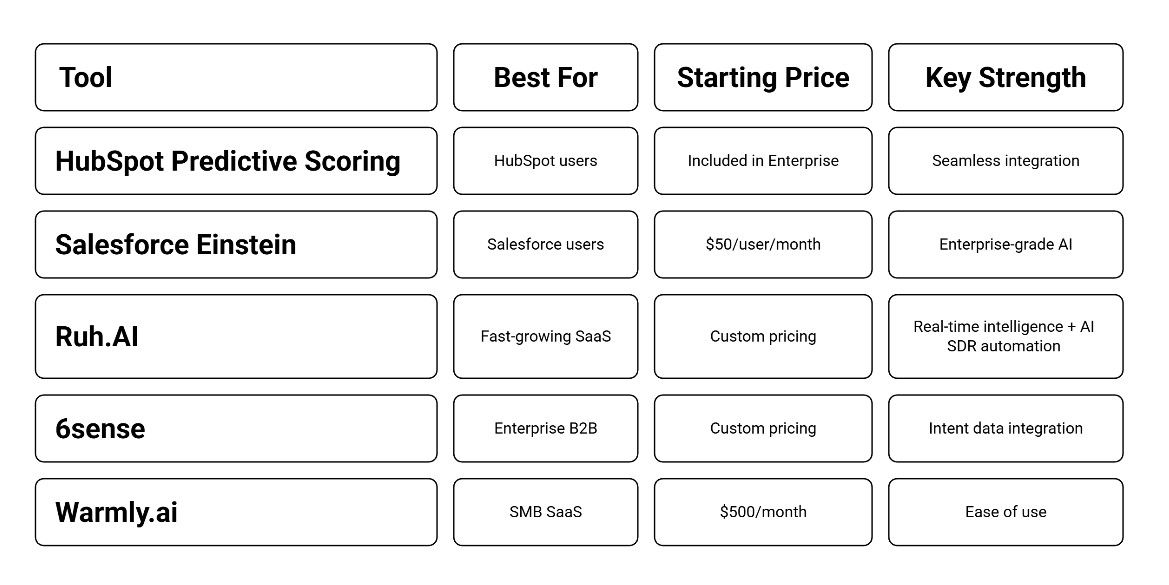
For most mid-market SaaS companies, Ruh.AI offers the best balance of power and simplicity with AI that learns your business quickly and provides actionable insights, not just numbers. Their SDR Sarah solution combines lead scoring with automated outreach, creating a complete AI sales development system.
Phase 3: Train Your Model (Week 5-6)
This is where the magic happens. Your chosen platform will:
- Analyze your historical data: Looking at thousands of past leads
- Identify patterns: What characteristics predict conversion?
- Build your scoring model: Creating algorithms specific to your business
- Test accuracy: Validating the model against known outcomes
Pro tip: Don't try to get it perfect right away. Launch with 80% confidence and improve from there. Perfection is the enemy of progress.
Phase 4: Roll Out to Your Team (Week 7-8)
Change management matters here. Your sales team needs to trust the AI, not fight it.
How to get buy-in:
- Start with a pilot: Choose 2-3 sales reps to test first
- Show them the data: Let them see how accurate the scores are
- Keep human judgment: The AI advises, but reps decide
- Celebrate early wins: Share success stories across the team
Common objection: "I know my leads better than a computer." Your response: "You're right and this AI learns from your expertise to help you do more of what works."
Phase 5: Optimize Continuously (Ongoing)
AI lead scoring isn't "set it and forget it." Plan monthly check-ins:
Metrics to review:
- Score accuracy: Are high-scored leads actually converting?
- False positives: Leads scored high but didn't convert (why?)
- False negatives: Leads scored low but did convert (what did we miss?)
- Rep feedback: What are your salespeople seeing in real conversations?
Tools like Ruh.AI provide dashboards that make these reviews simple—no data science degree required. Their platform learns from your feedback, implementing principles from model-based reflex agents that continuously adapt to changing conditions.
Common Mistakes to Avoid (Learn from Others' Pain)
After analyzing hundreds of implementations, here are the pitfalls that trip up most teams:
Mistake #1: Not Enough Quality Data
"Can we start with just 100 leads?"
No. AI needs volume to find patterns. Aim for at least 1,000 historical leads, with clear win/loss data. Less than that, and you're just guessing with extra steps.
Mistake #2: Ignoring Negative Signals
Most teams focus on positive actions (demo requests, email opens). But negative signals matter too:
- Unsubscribing from emails (strong disinterest)
- Bounced calls or ignored outreach (not engaged)
- Long periods of inactivity (losing interest)
- The best AI models factor in both positive and negative signals.
Mistake #3: Treating All Products the Same
If you sell multiple products or serve different markets, you need different scoring models. The signals that predict success for your enterprise product won't match your SMB offering. Platforms like Ruh.AI let you create segmented models ensuring accuracy across your entire product portfolio.
Mistake #4: Forgetting to Retrain
Markets change. Customer behavior evolves. Your AI needs periodic retraining typically every 3-6 months.
Signs you need to retrain:
- Score accuracy dropping below 80%
- Major changes to your product or pricing
- Expansion into new markets or industries
- Shifts in buyer behavior (like post-pandemic changes)
Mistake #5: Not Closing the Feedback Loop
Your sales reps talk to these leads every day. They know things the data doesn't capture. Create a simple way for reps to flag:
- "This lead scored low but was actually great"
- "This lead scored high but wasn't qualified at all"
Feed this feedback back into the model. Human insight + AI = unstoppable.
Measuring Success: KPIs That Actually Matter
How do you know if AI lead scoring is working? Track these metrics:
Conversion Metrics
- MQL to SQL conversion rate: Should increase 30-50%
- SQL to Opportunity rate: Target 20-30% improvement
- Overall win rate: Even 5-10% improvement is significant
Efficiency Metrics
- Time to first contact: Should decrease dramatically
- Average deal velocity: Faster sales cycles
- Calls per closed deal: Should decrease (less wasted effort)
ROI Metrics
- Cost per qualified lead: Should drop
- Revenue per sales rep: Should increase
- Customer acquisition cost (CAC): Should improve
Real benchmark: Forrester's research shows the average company sees 300% ROI in their first year with AI lead scoring. That means for every $1 spent on the tool, they generate $3 in additional revenue.
The Future is Already Here: What's Next for AI Lead Scoring
We're just getting started. Here's what's emerging in 2025:
Conversational AI Integration
Imagine this: A lead chats with your website chatbot. The AI doesn't just answer questions it scores the lead in real-time based on their questions and sentiment. High-intent questions trigger immediate sales notifications.
Ruh.AI's AI SDR platform is pioneering this integration, combining conversational AI with lead scoring for instant qualification. Their AI agent orchestration approach allows multiple AI agents to collaborate one handles conversation, another scores the lead, and a third triggers personalized follow-up automatically.
Multi-Modal Scoring
Soon, AI won't just analyze text and clicks. It'll consider:
- Voice sentiment from sales calls
- Body language from video meetings (with permission)
- Writing style in emails
- Even the technologies visible in their Zoom backgrounds
Autonomous Lead Nurturing
The AI won't just score leads—it'll automatically nurture them. Low-scored leads get educational content. High-scored leads trigger personalized outreach. Mid-range leads enter specific drip campaigns.
This is where AI orchestration and MLOps automation become critical. The system needs to coordinate multiple actions across platforms—sending emails, updating CRM records, notifying sales reps all based on real-time score changes. Multi-agent AI systems excel at this type of complex coordination.
The result? Your marketing and sales become a well-oiled machine that runs 24/7. Learn more about deploying these systems in our AI employee deployment blueprint.
Ethical AI and Transparency
As AI becomes more powerful, transparency becomes critical. The best platforms will:
- Explain exactly why each lead received their score
- Allow human override and adjustment
- Respect privacy regulations (GDPR, CCPA)
- Avoid bias based on protected characteristics
Getting Started: Your Next Steps
Ready to transform your SaaS sales process? Here's your action plan:
This Week:
- Audit your current lead data (quality and quantity)
- Calculate your current MQL-to-SQL conversion rate (your baseline)
- Document your Ideal Customer Profile
Next Week: 4. Research 3-4 AI lead scoring platforms 5. Schedule demos (most offer free trials) 6. Get buy-in from sales leadership
Within a Month: 7. Choose your platform and start implementation 8. Train your sales team on the new process 9. Launch a pilot with 2-3 reps
Within a Quarter: 10. Roll out company-wide 11. Measure your results vs. baseline 12. Optimize based on what you learn
The Bottom Line
AI lead scoring isn't magic. It's mathematics applied to your business—and it works.
The data is clear: Companies that implement AI lead scoring see significant improvements in conversion rates, sales efficiency, and revenue. According to Gartner, by 2025, 75% of B2B sales organizations will be using AI-powered lead scoring as a standard practice.
The question isn't whether you should use AI lead scoring. It's whether you can afford to be in the 25% that doesn't.
Your competitors are already doing this. Your best leads are already being scored by someone make sure it's you.
Ready to Talk?
Contact our team to discuss how AI lead scoring can transform your SaaS sales process. We'll analyze your current funnel and show you exactly what's possible.
Frequently Asked Questions
What is the AI lead score?
Ans: An AI lead score is a numerical value (typically 0-100) that represents how likely a lead is to convert into a customer. Unlike traditional scoring that uses simple point systems, AI analyzes hundreds of behavioral, firmographic, and engagement signals simultaneously. The score updates in real-time as the lead interacts with your brand, giving your sales team instant prioritization guidance.
How to use AI for lead scoring?
Ans: Using AI for lead scoring involves five key steps: (1) Connect your CRM and marketing data to an AI platform like Ruh.AI's SDR solution, (2) Let the AI analyze your historical lead data to identify conversion patterns, (3) Configure scoring thresholds that match your sales process, (4) Train your team to prioritize high-scored leads, and (5) Continuously refine based on outcomes. Modern AI solutions like SDR Sarah can automate much of this process, integrating seamlessly with your existing workflow.
What is a key advantage of AI-powered lead scoring?
Ans: The primary advantage is predictive accuracy. While manual scoring achieves 60-70% accuracy, AI-powered systems consistently hit 90%+ accuracy according to Gartner research. This means your sales team wastes far less time on unqualified leads and closes deals faster. AI also scales effortlessly—handling 10,000 leads as easily as 100—without additional headcount. Learn more about AI's role in sales personalization.
What is the AI model scoring?
Ans: AI model scoring refers to the underlying machine learning algorithms that calculate lead scores. Common models include logistic regression (predicts probability of conversion), random forests (combines multiple decision trees), and neural networks (identifies complex patterns). These models are trained on your historical data and continuously improve as they process more leads. For technical teams interested in AI orchestration and deployment, understanding these models helps optimize implementation.
What is the purpose of lead scoring?
Ans: Lead scoring exists to solve a critical business problem: sales team efficiency. Without scoring, reps waste 40-50% of their time on unqualified prospects. Lead scoring prioritizes leads, ensuring reps focus on opportunities most likely to close. For SaaS companies, this is crucial—AI lead qualification frameworks like BANT, MEDDIC, and CHAMP help teams identify decision-makers, budget holders, and urgent needs quickly. The result: shorter sales cycles and higher win rates.
What are the 4 main types of AI?
Ans: The four main AI types are: (1) Reactive AI - responds to inputs without memory (like spam filters), (2) Limited Memory AI - learns from historical data (what most lead scoring uses), (3) Theory of Mind AI - understands emotions and intentions (still developing), and (4) Self-Aware AI - has consciousness (theoretical). Lead scoring primarily uses Limited Memory AI, which is why historical data quality matters so much. Explore more about model-based and reflex agents in AI systems.
What are the 5 advantages of AI?
Ans: AI's five core advantages in business are: (1) Speed - processes data instantly that would take humans hours, (2) Scalability - handles growing volumes without linear cost increases, (3) Consistency - eliminates human error and bias, (4)** Pattern Recognition** - spots insights humans miss in complex data, and (5) 24/7 Operation - works continuously without breaks. For lead scoring specifically, these translate to real-time prioritization, enterprise-scale handling, unbiased evaluation, predictive intelligence, and always-on qualification. Learn how multi-agent AI systems amplify these advantages through collaboration.
What are 7 types of AI?
Ans: The seven AI types are: (1) Narrow/Weak AI - specialized tasks (like lead scoring), (2) General AI - human-level intelligence across domains (theoretical), (3) Super AI - exceeds human intelligence (theoretical), (4) Reactive Machines - no memory, pure response, (5) Limited Memory - learns from past data, (6) Theory of Mind - understands emotions (emerging), and (7) Self-Aware AI - conscious systems (theoretical). Most business AI, including lead scoring, falls under Narrow AI with Limited Memory—highly effective for specific tasks but not conscious or generally intelligent.
What is the 30% rule in AI?
Ans: The 30% rule in AI implementation states that you should expect to spend 30% of your project budget and time on data preparation and cleaning. For lead scoring, this means auditing your CRM data, standardizing fields, removing duplicates, and ensuring conversion outcomes are properly tagged. Companies that rush this step often see poor AI performance—"garbage in, garbage out" applies fully here. The AI employee deployment blueprint emphasizes this foundation phase as critical to success.